Essences Act II - Renaud Salmon Pays Homage to Amouage
Renaud Salmon turns scent into a sensory dialogue of taste, texture and time
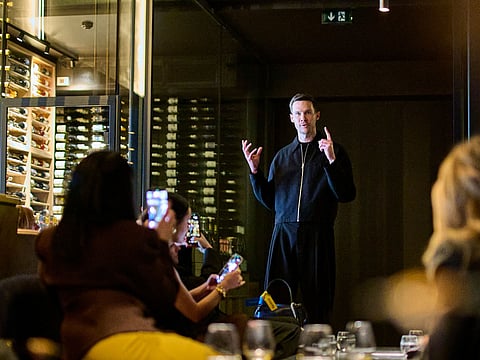
Copenhagen provided the perfect stage for the launch of Amouage’s Essences Act II at Alchemist, the restaurant famed for defying all expectations of dining. The city’s design, culture and restless curiosity reflected the evening itself: unconventional, intellectual and fully immersive. Conceived by Renaud Salmon, Amouage’s Chief Creative Officer, this was neither a simple perfume launch nor a tasting menu. It was a complete sensory experience, where scent, taste, texture and imagery collided to provoke thought, stir emotion, and invite reflection. Every detail - from projections to plates - was orchestrated to ignite curiosity, celebrating perfume as craft, culture, and philosophy.
The evening began in silence. In the first room stood an immersive cube, alive with projections tracing centuries of human experience. Historic faces flickered and vanished, replaced by fragments of our own, drawing guests into a space at once intimate and hypnotic. The montage spanned eras, gradually shifting toward the present, culminating in a digital tableau that pulsed with immediacy.
Salmon explained: “With the pictures, we were all strangers at first - then instantly connected through reflection and empathy.” Six hours seated among unfamiliar people created bonds not through conversation, but through shared contemplation. The images captured contradictions: tender and violent, progressive and regressive, unresolved yet compelling. Perfume became not an isolated luxury, but a lens onto culture itself.
As the projections faded, the walls revealed a sanctuary of culinary experimentation. Chef Rasmus Munk translated the perfumes into taste, mirroring sweetness, bitterness, metallic and animalic textures before the scents fully revealed themselves. Salmon reflected: “It’s empowering to imagine something and make it happen. This evening was about bringing our guests to try, really to change their expectations and reframe the whole food and scent experience.”
Certain dishes were deliberately provocative. The butterfly, for example, was as much a statement as a meal. “I was very moved by the butterfly,” Salmon admitted, “because it was breaking my heart to eat it in a way. And I’m glad I felt discomfort, not just something pleasant. It pushed the limits.” Beyond theatricality, it was an educational moment: insects, including caterpillars and butterfly larvae, are high in protein - often surpassing chicken - and increasingly considered a future food source. “Sometimes it’s a feeling of disgust,” he added, “and even if I felt very uncomfortable with some dishes, it doesn’t change the fact that what the chef has done is outstanding. That was part of the intention - to challenge perception.”
Time as material
At the heart of Essences Act II is an exploration of time, treated as a tangible force rather than a metaphor. Salmon drew on geometry and physics, using shapes to structure experience. The trilogy - Remain, Sequence, Line 618 - is organised around the dot, circle and line, symbolising origin, cyclical motion, and infinite possibility.
Remain by Pierre Negrin embodies beginnings. Salmon associates it with childhood: “Remain is related to childhood, but looking at adults being a child.” Mandarin, Pimento Berry and Frankincense spark clarity, while floral and ambery depths broaden the moment, rooting it in memory and the primeval.
Sequence by Julien Rasquinet reflects life’s cycles: “Sequence is colourful, vibrant, like being a young adult - sky’s the limit and the force of life.” Lychee, Raspberry and Saffron open with bright optimism, while Rose, Osmanthus, Tonka Bean, Oud and Leather create depth and evolving sophistication.
Line 618 by Nathalie Lorson gestures towards the unknown: “Line 618 is like the future - a parallel route I could have taken at some point.” Black Pepper and Pineapple generate dynamic tension, softened by Heliotrope and Pine, and resolved in Sandalwood, Patchouli and Leather. Its name references the Golden Ratio, linking mathematics, proportion and sensory experience.
Salmon’s personal reflections illuminate the power of scent to carry memory: “I once smelled soap in a hotel bathroom and was transported instantly back to primary school - a memory I didn’t even know I still carried. That’s the beauty of perfume. It doesn’t remind. It returns.”
When asked how it feels to create fragrances that will go on to absorb the most intimate moments of strangers’ lives - first loves, marriages, childhoods long forgotten - Salmon pauses. “I try not to think about the responsibility too much,” he says. “Because once you do, you start watering down what you want to do.”
That refusal to dilute is fundamental to Amouage. Founded in Oman in 1983 as The Gift of Kings, the house has never operated in the language of restraint or mass appeal. Its identity has been built instead on excess as intention - high concentrations, rare materials, long maturation processes, and narratives that demand time rather than instant gratification. In an industry increasingly shaped by algorithms, trend cycles and risk aversion, Amouage remains committed to something slower, denser and more uncompromising. The perfumes are not designed to please everyone; they are designed to last - in memory, on skin, and across generations.
Memory, craft and human touch
Each fragrance underwent six months of infusion alongside Australian sandalwood chips, developing patina, depth and texture. Alcohol for dilution matured in handcrafted French oak barrels, creating complexity and gravitas. “Imperfection doesn’t diminish creation. It announces the humanity within it,” Salmon explains.
He speaks with warmth, curiosity and poetry: “I want to keep dreaming big, pushing craft, and inspiring curiosity.” Every choice - from bottle design to photography - is guided by texture and cohesion. “I like my fragrances to have texture and patina. It’s about feelings, not just listing ingredients. The world is moving towards predictability and over-polished perfection. I look for the imperfections that draw you in and tell you: I’m human.”
Creating a perfume at this level is a feat of endurance as much as imagination. Each composition is built through countless trials - minute adjustments, repeated evaluations, months of smelling, revisiting, and recalibrating. The nose becomes saturated; perception blurs. What once felt electric can flatten under repetition, while a subtle imbalance can suddenly dominate. Salmon describes it as a process of accumulation and erosion happening simultaneously. “At some point,” he says, “you realise the next iteration isn’t better than the previous one. That’s when you know. You have to trust your gut.”
Salmon also reflects on the tension between attachment and release: “Once the product is out, it’s not yours anymore. If it moves people, it means they care. That’s the point.”
What emerges is not perfection, but intention - scent as something lived with, argued over, remembered. Care, in this context, is not gentleness. It is the willingness to stand behind an idea without smoothing its edges, to let it provoke, and live on.
“If it moves people strongly - even negatively - it means they care.”


