Edible myths: Moza Almatrooshi’s art of food, memory, and ecology
In the shifting light between desert and sea, Almatrooshi creates worlds you can taste
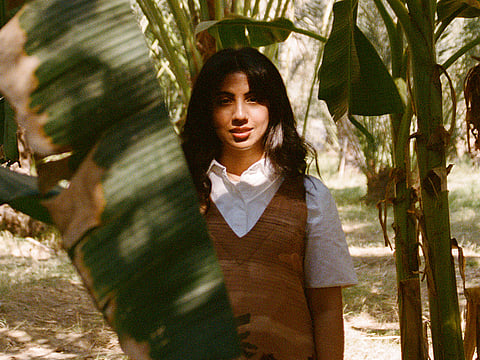
Moza Almatrooshi is not just an artist, nor just a chef—she is a storyteller who folds myth, ecology, and culinary practice into a single, immersive experience. With her work, the table becomes a stage, the kitchen a laboratory, and every ingredient a cipher.
Almatrooshi’s earliest memories of food are intimately tied to her father, who ran the household kitchen with unguarded passion. “He taught me early on that food wasn’t just about feeding; it was about translating love in real time”, she says. For her, cooking has never been neutral—it carries memory, care, and emotion. These early lessons cemented a belief that food can be a vessel for connection, a way to communicate when words fall short.
Among the flavours that shape her sensibility, honey is paramount. Not merely for its sweetness, but for what it represents: the interdependence of ecology and survival. “I feel most connected to honey. It’s an ingredient rooted in our mountains, but transcends geography. It symbolises the intimacy between ecology and survival, how bees, trees, and people sustain one another”, she explains. In Almatrooshi’s hands, honey is more than flavour—it’s a story, a philosophical anchor, a reminder of how the small lives around us matter.
During her MFA at Slade School of Fine Art in London, Almatrooshi’s understanding of food shifted radically. It was no longer just nourishment—it became a tool for storytelling, activism, and performance. “The turning point was during my MFA, when food expanded further than being a stand-in for language. There’s longstanding symbolism in food and art, and I relied on piecing these symbols together to reveal narratives that would not land in the same way when spoken directly”, she reflects. Food became a living archive, capable of preserving silenced voices and forgotten histories.
Almatrooshi sees her artistic and culinary practices not as separate paths, but as overlapping spheres. “It wasn’t a switch but a folding-in. Fine art gave me tools of criticality and form, while food was always in my hands, in my home, and in my body. I realised that the kitchen could be a studio, the table a stage, and recipes an archive. So I didn’t abandon art for food, rather I let them contaminate each other until something hybrid emerged.”
Her dual training—an MFA at Slade and patisserie at ICCA, provides a curious tension: rigorous technical precision paired with expansive conceptual freedom. She approaches food with both exactitude and imagination, where every dish is a narrative and every gesture a performance.
A striking dimension of her work is the resurrection of pre-Islamic Arabian myths. Many of these stories have been erased or forgotten over centuries, leaving behind only traces in language and ritual. “I look for absences and the silences in archives. Many erased Arabian deities and mythic figures left faint traces in language and rituals. I follow those traces, almost like foraging. My aim isn’t to reconstruct the myth exactly but to let it breathe again through form and expression”, she says. The result is not a literal revival but a living reimagining—a dialogue between past and present.
Almatrooshi refuses to treat fiction, symbolism, and lived experience as separate. For her, they are intertwined. “Fiction allows me to stretch beyond official narratives, symbolism gives food layers beyond flavour, and lived experience roots the work in care and credibility. Together, they create a space where myth and reality are equally valid ways of knowing.” This fusion renders her practice intellectually dense but viscerally immediate.
Her “landscape-to-table” dinners, hosted under her Ballad project, exemplify her philosophy. Guests traverse mountains, trails, or horse paths before consuming a meal inspired by the land they just explored. “Ballad’s dinners are landscape translations. We source produce from farmers, and bring the mountain into each dish. It’s a way of honouring the ecology that sustains us while resisting the detachment of industrial food systems. Guests enter into a dialogue with terrain, season, and history”, she explains. Here, eating is an act of witnessing, and every bite carries a map of place and season.
In another project, The Alphabetics of the Baker, Almatrooshi turned bakers’ movements into sculptural bread forms. “That project revealed how much of baking is embodied knowledge; through gestures of folding, stretching, and kneading. Translating those movements into bread forms showed me how labour imprints itself physically into matter. It reminded me that cooking is choreography, and that the body carries archives of care and endurance.” Through this work, labour itself becomes a medium for storytelling, and the kitchen a theatre of memory.
For Almatrooshi, performance is inseparable from food. “In my work, food often becomes both prop and protagonist. Cooking in front of an audience, or inviting them to eat a myth made edible, creates a participatory performance. The table becomes a stage where power, ritual, and intimacy are acted out.” Diners are not passive observers—they are participants in a carefully choreographed narrative, consuming both flavour and story simultaneously.
Almatrooshi navigates the complex politics of food with nuance. “Food systems empower us when they preserve ecological knowledge, sustain communities, and embody care. But they’re oppressive when they erase small farmers, commodify heritage, or exploit labour. In my projects, I try to expose both sides: celebrating resilience while questioning who gets excluded or silenced in the system.” Every project, she suggests, is a reckoning with both beauty and brutality inherent in how humans produce and consume food.
Raised in a creative family, Almatrooshi learned early that imagination is labour, and care is work. “Growing up in a creative family normalised imagination as a form of work and care. It gave me permission to live between worlds. Today, I try to extend that permission to others, whether through collaborations, mentoring, or simply showing that food and art can be a feminist, sustainable path.” Feminism, for her, is inseparable from her practice: a tool to reclaim narrative sovereignty, whether through myth, ingredient, or gesture.
Currently, Almatrooshi is captivated by the UAE’s micro-seasons—the subtle shifts in flora that once guided foragers and farmers. “I’m currently drawn to micro-seasons in the UAE, tiny shifts in flora that once guided foragers and farmers. I’m also interested in all that resonates with ecology and food as urgent themes in our lifetime. These threads keep unfolding into dinners, films, and publications that keep reimagining how the land continues to hold us.” Her work insists that ecological observation is not passive—it is a call to action, a way of understanding humanity’s place within the landscape.
Moza Almatrooshi’s work refuses compartmentalisation. Art, food, ritual, and myth bleed into one another, creating experiences that are simultaneously intellectual, aesthetic, and visceral.
In her hands, food is never inert. It is memory, it is myth, it is resistance and, above all, it is a reminder that we are part of the story we eat.


