Web addiction driving to fantasy
Government gets caught in dilemma
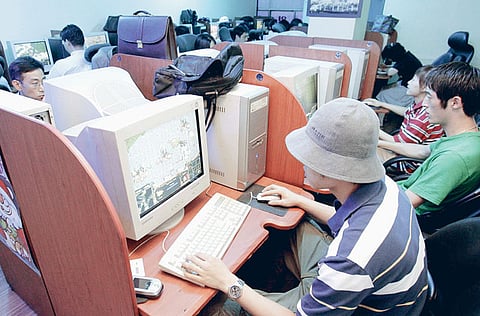
Seoul: As dusk descends on the Sinchon neighbourhood of Seoul, a wave of Saturday shoppers melts away, on cue, into restaurants and bars. But in a windowless room several floors above the throng, Ji Yu-tae is steeling himself for a very different night's entertainment.
His only companions are a bottle of vitamin drink, cigarettes and a monitor displaying a scene from Aion, one of South Korea's most popular online games. When the hunger pangs become irresistible, he will click a box in the corner of his PC screen and order instant noodles.
By Monday morning, after two days of almost non-stop gaming, Ji will make his way to work, pale and sleep-deprived, but content that he has progressed in the virtual world that has been his second home for the past two years.
Obsessives
Seated next to him among rows of screens at this PC bang, an internet café in the South Korean capital, are scores of fellow obsessives whose attachment to online gaming is fast becoming a problem in the world's most advanced internet society.
According to the government, about 2 million South Koreans — nearly one in 10 online users — are addicted to the internet. Many spend every waking moment immersed in role-playing games, in which players form alliances to guide their characters through mythical worlds, collecting extra powers and other items as they go.
"I've been playing this for about two years and won't stop until I get to the end," Ji, a 27-year-old mobile content developer, says as beads of sweat form on his brow. "In my line of work I spend a lot of time in front of a computer, so this is where I feel most comfortable." But he denies that his obsession could be turning into an addiction. "It's my way of relieving stress. I could drink or go to the cinema, but this is how I want to spend my spare time. I don't have a girlfriend, and I'm not likely to meet one here."
The government has responded to juvenile web addiction by spending millions of dollars on counselling centres and awareness classes for children. From September, gamers aged under 18 will be unable to access 19 popular online titles, such as Maple Story and Dragon Nest, from midnight to 8am. Those who play outside the curfew will find their characters growing weaker the longer they play.
Now, however, the government must reconcile its support for online activity with the emergence of an older generation of web addicts. While the number of teenage addicts has fallen from more than 1 million to 938,000 in the past two years, those in their 20s and 30s have risen to 975,000, with the unemployed and university students considered at greatest risk.
South Korea's status as the world's most wired nation gives them the technical wherewithal to fuel their addiction. The country boasts the fastest and most developed broadband network on the planet, and more than 90 per cent of homes have high-speed internet connections.
There are almost 22,000 PC bangs — online havens where, for a small hourly fee, the real world gives way to a virtual one that some enter only to find they are unable to leave. They are the driving force behind a gaming industry worth an estimated £1.6 billion (Dh9 billion) and involving 30 million people.
The popularity of StarCraft, a military-sci-fi game, has given rise to an elite class of professional gamers who have been elevated to the status of national e-sports icons. The best are said to make up to $300,000 (Dh1.1 million) a year in televised contests watched online by tens of thousands of adoring fans.
The arrival later this month of a new version, StarCraft II: Wings of Liberty, is expected to generate the sort of hysteria usually reserved for a Hollywood blockbuster.


