Techie Tonic: How AI could turn technology into a tool for continuous learning
Growing technology complexity is one of the biggest challenges facing modern enterprises
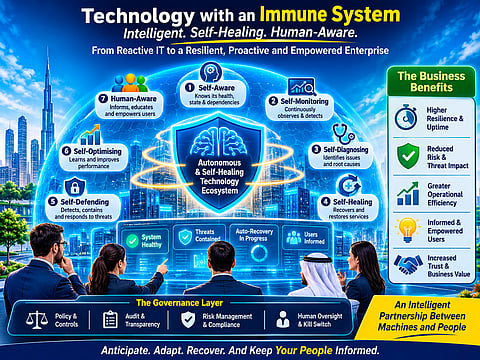
A dream emerged during last weekend discussion with a group of accomplished CXOs, where the conversation moved beyond the usual narratives of artificial intelligence, automation, efficiency, and cost savings. As ideas flowed across the table, a shared vision began to take shape. We imagined a future where technology systems do far more than detect problems, generate alerts, or enforce controls.
Instead, these systems would act as intelligent mentors, capable of understanding human behaviour, correcting mistakes in real time, and teaching users and administrators how to make better decisions. The collective insight was simple yet profound, as the true power of AI may not lie in replacing human effort, but in continuously enhancing human capability, ensuring that every error becomes a learning opportunity and every interaction makes individuals, teams, and organizations smarter and more resilient.
Get updated faster and for FREE: Download the Gulf News app now - simply click here.
Imagine a world where every technology platform possesses built-in intelligence capable of learning from human behaviour, correcting mistakes in real time, and delivering personalized training exactly when it is needed. Instead of acting as passive tools, systems would become active mentors, continuously helping users and administrators improve their skills while strengthening organizational resilience.
Consider email security, a challenge faced by virtually every organization today.
Traditional email security systems are primarily designed to identify and block threats. They flag suspicious emails, quarantine malicious attachments, and generate alerts for security teams. While effective, these systems typically stop at detection. Human intervention is still required to investigate incidents, understand root causes, and educate users after mistakes have been made.
The next generation of intelligent systems could operate very differently.
An advanced AI-powered email security platform would constantly observe patterns across email traffic, user behaviour, device activity, and administrative actions. It would analyse how employees interact with messages, identify recurring mistakes, and determine where knowledge gaps exist.
For example, the system may discover that finance employees frequently interact with invoice-related phishing emails. Rather than simply issuing warnings, it could automatically generate personalized micro-training sessions focused on recognizing financial fraud tactics. If executives regularly access corporate email from unmanaged devices while travelling, the platform could instantly provide tailored guidance on secure remote access practices.
The same intelligence could be applied to administrators. If security teams repeatedly modify the same email policies or struggle with recurring configuration issues, the platform could recommend targeted learning modules or policy optimization guidance aimed at improving operational effectiveness.
The result is a shift from reactive awareness programs to proactive behavioural improvement.
Such capabilities extend far beyond cybersecurity.
In cloud computing environments, organizations often encounter misconfigured storage repositories, excessive permissions, or exposed services. Today, these errors typically result in alerts, investigations, and remediation activities. In the future, intelligent cloud platforms could automatically recognize the mistake, apply corrective actions, explain why the issue occurred, and deliver a focused learning experience to the responsible individual.
Every error would become a teaching moment.
Enterprise resource planning systems could identify users who repeatedly enter incorrect financial information and provide contextual guidance before transactions are submitted. Manufacturing environments could detect unsafe operating behaviours and offer immediate coaching while simultaneously recommending process improvements to management.
What makes this concept particularly compelling is the transition from measuring training completion to measuring behavioural outcomes.
Organizations currently invest significant resources in compliance-based training programs. Employees attend courses, complete assessments, and receive certificates. However, completion does not necessarily equate to understanding, nor does understanding always lead to behavioural change.
Future intelligent systems would focus on different metrics. Rather than asking whether training was completed, they would evaluate whether behaviours improved. They would measure risk reduction, learning effectiveness, operational maturity, and organizational resilience over time.
This vision also addresses one of the largest challenges facing modern enterprises, which is the growing complexity of technology.
As organizations adopt cloud computing, artificial intelligence, digital workplaces, and connected ecosystems, expecting every employee to maintain expert-level knowledge becomes increasingly unrealistic. Intelligent systems can bridge this gap by providing continuous, personalized support directly within daily workflows.
The ultimate destination is an enterprise built on self-improving intelligence.
Infrastructure becomes self-healing. Applications become self-optimizing. Security controls become self-adapting. Most importantly, people become self-learning through continuous guidance delivered by the very systems they use.
In such a future, technology will no longer exist solely to automate tasks or enforce controls. It will serve as a trusted advisor, helping individuals make better decisions every day.
The most resilient organizations of tomorrow may not be those that prevent every mistake. Instead, they will be the ones that ensure every mistake becomes an opportunity to learn, improve, and emerge stronger than before. In that world, the true value of artificial intelligence will not be measured by how much work it replaces, but by how much human potential it unlocks.


