Talk to the digital wall
With the UAE an early adopter of new signage technologies, innovation is moving full steam ahead as the industry strives to connect minds
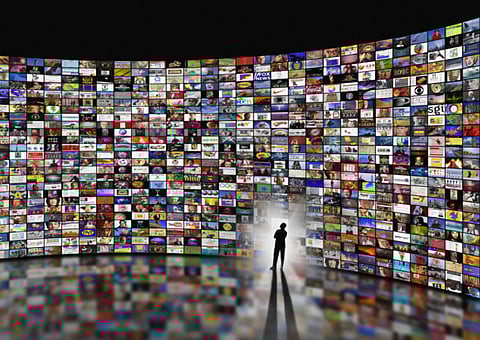
An indication of how far signage has come is in the fact that we rarely meet a wall that we don’t want to talk to. As consumers we expect to interact via touch screens, by flashing a device, or by simply opening our eyes wide. In the UAE, vendors are no longer surprised to be offered robots to assist in the creation of new signage or graphics. While consumer engagement using techniques such as gamification is one of the drivers, being environmentally friendly is another.
“Surfaces are going to be very important. All surfaces will become screens,” says John Quinn, Presentologist, Satellite Visual Communication, which works on technologies for audience engagement.
One example is the digital signage panels being used at multiplexes. One can watch movie trailers, select a seat, and buy tickets through a large touch screen — all without standing in a queue.
As competition between surfaces intensifies, the industry will innovate to drive participation. Huge video walls comprising touch, gesture, virtual aisles and augmented reality will demand attention.
“New technologies that are easy to understand and manipulate are accessible to a large audience,” Enis Kraiem, Regional Sales Manager, Fujifilm Middle East, tells GN Focus.
According to a report by Global Industry Analysts, the global digital signage systems market will reach $13.8 billion (Dh50.7 billion) by 2017, with experts predicting exponential growth up to 2024.
“Technology has started communicating with humans and these interactions are growing across several vertical industry sectors. The integration of real-time data and predictive analytics into digital signage is making a big splash among retailers,” says Sharif Rahman, CEO, International Expo Consults (IEC), organisers of SGI Dubai.
UAE a step ahead
While earlier the Middle East was perceived to be lagging behind more advanced adopters of technology, now the UAE is, in fact, one of the earliest to implement these new systems.
“We believe the UAE is adopting new trends in Western Europe and US markets quicker than other regions do. Professional service and creative agencies within the graphic arts industry are usually the fastest to adopt and introduce new trends,” says Abdulla K. Abul Ela, Regional Product Manager, Wide Format Print Group, Marketing Department, Canon Middle East.
Expo 2020, where connectivity is key, brings signage into focus. “There will be rapid growth in the UAE especially with the future developments for Expo 2020,” says Kraiem.
Signs of the future
Innovations in signage are used by FMCG companies, malls, government offices, banks and cinemas. The retail industry remains one of the keenest adopters of new technology since it brings almost instantaneous benefits to them. Using digital signage solutions to target customers more efficiently leads to customers increasing dwell time. This, in turn, is tied to a rise in sales. Technology is the driver for much consumer interface today.
Malls and duty-free areas in the UAE are already implementing technologies such as Bluetooth-enabled digital signage that can send messages to a person’s phone as he or she walks past. Merchandisers can also make window shoppers interact through the augmented reality feature in digital signage panels. Instead of competing to stay ahead of mobiles and tablets, digital signage is now making friends with them to better connect with the consumer.
One way for signage to be most effective in a pro-technology, connected city is “by increasing the value of printed materials through linking the actual print with digital media, which we call cross media. This is because print is still the preferred way of advertising and communication in our region,” says Abul Ela.
Creative applications are already evident. Recent visitors passing by Harvey Nichols at the Mall of the Emirates in Dubai were taken aback by framed moving pictures of Victorian women overlooking mannequins in the window. The movement brought alive the whole scene.
Going green
With green lifestyles one of the focus areas for development across sectors, original equipment manufacturers in the printing industry are warming up to LED-curing technology and a new generation of LCD. “It consumes 75 per cent less energy than UV arc lamp technology and the lamps last 25 times longer. Digital LCD and LED still represent a minor part of the advertising industry, but are expected to record the highest growth in this segment in the next five years. We can already see this in the UAE. LCD is present on the roads and public areas — especially malls,” says Kraiem.
New technology being showcased at SGI includes UV, green printing and 3D/4D engraving technologies along with laser and 3D letter-bending machines, indicating that much before the technology reaches a user, innovation is already on its way.
Power of printing
The printing industry is keeping up with the fast-paced nature of developments in consumer-facing technology by producing high-quality, high-speed equipment. “Future developments will focus more on UV inkjet for a wider variety of applications such as labels, commercial printing, security, packaging, textile printing, decoration and industrial manufacturing,” says Kraiem.
Digital printing is, in fact, a leader in innovation. “Opportunities for non-consumer inkjet-printing technology are bright. Expansion into high-volume point-of-purchase and personalised signage, corrugated retail display stands, textiles and decorative markets, high-end photography and fine arts applications indicates latent demand being addressed with digital printing technology in ways not possible before,” says Abul Ela.


