Swallowing the changing tablet
The digital tablet market is rapidly evolving, sparking massive changes in information consumption patterns in the UAE
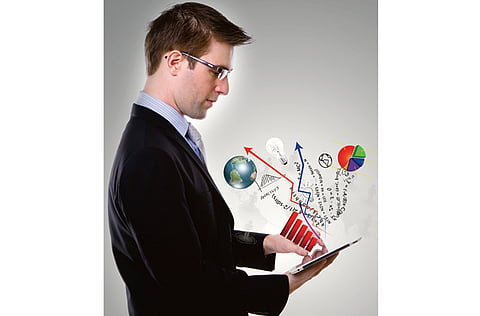
Information consumption patterns are fast undergoing transformation across the world with the increasing integration of the internet into our daily lives. The “four screens”, as Jack Lee, corporate vice-president for Lenovo Group and general manager for Middle East and Africa refers to them, have taken over how information is delivered, exchanged, shared and consumed.
While laptops and PCs are well entrenched in their roles, particularly for professionals and students, and mobiles have practically become essential items for most, tablets have only more recently begun to be taken seriously. Raed Hafez, managing director for Motorola Mobility, Middle East and Africa, says, “Tablets have transformed from a novelty device used for internet browsing and gaming to a personal device merging the smartphone and the personal computer.”
The iPad Business Survey (January 2012), studying the patterns of iPad usage, found that “IT and business professionals in Asia, Africa, the Middle East and South America are least likely to continue buying newspapers once they acquire an iPad.” This is in comparison to less significant shifts in the rest of the world, with 80 per cent of the users in the Middle East buying fewer books and newspapers and 30 per cent buying fewer DVDs.
Badreya Al-Jenaibi of the Department of Mass Communication, United Arab Emirates University (Al Ain), released an initial study on the use of social media in the UAE, concluding that social media usage patterns in the UAE were similar to trends worldwide: Facebook, LinkedIn and Twitter being most popular among social media networkers and microbloggers, while YouTube takes pride of place for video sharing, Google Reader for bookmarking and Flickr for photo sharing.
Physical to digital
This recent sharp rise in movement away from physical in favour of adoption of digital, due to the rise of popularity of the tablet, was well reflected in tablet sales in the UAE in 2011. Retailers Virgin Megastores and Jacky’s Electronics reported a sharper rise in tablet sales in the last year in comparison to the better entrenched mobility categories of smartphones and laptops. Ashish Panjabi, COO, Jacky’s Electronics, says, “Tablets saw over 150 per cent growth rate since DSF 2011 and smartphones 40 per cent, both in unit terms.”
Since opening the only Apple Shop in-store at their premises last year, a Virgin Megastore spokesperson states that its sale of the iPad has tripled, with iPad2 being the most-bought tablet across brands available at their store.
What does this really mean for media, marketing and communication professionals in terms of targeting audiences? News has already made the shift into digital delivery, preceding the print copy, which often now primarily contains analysis and features. Justin Bieber was a product of music going viral, an increasingly adopted method of distributing videos and music. The Kindle experience, delivered across digital form factors (besides its own e-reader with the whole Amazon bookstore backing it), changed how books would be distributed and consumed forever.
Natrajan Ramsubramani, a banking professional in Dubai, uses the tablet to seamlessly balance work and life. He says, “I use the tablet primarily to access the internet: Facebook, LinkedIn etc. I also have apps such as BBC and CNN, which I access to get news. Also, the gaming apps are used by my daughter. During holidays I sync my office mail to the iPad and use it for official purposes as well.”
The work device
Drawing from the conclusions of the iPad survey, the tablet is now also being increasingly seen as a device for increased professional use. Panjabi, commenting on his usage of the tablet, says, “I probably use my tablet more for work today than I do for personal use. A year ago, the situation was quite different; I was hardly using my tablet for work. With cloud computing, whether you are using Apple’s iCloud or even third-party Apps such as Dropbox, your work is more portable and can follow you around wherever you go.”
Speaking of the future of tablets, Panjabi says, “Ultrabooks are an interesting trend as the difference between what we call a notebook and a tablet will blur as Ultrabook designs evolve. Microsoft is launching Windows 8 in 2012 and that promises to close the gap between notebooks, tablets and smartphones.”
Lee, speaking of the tablet’s increasing popularity as a work device, says, “We introduced the first true business-class tablet, the ThinkPad tablet, which offers superior security and productivity features for professional use. At CES this year Lenovo unveiled the IdeaPad Yoga — a convergence of notebook and tablet form factors with a 360 degree flip-and-fold design. Due to the run up to the upcoming Windows 8 platform, this is the kind of fresh thinking and innovation we will see challenging the now-ubiquitous slate tablet device and adapting solutions to consumer needs.”
Mark Prosser, product marketing manager, mobility products, Acer Computer ME, says, “If you look at global trends, the consumer is demanding tablets with high-definition screens with better resolution — lightweight with increased battery life. There is a marked difference in our product portfolio and our latest offering, the Iconia Tab A200, which is ideal for sharing good times via gaming, e-books, movies, music, photography, social networking and more. It’s no longer a case of just owning a tablet device. It’s becoming quite common for people to be able to link or connect the tablet to other devices the consumer owns.”
Increased adoption of the tablet — especially given its larger screen size compared to the standard smartphone and weight advantage over the laptop — is a direct challenge to revenue models of all information, communication and entertainment providers who are now faced with both challenges and vast new opportunities.
Change in audience approach is no longer an option — it has become a necessity.
USAGE: Getting creative


