FIFA chief forced to defend Balogun World Cup reprieve
Trump call, Belgium anger and UEFA rebuke fuel controversy over Balogun reprieve
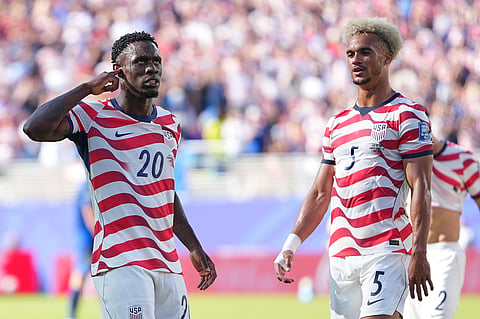
FIFA chief Gianni Infantino on Monday defended the decision to reprieve US World Cup star Folarin Balogun after Donald Trump said he had appealed directly to the head of world football's governing body over the issue.
Balogun, the US team's outstanding player at the World Cup, had been set to miss the last-16 game against Belgium in Seattle later Monday after receiving a red card in the victory over Bosnia-Herzegovina in the previous round.
But on Sunday FIFA said it was suspending the card, allowing Balogun to play against Belgium, sparking a furore.
The uproar showed no signs of abating with just hours to go until the 5:00 pm (0100 GMT Tuesday) kickoff of the biggest game in the history of American soccer.
FIFA also dismissed Belgium's appeal over the decision as "inadmissible".
Belgium's football association said earlier it had "still not received any decision or any explanation from FIFA regarding this matter".
Under pressure to explain FIFA's decision to allow Balogun to play, Infantino insisted on Monday that his organization's disciplinary process was independent and he could not influence it.
Trump contacts Infantino
That came after Trump confirmed he had contacted Infantino directly about the red card.
Trump told reporters at the White House he had called Infantino, with whom he has built a close relationship, "because I didn't think it was a foul".
"All I did was ask for a review, I didn't say you have to do this," Trump added.
Infantino said he had explained to Trump that "there was an ongoing legal process involving FIFA's independent judicial bodies and that the case would be decided in due course by the competent bodies".
'Crosses red line'
The football chief said he always read the decisions handed down and "sometimes I am surprised by them. Sometimes I agree with them, and sometimes I disagree."
He added: "What I always do, however, is respect those decisions and the autonomy of the bodies that make them."
The chair of the FIFA disciplinary panel that considered Balogun's case issued a statement on Monday defending the decision but did not divulge the reasons why the US striker was reprieved.
The panel said simply that suspending disciplinary sanctions was "nothing new in the modern game" and was entirely within the discretion of FIFA.
European football's governing body UEFA said earlier FIFA had "crossed a red line" by allowing Balogun to play.
"Football, like any other sports, relies on rules, which are the basis for fair, honest and transparent competition. Sometimes rules are open to interpretation. In this case not," UEFA added.
It also warned of the ramifications for the sport as a whole.
"Football is the most loved sport in the world because it is a beautiful game and is trusted because is played everywhere with the same laws," UEFA said.
"A tournament is never a pure standalone and, if the tournament in question is the World Cup, it has the power to drive positive or negative consequences on the game as a whole."
'April Fool's joke'
Belgium coach Rudi Garcia said he thought it was an April Fool's joke when he heard Balogun's card had been suspended, while Norway coach Stale Solbakken said FIFA had made "a big mistake".
Former England and Manchester United star Gary Neville said FIFA's decision represented "a stain" on the World Cup.
"(Trump) rang up somebody at FIFA and asked them to change their mind, and lo and behold, an independent committee then changed their mind," Neville said. "It stinks."
Infantino said he often discussed events at the World Cup with Trump.
"I regularly discuss matters related to the FIFA World Cup with the President of the United States, and on this matter, I did receive a call from President Donald Trump," he said.
"Just as I receive calls from heads of state, government officials, football stakeholders and business executives from around the world on many different issues."
Infantino, a Swiss-Italian who has led FIFA since 2016, was a frequent visitor to the White House in the buildup to the World Cup.
Last year he awarded Trump a newly created FIFA peace prize, which he presented to the president at the World Cup draw in Washington.


