World Cup Halftime goes Super Bowl: Shakira soars, Justin Bieber song choice sparks debate, falls flat
Halftime spectacle sparks debate over Bieber’s song as Shakira channels football’s spirit
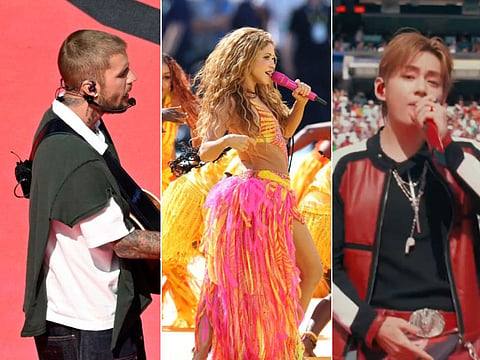
Did Justin Bieber choose the wrong song? Or was Shakira always going to own the World Cup halftime show?
And, truth be told I wasn't expecting to be debating Justin Bieber's song choice during a FIFA World Cup final. Yet here we are at 3.40am UAE time doing a glorious postmortem of his song choice.
Fun facts first: For the first time in the tournament's history, FIFA gave us a Super Bowl-style halftime show. It was bold, ambitious and unapologetically American, packing the break between Spain and Argentina with a dizzying parade of global stars.
Madonna. BTS. Justin Bieber. Shakira. Burna Boy. Even the Muppets made an appearance.
By the time the players returned to the pitch, social media had already delivered its verdict.
Some viewers questioned why football even needed a halftime show, while others argued the production felt overstuffed, trying to cram too many ideas—and too many celebrities—into a short window.
Justin Bieber, meanwhile, found himself at the centre of the debate, with many fans suggesting his performance slowed the energy just when the show needed momentum. I'm not convinced that's entirely fair. Bieber wasn't the problem. The song probably was.
There's a reason halftime performances work when they work. They're built around songs that instantly lift a stadium. Songs that make tens of thousands of people jump to their feet within seconds. They're communal experiences as much as musical ones.
Bieber chose to do something different.
His stripped-back performance of Everything Hallelujah was intimate, reflective and deeply personal. On another stage, it may well have been one of the evening's standout moments.
But this wasn't another stage. This was football's biggest stage.
At a World Cup final, where emotions are already running at fever pitch, the audience isn't necessarily looking for quiet reflection. They're looking for release. They're looking for anticipation. They're looking for the kind of electricity that carries them into the second half.
Instead, the tempo dipped. That doesn't make Bieber a bad performer. It simply means the moment and the music weren't quite speaking the same language.
Then Shakira walked on. And suddenly everything clicked.
Maybe it's because she has become part of football's DNA over the past two decades. Maybe it's because Waka Waka still instantly transports millions of fans back to the 2010 World Cup. Or maybe it's because nobody understands how to command a stadium quite like Shakira.
Whatever the reason, her performance felt effortless. She wasn't trying to convince football fans that she belonged there. She already did.
For me, she understood the assignment better than anyone else that night.
That's not a criticism of Bieber, Madonna, BTS or Burna Boy. All of them delivered polished performances.
But Shakira was the one artist who felt inseparable from the occasion itself.
The bigger question, though, has very little to do with Justin Bieber.
It's whether FIFA wants the World Cup to become the Super Bowl. For decades, halftime at a World Cup final was exactly what the name suggested — a chance for players to regroup, coaches to reset and fans to catch their breath.
Now it's another entertainment property.
On one hand, it's easy to understand why FIFA is embracing the formula. A halftime show creates viral moments that live far beyond the match itself, attracting audiences who might never have tuned in purely for football.
From a business perspective, it's a smart play. From a football perspective, I'm still undecided.
The World Cup has never struggled to create theatre. It has given us Diego Maradona's brilliance, Zinedine Zidane's infamous headbutt, Andrés Iniesta's extra-time winner and Lionel Messi finally lifting the trophy. It has produced tears, miracles, heartbreak and moments that have become part of sporting folklore.
Football has always been its own greatest entertainer. Maybe that's why the halftime show felt slightly unnecessary.
Not because the artists weren't talented.
Not because Justin Bieber chose the "wrong" song.
But because football rarely needs help stealing the spotlight.
As the final unfolded, that's exactly what happened.
The conversations shifted away from celebrity cameos and set lists, and back to tackles, chances, missed opportunities and the drama on the pitch.
The beauty of World Cup
Perhaps that's the beauty of the World Cup. You can throw every global superstar imaginable at it. You can build giant stages, invite pop royalty and fill the break with chart-topping artists.
Yet somehow, the game still finds a way to become the biggest star of all. So, did Justin Bieber choose the right song?
Probably not for that moment. Was Shakira the better fit? Absolutely.
But the bigger takeaway from FIFA's halftime experiment is this: no matter how many celebrities are invited to the party, football has a habit of making itself the main event.
And maybe that's exactly how it should stay.


