Infant COVID jabs: Vaccine trials for kids 6 months and up, what we know so far
Here’s why younger kids are still waiting for a COVID-19 shot
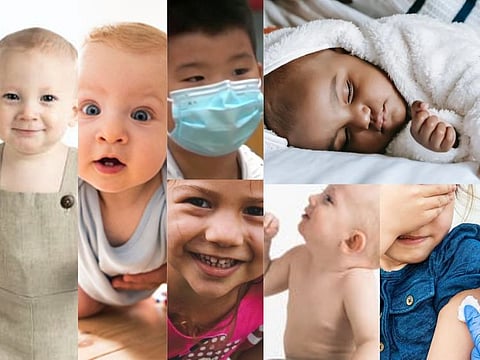
Highlights
- There are 1.9 billion children on the planet.
- It is not yet known when COVID jabs will be approved for the youngest children, from ages 6 months to 2 years old.
- In the UAE, the Sinopharm vaccine was approved for children from ages 3 to 17.
- Other vaccine-making countries — China, US, UK and India — have also started clinical trials on COVID shots for the little ones.
- Why is it taking so long to get vaccines for kids approved? A few things still need to happen before the shots can be OK'd for younger kids.
- There are at least 2 on-going COVID vaccine trials on infants and toddlers.
- Approval may happen soon, as early as September.


Delta is gripping the world. There are more than 1.9 billion children on the planet. Now, the data is out: the highly contagious variant is making kids sicker.
A South Korean study shows Delta cases have 300 times higher “viral load”, according to a report out Tuesday (August 24, 2021). Earlier, a CDC internal document dubbed Delta “as infectious as chicken pox”.
Delta has superseded other variants. It has almost completely driven Lambda out. More than 4.98 billion vaccines had been administered till today, according to a Bloomberg tally. No vaccines had been approved yet for infants and toddlers.
Everywhere else in the world, there are no exact dates when youngest children, from ages 6 months to 2 years old, would get their first COVID jabs. Why is it taking long to get a greenlight for vaccines for the little ones? Some key things that need to happen first before the shots can be OK'd for them.
How soon will they get it? Here’s what we know far:
Are children getting infected with COVID?
Yes. Although fewer children have been infected with COVID-19 compared to adults, the CDC warned that children can:
Are children getting sicker due to the Delta variant?
Yes.
The Delta variant is as infectious as chicken pox.US Centres for Disease Control and Prevention internal document, as reported by US media
What's the evidence?
An internal CDC document leaked by US media cited studies from Canada and Singapore (not yet peer-reviewed) that found higher odds of hospitalisation and death. Meanwhile, a study from Scotland found a double risk of hospitalisation with Delta compared to Alpha. A Chinese study published on the biology server medrxiv.org [code: 2021.07.07.21260122v2] reported that people infected with the Delta variant can carry 1,000 times the viral load as those infected with the original virus.
That study also found that people with Delta carry detectable virus earlier than with the original virus (4 days vs. 6 days after exposure). Still another study found that they remain infectious longer (18 days vs. 13 days).
The Alpha variant was already demonstrated to cause more severe COVID-19 than the original virus. Paediatricians are reporting children getting sicker from Delta. Epidemiologists Dr. Eric Feigl-Ding, cited record paediatric hospitalisations, potentially surpassing the winter pandemic peak. "#DeltaVariant surge will worsen for kids," he stated on Twitter.
On Saturday (August 22) hospitals in the US South and Midwest reported they are treating more children with COVID-19 than ever and are preparing for worse surges to come. Over the last 6 weeks, doctors reported a bio jump in paediatric COVID cases as unvaccinated people have become vectors of Delta. Clinicians reported kids are getting sicker in places where community spread of the variant is high.
The American Academy of Pediatrics reported 93,824 new cases among children in the US in the week of August 5 — a 30% jump from the previous week, and the highest since February. Hospitalisations are also reported to be spiking among those under the age of 17. [Source: https://bit.ly/3kAYXGj]
Do vaccines work against Delta?
Experts agree on one thing: the approved vaccines still offer strong protection against infection by the Delta variant, though the efficacy of existing vaccines are seen to be "waning".
What are the COVID-19 vaccines for adults approved by the WHO?
The WHO declared these vaccines to be safe for most people, 18 years and older. It includes people with pre-existing conditions of any kind, including auto-immune disorders. These conditions include:
As of today (August 24, 2021) there are 22 COVID vaccines approved by at least one health authority.
What do vaccine studies show about their effects on children aged <12?
Initial findings on COVID-19 vaccine’s use in younger children are out. For example, with the Pfizer jab, data shows that 1/3 of the dose for adult is the optimal range for children younger than 12 and older than 5, Dr. Flor Muñoz at Texas Children's Hospital and Baylor College of Medicine, told US media. She runs the Pfizer study.
Moderna has kicked off a trial on children with 6,795 participants in the US and Canada. The children will be ages 6 months to <12 years. In Part 1, each participant ages two years to less than 12 years may receive one of two dose levels (50 μg or 100 μg).
Also in the trial's Part 1, each participant ages six months to less than 2 years may receive one of three dose levels (25 μg, 50 μg and 100 μg).
An interim analysis will be conducted to determine which dose will be used in Part 2, the placebo-controlled expansion portion of the study. Participants will be followed through 12 months after the second vaccination.
What COVID-19 vaccines are approved for children?
Sinovac | June 7, 2021 | China approves it emergency use for those aged between 3 and 17 years old.
Sinopharm | July 20, 2021 |China approves its emergency use for young people ages 3 to 17.
Sinopharm | August 2, 2021 | UAE approves Sinopharm for use in children aged between 3 to 17.
Pfizer/BioNTech | May 10, 2021 | US FDA approves shot for use in children ages 12 through 15.
Moderna | July 23, 2021 | The EU Commission approves vaccination with Moderna’s shot to children aged between 12 and 17.
Moderna | August 17, 2021 | UK confirms the mRNA-1273 is safe and effective for 12-17 year olds.
Moderna | August 23, 2021 | Saudi health regulator approves mRNA-1273 for children from 12-17 year olds.
What are the on-going trials for COVID vaccines on children?
mRNA-1273 | March 15, 2021 | Trial on children aged 6 months-to <12 years old starts for Moderna. Earlier, Moderna's COVID-19 vaccine is 96% effective among youths aged 12 to 17, according to the results of its first clinical trials involving 3,235 participants (two-thirds got the vaccine and one-third got a placebo).
The Moderna trial began enrolling 6,795 participants younger than 12. The participants were to be split equally into three age brackets, including a 6 to 11 year old group, of 2,265 participants each. Part 1 of the company’s paediatric vaccine trial involves participant ages two years to less than 12 years were to receive one of two dose levels (50 μg or 100 μg).
Pfizer/BioNTech | March 31, 2021 | Pfizer and BioNTech dosed the first healthy children in a Phase I/II/III study to test safety and immune response against COVID-19, in children aged 6 months to 11 years. Pfizer is on a faster timeframe. It has a trial size of 3,000 children in the 5-to-11-year-old group. The company chose 10µg and 3µg doses based data gathered from 144 children in a Phase I trial. In the Phase II/III trial, up to 4,500 children will be enrolled at more than 90 sites in the US, Finland, Poland and Spain.
Sputnik V | July 5, 2021 | Trial on children aged 12-17 years old starts in Moscow (on 100 volunteers who haven't been previously infected with COVID).
Janssen | September 2, 2021 | Janssen, the vaccine arm of J&J, has enrolled an estimated 4,350 adolescents for its vaccine trial. The study (code: NCT05007080) is designed to evaluate 2-dose levels of the shot (Ad26.COV2.S) in healthy adolescents aged 12 to 17 years to prevent severe COVID. There are no study results at the moment.
TRIALS IN MULTIPLE SITES
• Today, clinical trials had been hugely accelerated. With the internet, sign-up (a requirement for getting “informed consent”) is fast and at a large scale. For example, Pfizer announced it is conducting on children from 6 months to 11 year olds in 90 sites — in the US, Finland, Poland and Spain. • Moderna is conducting clinical trials on young kids in more than 100 sites in the US and Canada on more than 7,000 kids-volunteers, with full consent from their parents.
When are the results for these paediatric vaccine trials expected?
Pfizer expects to have results for the 5-to-11-year-old group next month (September 2021). Results for children aged 2 to 5 shortly after that. Results for the youngest children — 6 months to 2 years old — are expected in October or November.
(This timetable will be updated as soon as new information is made available).
What’s the latest on these trials?
The FDA had asked the vaccine makers to include 3,000 children in the 5-to-11-year-old group from each. This is double the original number of target trial participants. Results were expected first for this age group.
In general, a larger sample size may increase the likelihood of detecting rarer events, possibly including: myocarditis (inflammation of the heart muscle) and pericarditis (inflammation of the lining around the heart).
4,600 PARTICIPANTS IN PFIZER TRIAL FOR INFANTS AND TODDLERS:
• There are least two trials on vaccines for children 6 months to 11 years old. • One is the Pfizer/BioNTech trial, which seeks to enlist over 4,600 participants in 3 age groups: 5 to 11-year-old age group; 2 to 5-year-old age group; and 6-month to 2-year-old age group. • Participation in the study will last approximately 2 years. The clinicaltrials.gov ID for the Pfizer trial is NCT04816643. • Dose finding is being initiated in this study in participants ≥5 to <12 years of age based on the acceptable blinded safety assessment of the 30-μg dose in 12- to 15-year-olds in the previous (study code: C4591001).
What are the rare side effects seen in previous vaccine trials?
In June 2021, the CDC published data showing that the two vaccines (Pfizer and Moderna) may have caused myocarditis and pericarditis in more than 1,200 Americans — including about 500 who were younger than 30. The symptoms typically appeared within two weeks and were more common in young men and boys.
What vaccine is approved in the UAE for children?
In the UAE, Sinopharm was the first, and so far the only, vaccine for children in the 3-11 years age group. In June 2021, the UAE launched a clinical trial of the Sinopharm COVID-19 vaccine on children, with 900 children aged between 3 and 17 enrolled.
The trial was the first project in the MENA region designed to study young children’s immune response to being inoculated against COVID-19. Following the trials, the UAE health authorities approved the Sinopharm COVID vaccine for children for the age group (3 to 17).
Why is vaccinating children against COVID-19 important?
There are 1.9 billion children below the age of 15, comprising about 27% of the world’s population. Moreover, questions about vaccinating children — including those under 12 — are of huge interest to parents and teachers. Once the vaccine trial data is out, regulators will take a call on balancing potential vaccination risk/side effects against the risks of COVID-19.
ADVERSE REACTION REPORTS
• The CDC maintains the online Vaccine Adverse Event Reporting System (VAERS), an online database. • Reports of death after COVID-19 vaccination are rare. More than 357 million doses of COVID-19 vaccines were administered in the US from December 14, 2020, through August 16, 2021. • During this time, VAERS received 6,789 reports of death (0.0019%) among people who received a COVID-19 vaccine. FDA requires healthcare providers to report any death after COVID-19 vaccination to VAERS, even if it’s unclear whether the vaccine was the cause.
What do regulators say about the risks children face with COVID vaccines?
Members of a CDC advisory committee have said that the benefits of shots for people older than 12 greatly outweigh the risks, including of heart problems. Data to be gleaned from the on-going studies will reveal the risk-benefit profile for children from 6 months to 11.
Can vaccines halt COVID outbreak among children?
The approval and availability of vaccines alone will not bring this paediatric outbreak to a halt — unless they are actually vaccinated. If so, experts say it will help curb the spread of the virus for everyone, and give many families a better sense of how to plan for the future. Pending approval for the youngest age group, the timeline remains uncertain.
CLINICAL TRIALS ON CHILDREN: WHAT EXPERTS WANT TO KNOW
• The paediatric COVID vaccine studies will help vaccine makers and regulators assess the potential safety and “immunogenicity” of the candidate vaccines. • If approved for infants and toddlers, the COVID vaccines will have come full circle, as younger-age population form an important part of society. A step-by-step process will help vaccinologists know which dose will be used in Part 2, the placebo-controlled expansion portion of the study. • After the second dose, participants will be followed through 12 months. In general, vaccine efficacy (VE) will either be inferred through achieving a “correlate of protection”, if established; or through “immuno-bridging” to the young adult (ages 18-25) population.
TIMELINE
RAPID TRIAL: The COVID-19 vaccine threshold is getting younger. Following are the updates:
March 15, 2021
Dosing starts for first participants among children ages 6 months to <12 years with Moderna vaccine.
March 31, 2021
May 10, 2021:
The FDA authorises this age group (12 to 15) to be vaccinated before the school year begins in late summer.
May 18, 2021
At least 600,000 children ages 12 to 15, have received their first dose of the Pfizer-BioNTech Covid-19 jab in the US.
June 7, 2021:
China allows those aged between three and 17 years old to get Sinovac COVID-19 shots.
June 8, 2021:
Pfizer announces vaccine trials in healthy children from 6 months to <12 years of age, with 4,500 participants at more than 90 sites in the US, Finland, Poland and Spain.
June 9, 2021:
Pfizer advances clinical trials for 5- to 11-year-olds at lower doses. The company will use 10 micrograms of each vaccine dose for kids between the ages of 5 and 11 in Phase 2/3 trials, and 3 micrograms of each dose for those 5 and younger. People ages 12 and older received 30 micrograms in each dose.
July 20, 2021:
China approves Sinopharm's COVID-19 vaccine approved for emergency use for young people ages 3 to 17 in China.
July 26, 2021
The US FDA asks Pfizer, Moderna to test their vaccines in more children to help rule out safety issues.
August, 2, 2021:
The UAE approves the use of Sinopharm for children between ages 3 to 17.
August 17, 2021:
UK approves Moderna COVID-19 vaccine in 12-17 year olds.
August 23, 2021:
Saudi Arabia approves Moderna COVID-19 vaccine in 12-17 year olds.
August 23, 2021:
Pfizer/BioNTech COVID-19 vaccine gets full FDA approval.
MOVING FORWARD
• Evaluation of COVID vaccines for infants and toddlers is now moving forward. Inci Yildirim, MD, PhD, associate professor of paediatrics (infectious diseases) at Yale School of Medicine, is leading Yale’s component of Moderna’s clinical trial of a vaccine for children 6 months to 12 years of age. Yildirim said vaccinating young children could protect their own health more than people assumed when the pandemic began. • “As the pandemic evolved we have learned many things we didn’t know initially,” says Yildirim said: “We learned in fact that children can get infected and develop severe disease requiring intensive care unit admissions. We have seen children transmitting SARS-CoV-2 to other children and adults.” Vaccinating children will significantly contribute to herd immunity, the infectious disease expert added.


