With freedom comes responsibility
Kuwait is suffering as a result of a trend in which free speech is exploited as a means to seek high office
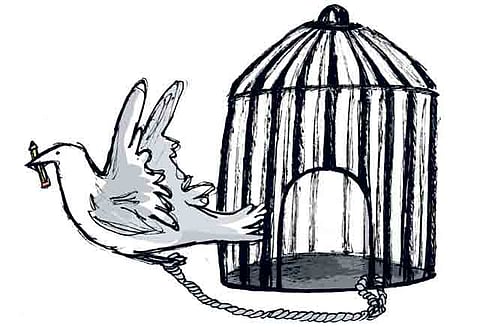
It is not an exaggeration to say that the arrest of journalist and lawyer Mohammad Al Jasem on charges of insulting the Emir has put the defenders of freedom in an embarrassing situation.
In principle, they oppose the arrest and trial of people who have merely expressed an opinion, whether orally or in writing, within or outside their home country. After all, freedom of opinion is enshrined in the Constitution of Kuwait, enacted in 1962.
Many people in Kuwait feel the need to defend their considerable freedom, whereby newspapers, magazines, periodicals and satellite TV stations are open to all ideas and arguments.
They are keen for freedom to continue to prevail in Kuwait, and this explains why they have taken to the streets to express their opinion whenever mouths have been gagged, to restore the situation to normal.
These are the successors of the founding fathers, who endured difficulties and made huge sacrifices so that future generations could reap the benefit.
These are the people who realised the noble goal of building a state of institutions and law.
However, many who would defend freedom believe that Al Jasem went too far, and that his pushing the boundaries does not serve the interest of promoting and developing Kuwait.
They believe that Al Jasem's writings provide justifications to those who would belittle democracy in Kuwait. They also think his writing does not take into consideration the conditions in Kuwait and the region at this critical turning point.
There are many prominent, patriotic figures who have not been accused of "attacking" or "insulting" the Emir of Kuwait, although they have a long history of opposing the government and exposing its mistakes. And there is no doubt that these figures will not condemn Al Jasem, who remains in detention.
Selfish motive
However, they believe that Al Jasem stepped up his criticism of the government on his blog and elsewhere for the purpose of realising political gain.
They say Kuwait is fertile environment for such practices, prompting a "fashion" or "trend" of outspoken opposition. Following this trend has become a prerequisite for those who want to be nominated to the National Assembly, as well as for those of the nation's representatives who wish to remain in parliament.
This is why criticism has ceased to be constructive. There is a new style of opposition, and its only aim is to insult the government.
Recently, the increasing stridency of criticism emanating from the opposition has become clearly apparent in newspapers, magazines and periodicals.
This opposition has also dominated Kuwaiti public forums and the sessions of national and municipal councils, cooperative associations, trade and student unions, and various civil society institutions.
There is a prevailing trend of populism in Kuwait, with its adherents hoping to receive "donations" and "gifts" from the state. This populism is undoubtedly seen as the key to political gain.
As a result, members of parliament have become expert at proposing increases in salaries, allowances and bonuses, as well as drafting laws that would add to the state's burden — as if the state's coffers were a spring that could never dry up.
It would be acceptable if those increases were called for in order to improve performance, productivity and efficiency, but the problem is that they are mere propaganda and a means to win votes at any cost.
Many of these proposals are perplexing, such as one made by Islamist parliament members who called for a stipend of 500 Kuwaiti dinars (Dh6,280) for every non-working woman, including housewives, even though divorced women already receive assistance to the tune of 400 dinars per month from the Ministry of Social Affairs.
Dangerous development
If populism were confined to Kuwait's public affairs within the limits of its domestic issues, it might be acceptable. However, this trend has taken a critical turn and is now affecting the state's foreign affairs. The resulting political rivalry is potentially a very dangerous matter. The most obvious example concerns relations with Iraq, as some are calling for a revival of the competition seen in the tragic past, with all its catastrophic consequences.
Most patriotic Kuwaitis want to leave this painful past behind, turn over a new leaf and look forwards. Interfering in such a sensitive political issue could be seriously harmful to the national interest. Such issues fall within the jurisdiction of the executive authority and its affiliated committees, which are supposed to meet and discuss them away from the clamour of the media.
True patriots will continue to advocate freedom of expression, while recognising that there is a fine line between "criticism" and "defamation". After all, the exercise of freedom entails responsibility.
Dr Mohammad Hussain Al Yusefi teaches at Kuwait University.


