Why, exactly, is Hillary’s announcement a big deal?
In a country that still struggles with issues of race and gender, the idea of a first woman president to succeed their first non-white one is, by itself, fascinating
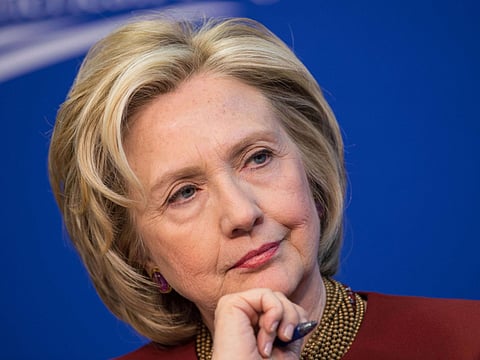
In the middle of last week, rumours began swirling through Washington and media worlds that Hillary Clinton would formally announce her candidacy for president on Friday. Within the day, the rumour had changed to Saturday. Then, on Friday, every significant media outlet in the US reported that the announcement would come on Sunday. The Washington Post said quite specifically that there would be a tweet, followed more-or-less immediately by a YouTube video, both at 10am.
By mid-afternoon on Sunday, nothing had happened, but that did not slow down the media’s drumbeat. A cynic might speculate that this had been the point all along. Without actually doing anything (except, one presumes, leaking bad or misleading information to credulous journalists) Hillary had managed to get everyone talking incessantly about new candidacy for three days.
Which raises the question: Why? It is not as though everyone on earth who cares has not known for years that Hillary planned to run for the White House in 2016. Why should the actual announcement date be anything more than a footnote? One can argue that presidential announcements (at least those by serious candidates) deserve, and receive, significant media attention. If Senators Ted Cruz (two weeks ago), Rand Paul (last week) and Marco Rubio (this week, according to the political rumour mill) all deserved their hour or so of national TV coverage, then Hillary surely deserves hers. But Hillary got a lot more than an hour. She got an entire weekend of the political world discussing little else.
The answer is that Hillary, for the moment at least, is something beyond an ordinary candidate. It is not just that she is the first woman to have a serious chance of winning the American presidency — though that fact surely is an element in the attention she receives. Nor is it simply the fact that she is a Clinton.
What sets Hillary (the only major American politician who is routinely referred to by her first name) apart is her status as president-in-waiting, something the US has not seen for nearly two generations.
Let us pause here to clarify that term. It refers to the veneer of inevitability that certain politicians acquire at certain moments in their career. It settles upon them when the messy business of an actual campaign still lies far in the future. Yet, there is a general sense among supporters and opponents alike that a particular politician is inexorably bound for the White House (not just the party nomination — ‘inevitable’ nominees are one thing, ‘inevitable’ presidents are something else entirely).
The key thing to understand is that this comes with no guarantee of actually becoming president. The successful examples of presidents-in-waiting are Dwight Eisenhower in the waning years of the Truman administration and Ronald Reagan in the final two sputtering years of Jimmy Carter’s presidency. There are also, however, cautionary tales. Most famously, there was Ted Kennedy who seemed like a near-inevitable president for close to a decade but stumbled badly from the moment he actually decided to run. More recently, Gary Hart, after an unsuccessful run in 1984, seemed destined to sweep towards the White House four years later, only to implode in a sex scandal in the spring of 1987.
Like Ike, Reagan, Kennedy and Hart in their respective moments, Hillary dominates America’s current political landscape in a way no other candidate can approach. Unlike the situation she encountered eight years ago, there is no talented fresher face standing between her and the Democratic Party’s nomination. Indeed, more than a few Democrats who, remembering the divisive figure she was during her husband’s presidency, questioned her ability to win a national election back in 2008 have come on board.
A victory in November of next year remains far from inevitable. Hillary is a formidable political figure and clearly worries many Republicans. Yet, the fact that she appears to have cleared the field of serious challengers within her own party may not ultimately work to her advantage (in terms of toughening up a candidate, there is much to be said for the battle-hardening that comes with surviving America’s year-long system of party primaries and caucuses). The fact that she enjoys near-universal name recognition is a mixed blessing: For better or worse, nearly everyone in America already has an opinion of her — and changing the negative ones will not be easy.
Still, the next year (or year-and-a-half) promises to be an exciting time in American politics. In a country that still struggles mightily with issues of race and gender, the idea that Americans may — just may — elect their first woman president to succeed their first non-white one is, by itself, fascinating.
Gordon Robison, a longtime Middle East journalist and US political analyst, teaches Political Science at the University of Vermont.


