US needs real infrastructure plan. That’s not what Trump offered
Actual federal commitment will be only a small fraction of the $1.5 trillion cited by the US president in the State of the Union address
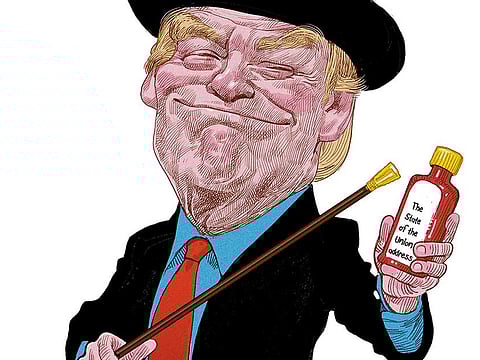
How can you tell when an infrastructure plan is not real?
Here’s a three-part test: 1) Does it provide a meaningful boost in our stock of public goods. 2) Does its funding design shift the historical federal responsibility for public investment to states and private investors. And 3) When it includes “pay-fors”, are they budget cuts taken from programmes that support low-income families?
We got almost no details in Tuesday night’s State of the Union address, but based on what we do know, United States President Donald Trump’s infrastructure plan handily fails this test.
On the first point — will Trump’s proposal lead to significant net additions to our stock of public goods? — though the president cited $1.5 trillion (Dh5.51 trillion) for infrastructure in the speech on Tuesday night, a new paper by policy analyst Jacob Leibenluft warns that, “the actual federal commitment will be only a small fraction of that, and it may be poorly targeted”. Note that Trump called on the Congress not to allocate $1.5 trillion, but to produce a bill that “generates” that amount, though the type of cost-shifting I describe below.
In fact, the administration’s 2018 budget proposes significant cuts to transportation spending, for example, and Leibenluft cites recent statements by administration officials advocating pay-fors that include cuts to mass transit and Amtrak, meaning no net additions and possibly net losses.
On the second point, all signs point to a funding design that will, by shifting costs away from the federal government, both short-change and poorly target public investment. According to Leibenluft “a leaked draft of the White House’s plan and previous administration statements give significant reason to be concerned that [Trump’s plan] would not support many needed projects, while shifting costs to states, localities, and individuals and potentially providing opportunities for lucrative private-sector gains”.
Let me pause on this point for a moment, as there’s one aspect of the “bait-and-switch” that’s been underappreciated, even by critics of the plan as we know it. Based on the leaked draft, Leibenluft points out that the federal share of projects would be limited to no more than 20 per cent. “In other words, this initiative’s primary purpose is to find someone else to provide most of the revenues needed to build new infrastructure.”
That someone else is, in part, intended to be states and localities. As Trump put it on Tuesday night: “Every federal dollar should be leveraged by partnering with state and local governments and, where appropriate, tapping into private sector investment ...”
Besides abrogating the critical role of the federal government in supporting state and local infrastructure, consider the impact of the recently passed tax plan on this funding strategy. But significantly lowering the amount of federal taxes that state and local taxpayers can deduct from their tax bill, states will have a much harder time raising revenues to support infrastructure or anything else. In other words, Trump and the Republicans are shifting infrastructure costs to the states and the same time they’re cutting the states revenue-raising capacity off at the knees.
The other cost-shift in play here is to individuals through tolls and fees. Private investment has also been at the heart of Trump’s infrastructure financing, to the tune of four private dollars for every one public dollar. But investors want a return, and that means projects must spin off revenue. In other words, we’re talking urban toll roads, not dangerously eroded water systems.
Ifrastructure investment
This is key to the bait-and-switch of the administration’s plan, as per Leibenluft: “If another entity must pay for at least 80 per cent of a project’s cost, the administration is effectively punting on how the revenues to pay for new infrastructure will be found. As a result, any claim that the plan is supporting a certain amount of infrastructure investment ... is far less than meets the eye — ignoring the fact that the investment will only occur if states, cities, and individuals are willing and able to pay more.”
Lastly, Republicans have already revealed that they’re shameless when it comes to deficit concerns: Tax cuts that favour the rich can be deficit financed, but spending must be paid for with cuts to programmes that help the economically vulnerable. Again, we’ll need to watch for details in coming weeks, but trust me, they’re not going to cut defence (to the contrary). Two-thirds of the spending cuts in Trump’s last budget — $2.5 trillion over 10 years — came from programmes that help those with low and moderate incomes.
It’s easy to get lost in the details, but there’s a very simple way to understand what’s really going on here. Ever since Trump took office, he’s ignored the working-class voters who helped put him there, and outsourced policy decisions to a Republican Party whose goal is to shrink government and return the proceeds to their wealthy donors. Though Trump’s sales job tonight tried to obfuscate this reality, his infrastructure plan perfectly fits this mode.
Given the deep and increasing need for investments in roads, bridges, subways systems, safe water, public schools and so much more, that’s a serious, lasting and costly mistake.
— Washington Post
Jared Bernstein, a former chief economist to former US vice-president Joe Biden, is a senior fellow at the Centre on Budget and Policy Priorities and author of The Reconnection Agenda: Reuniting Growth and Prosperity.


