US election campaign’s forgotten war
Political calculation may provide both Trump and Hillary with a continuing rationale to avoid subjecting the Afghanistan war to close scrutiny
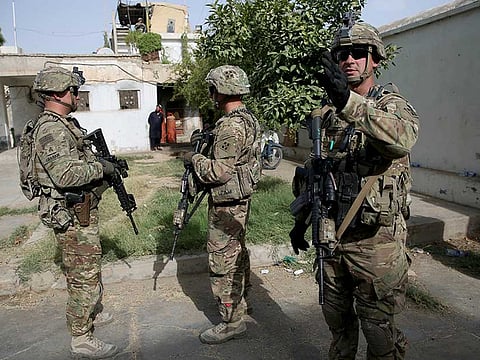
Although hardly news, it bears repeating that the Afghanistan war stands as the longest in all of United States’ history. By the presidential election day in November, it will have entered its 16th year. America’s next president will surely inherit the war there, just as Barack Obama inherited it from George W. Bush. Here is a situation where the phrase “endless war” is not hyperbole; it accurately describes reality.
Given this depressing fact, one may think that those aspiring to the office of the US commander-in-chief would have something to say about how they intend to win or at least curtail that conflict, or perhaps why the US should persist in such a costly endeavour. But in their lengthy convention speeches, neither Donald Trump (who spoke for 75 minutes) nor Hillary Clinton (who spoke for 66) found the time to even mention Afghanistan.
Their silence hints at what we can expect in the weeks between now and November: A campaign in which the opposing candidates will vigorously impugn one another’s qualifications for high office while dodging any serious examination of America’s core national security issues. Of bellicose posturing and the insipid recitation of platitudes, there will be plenty. Of critical analysis probing the recent failures and disappointments resulting from US military interventions, expect very little.
For a long time now, Americans have displayed a tendency to sanitise, marginalise, or altogether forget wars that resist incorporation into the preferred triumphal narrative of US history. Afghanistan falls into the category of the best forgotten.
Yet, however inconvenient, Afghanistan demands attention. For here the US first set out to test the proposition that has formed the cornerstone of its national security policy since 9/11: That the deft application of US military power can not only eliminate those threatening to harm America, but also install in their place a stable political order conducive to liberal values.
In Afghanistan, the US and its allies have succeeded on neither count, despite considerable sacrifice and expenditures exceeding one trillion dollars. Notwithstanding many years of western tutoring, the Afghan government, currently dependent on international donors for 70 per cent of its operating revenue, has shown little capacity to stand on its own. Efforts to root out pervasive corruption have gone nowhere. Opium production flourishes, with Afghanistan persistently supplying 90 per cent of the world’s heroin. Although no longer at the helm in Kabul, the Taliban persists and by some estimates is growing stronger. Hardly less troubling, Daesh (the self-proclaimed Islamic State of Iraq and the Levant) has established a local Afghan franchise.
The operation once grandly known as Enduring Freedom now goes by the bland name Resolute Support, the restyling itself a de facto admission of expectations ratcheted downwards. The mission objective is now, in essence, simply to hang on.
Taken in total, the present-day situation in Afghanistan represents a policy failure of staggering dimensions, matched in recent years only by the equally abysmal results achieved by US efforts in Iraq — site of another long war that shows no sign of ending anytime soon.
Political calculation may provide Trump and Hillary with a continuing rationale to avoid subjecting the Afghanistan war to close scrutiny.
Because Trump’s candidacy is fundamentally idiosyncratic, divining the reasoning behind his silence is necessarily a speculative exercise. But one real possibility is that he is oblivious to the events that have occurred in Afghanistan since US forces began arriving in the autumn of 2001 and so has nothing to say. Another is that there are other issues — Libya offering a prime example — that he can more readily hang around Hillary’s neck.
As for Hillary, she may be reticent to remind voters that it was during her husband’s presidency that Islamist militants in Afghanistan first laid the basis for the 9/11 conspiracy. In that sense, the less said about that country the better. Then there is this additional factor: Hillary has gone out of her way to emphasise her cordial relations with senior military leaders, no doubt hoping, thereby, to bury a residual impression of the Democrats as an anti-military party. For her to focus critical attention on Afghanistan will necessarily call into question the performance of senior officers who commanded US and Nato troops there and came home without getting the job done. As the prominent role allotted to one of those commanders at the Democratic convention suggests, Hillary appears less interested in holding generals accountable than in securing their endorsement.
If the candidates don’t turn to Afghanistan on the stump, we may hope — indeed, should insist — that the upcoming presidential debates oblige both Trump and Hillary to address questions like these: What specific lessons do you take away from this longest of American wars? Please explain how you will apply those lessons once in office. As for Afghanistan itself, where does America go from here?
To evade such questions would be an abdication of responsibility.
— Los Angeles Times
Andrew J. Bacevich is the author most recently of America’s War for the Greater Middle East: A Military History.


