Task cut out for Pakistani politicians
The real worry is the disenfranchisement of Pakistani Pashtuns
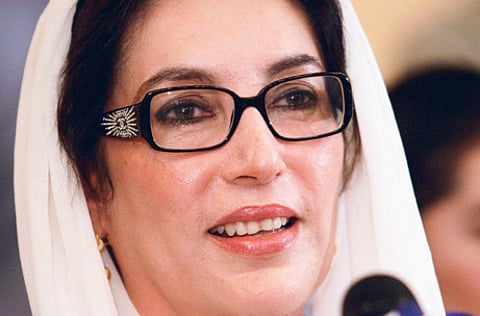
A Pakistani politician’s existence is fraught with life-threatening situations. In recent years, several high-profile politicians have been assassinated: former prime minister Benazir Bhutto in 2007, Punjab governor Salman Taseer and minority affairs minister Shahbaz Bhatti in 2011 being the cases in point. The dangerous trend has continued this month with the targeting of lower-profile candidates running for office in the May 11 parliamentary elections. In these instances, the Pakistani Taliban or other religious extremist groups were the perpetrators, choosing their targets for either “un-Islamic” secular and progressive values or their perceived cooperation with the US against Pakistani militants and in the war in Afghanistan.
Beyond the tragic loss of life, the assassinations have the added casualty of limiting the space within which Pakistani leaders can safely operate. Taliban attacks have pressured willing and able voices against extremism into silence on issues such as minority rights, girls’ education and trade with India — issues that Pakistani society must publicly debate in order to fully embrace and institutionalise them. Those who remain vocal do so at great personal and professional risk: Pakistan’s Ambassador to the US, Sherry Rahman, faces charges in Pakistani courts for her support of revisions to the blasphemy law.
In the context of the upcoming polls, even more worrisome is that the spectre of assassination and violence can affect the election outcome and potentially the representation of key Pakistani constituencies. Pakistani Taliban spokesman Ehsanullah Ehsan announced the group’s intention to target candidates and party workers affiliated with the ruling coalition’s Awami National Party (ANP), Pakistan Peoples Party (PPP) and Muttahida Qaumi Movement (MQM). ANP and MQM candidates and activists have already been injured or killed — fear tactics intended to directly handicap the ruling coalition’s chances of returning to power.
Another side-effect of the Pakistani Taliban’s killing spree is that specific pressure on ANP can skew the Pashtun vote. After the 2008 elections, many had high hopes for the secular party based in the Pashtun-concentrated Khyber Pakhtunkhwa province. However, even then, security threats from the Pakistani Taliban prevented ANP from fully taking advantage of the mandate the voters had given it. ANP was viewed as a potential counter to the influence of religious parties like Jamiat-Ulema-e-Islam (JUI), which swept national and provincial elections during the Pervez Musharraf years as part of a coalition of religious parties known as the Muttahida Majlis-e-Amal.
The Pakistani Taliban’s renewed targeting of ANP can improve the chances of religious parties who have, in the past, shared common ideological ground with them. The influence of religious parties has typically been downplayed, but what they are peddling may have a new buyer. A survey conducted by the British Council earlier this year revealed that 38 per cent of Pakistani youth surveyed believed Islamic law was better suited for Pakistan than democracy. However, the Pakistani Taliban has also threatened some religious parties, such as JUI, for cooperation with the federal government.
The real worry is not the return of religious parties, but the disenfranchisement of Pakistani Pashtuns, who may decide to stay at home on election day to avoid violence. This is the last thing the Pakistani state needs in a province that borders the ungoverned tribal areas and where the notion of a greater Pashtun homeland — ”Pashtunistan” — exists in spirit if not fully in practice. ANP also faces threats in Karachi, where the growing Pashtun population has become ensconced in the city’s gangland-style political culture. Any handicap for Karachi’s Pashtuns in the upcoming elections can also potentially worsen the security situation there.
The PPP, which led the previous government with ANP as a coalition partner, faces similar challenges in reaching voters. President Asif Ali Zardari has been reluctant to participate in large public rallies during this campaign and for good reason. The memory of the 2007 assassination of his wife Benazir, following a rally in Rawalpindi, is still fresh among the PPP leadership. Fears of assassination have kept Zardari out of the public eye for most of his term and now limit how much his son Bilawal Bhutto, the PPP’s heir apparent, campaigns on behalf of the party as well. Bilawal could have rallied the party’s base at a time when the PPP needed it the most. Besides the PPP stronghold of interior Sindh, nowhere else is the party guaranteed to dominate.
Voter outreach is especially critical in north and central Punjab, the traditional domain of the Pakistan Muslim League-Nawaz (PML-N) and where Imran Khan’s Pakistan Tehreek-e-Insaaf (PTI) has made inroads. Most elections analysts believe that if PTI can continue to tap into PML-N’s base of support, especially among urban educated youth, then PPP’s chances in Punjab will be inadvertently strengthened.
It can also benefit from the fact that the strength of PTI’s “tsunami” appears to be tapering off. If PPP can access voters who are falling off the PTI bandwagon, it can have a chance in chipping away at PML-N’s lead. However, PPP cannot rely solely on PML-N’s failures or PTI’s wane.
For the time being, Pakistani Taliban threats continue to keep the most influential PPP politicians far from Punjab where it matters the most. Even more tragic is the possibility that ANP will be forced to boycott the elections. While much of the election focus has been on the historic political transition afoot in Pakistan, the threats serve as a reminder of the tough road ahead for whoever manages to survive and come out on top.
— Washington Post
Shamila Chaudhary is a South Asia analyst at the Eurasia Group and a senior fellow at the New America Foundation. She served as director for Pakistan and Afghanistan at the White House National Security Council from 2010-2011.


