Return to the path of non-violence
As we get stuck in the vortex of wars and aggression, we need to reflect on the peaceful means of voicing our opinions and demands
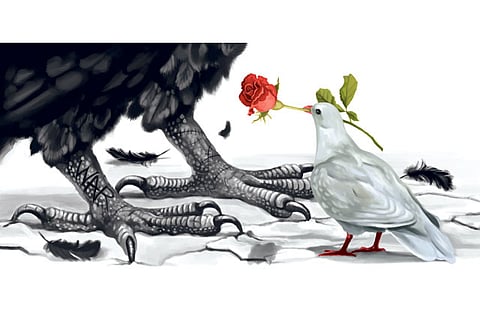
An eye for an eye makes the whole world blind — Mahatma Gandhi.
Non-violence is the most misunderstood concepts of today's world and look at the consequences. Countries are fighting wars to achieve peace! The outcome of this form of peace is death, anger and more people who want revenge leading to another war. Therefore it results in a vicious cycle of grief-anger-violence that wreaks havoc on innocent millions. It appears our knowledge-based civilisation is stepping back to the Bronze Age when these wars were the norm.
What is pacifism?
Pacifism is an active form of protest against wars, injustice and violence in an organised manner using non-violent means. It is the only alternative to war. It takes more courage to non-violently confront an armed person or angry mob. It is effective but takes time, work and patience. The results are always better than a war with many casualties and bitter memories that fuel revenge.
Pacifism has taken many forms in modern history. Refusal to work and wear foreign clothes and demanding freedom as Gandhi and his fellow Indians did against the British was pacifism in practice. When Rosa Parks refused to move from her seat, this was another pacifist protest. This resulted in the boycott of buses by African Americans in the 1960s demanding de-segregation of buses — another act of pacifism. The worldwide boycott of South African goods when South Africa practised apartheid is a pacifist act. The anti-war demonstrations around the world before the US and UK invasion of Iraq were pacifist acts. The reason the anti-war protests failed was due to the non-elimination of the fear and economic factors.
Origin and types
Many assume that the origins of pacifism lie in the Bible and "turn the other cheek" but the real origin of pacifism lies in the teachings of Buddha in ancient India. Buddha and his disciples used silence and non-cooperation as forms of protest when they were confronted with threats or bodily harm. Later, Confucius and other philosophers advocated this form of protest. All religions advocate pacifism.
Pacifism can be divided into two, namely, absolute pacifism and relative pacifism. People who follow absolute pacifism are against all wars and violence irrespective of who, where or when they take place. Absolute pacifists totally bar the use of force and rely on moral persuasion. They assume non-violent defiance will end with the aggressors being affected by divine intervention and will be forced to change or face hell when they die. Absolute pacifism has a religious connotation and is advocated by several religions.
However, relative pacifism as the name implies doesn't totally rule out force. In this, force is permitted in self-defence when attacked by another nation but not providing help to nations being attacked! This is because relative pacifists claim it will result in the formation of rival alliances, making the world a more dangerous place. Relative pacifists encourage passive resistance instead of expecting divine intervention against the aggressor. This usually takes the form of civil disobedience movements by a large number of people. Relative pacifism is devoid of religious context as it is a people's movement.
Relevance of non-violence today
We live in the age of weapons. Many countries take pride in the destructive force of the weapons they have or build — nuclear, biological, etc. Every day, the military-industrial complex is producing new weapons or upgrades of older ones. We have more military bases than shelters for homeless. However, more people die from hunger everyday while governments concentrate on acquiring the latest military technologies!
Religious zealots worldwide — be it Buddhist fundamentalists in Sri Lanka, Hindu zealots in India, Muslims fundamentalists in Asia, Christian zealots in North America and Europe, Jewish fundamentalists in Israel etc. use violence. They are doing this in the name of the very religion which forbids violence! That this is happening worldwide isn't surprising as pacifism is scorned today. However, some famous pacifists are Buddha, Jesus, Hajar, Mahavir, Guru Nanak, Tolstoy, Khan Abdul Gaffar Khan aka Frontier Gandhi, Martin Luther King Jr., Vida Goldstein, Dalai Lama and Aung Sang Sui Kyi.
Gandhi said, "Non-violence is the law of our species as violence is the law of the brute. The spirit lies dormant in the brute and he knows no law but that of physical might. The dignity of man requires obedience to another law — to the strength of the spirit." Looking at our world today, one will realise pacifism is more necessary than ever before.
For those who say they aren't a violent people, re-examine your premise for all are practising double standards in violence. If a teacher hits a child, we object and make the other apologise. If a woman is attacked, we object to the violence. However, we cheer on when our governments or militant organisations commit acts of violence in the name of freedom and justice! We cannot have double standards on violence. We are stuck in the vortex of violence. Let us all resolve to make non-violence the world ideal starting this decade.
Deepa Kandaswamy is an award-winning writer, political analyst and author based in India.


