Oil at $200: Still a real risk — or a market myth?
Prices surge on geopolitical fears, but markets still lack signs of a true supply shock
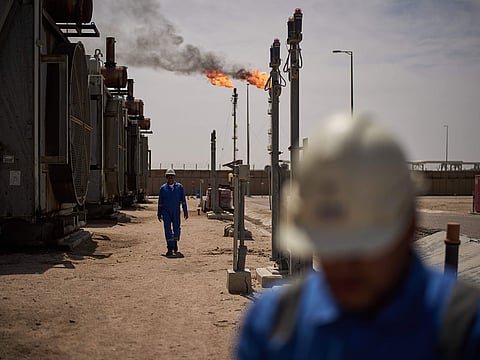
Dubai: Just weeks ago, the idea of crude oil surging to $200 per barrel moved from fringe speculation into mainstream discussion. Analysts began floating extreme scenarios. Policymakers quietly modeled them. Markets, briefly, seemed willing to entertain the possibility.
Today, with Brent hovering near $100 and WTI closer to $90, that narrative looks far less certain. So what changed? And more importantly, was $200 ever realistic?
Gap between fear and price
Oil has rallied sharply since late February, with West Texas Intermediate gaining around 30% and Brent rising nearly 40% to just above $100. That is a significant move in a compressed timeframe.
Yet even after that surge, prices remain far from the levels implied by the most aggressive forecasts. History offers perspective. In inflation-adjusted terms, crude has only reached the equivalent of $200 once in the past half-century — on the eve of the 2008 financial crisis.
That episode required a unique combination of tight supply, surging demand, and financial excess. Today’s market looks very different. Prices are elevated, but they are not signaling systemic scarcity.
What it would actually take
The current oil market is being driven less by fundamentals and more by geopolitical risk. At the centre of that risk sits the Strait of Hormuz, a corridor through which roughly a fifth of global oil supply moves.
Any sustained disruption there would reshape the market overnight. But that is not what is happening — at least not yet. Instead, prices are reacting to the possibility of disruption. Headlines about diplomacy push prices lower. Rejections of those efforts send them higher again. This pattern reveals a market that is pricing uncertainty rather than a confirmed supply shock.
To move toward $200, the situation would need to escalate far beyond what is currently visible. It would require a prolonged and verifiable interruption to flows through Hormuz, removing a meaningful share of global supply in a way that cannot be quickly replaced. That threshold has not been crossed.
Driven by headlines, not conviction
Recent price action makes this clear. The same market that sold off on hopes of a US-backed peace plan quickly reversed when Iran dismissed progress. That kind of behaviour reflects fragility.
This is not a market building a sustained trend. It is a market reacting in real time to shifting narratives. Such conditions create volatility, but they do not create the kind of conviction needed to drive prices toward extreme levels. A move to $200 would require sustained positioning built on a widely accepted view of structural shortage. What exists instead is hesitation.
Stress-testing is not forecasting
Part of the recent momentum behind the $200 narrative has come from reports that officials are examining what such a scenario would mean for the economy. Within the Trump administration, discussions around extreme price outcomes have been framed as contingency planning rather than expectation.
That distinction matters. Governments routinely model worst-case scenarios during periods of instability. These exercises are designed to test resilience, not to signal likely outcomes. Markets, however, often blur that line. The act of preparing for a shock can be mistaken for an implicit prediction of it.
Built-in limit: Economic reality
Even if geopolitical risks intensify, oil prices face a constraint that is often overlooked. At sufficiently high levels, oil begins to undermine itself. Bloomberg Economics estimates that prices around $170 sustained for several months would push inflation higher across major economies while simultaneously slowing growth.
At $200, those effects would become more pronounced. Higher energy costs feed directly into production, transportation, and consumer prices. That pressure erodes demand. Growth slows. Consumption weakens. The very conditions that drive prices higher begin to reverse them. This feedback loop acts as a ceiling. Not an absolute one, but a powerful constraint.
Why prices remain elevated
Despite the pullback from recent highs, oil is still trading at levels that reflect a meaningful risk premium. The market continues to factor in the possibility of escalation, particularly around shipping routes and regional stability.
That premium explains why prices remain elevated relative to historical averages. It also explains why volatility persists. Traders are navigating a landscape where outcomes are unclear and timelines uncertain. But pricing risk is not the same as pricing catastrophe.
So, is $200 still realistic?
It remains possible, but only under conditions that are not currently in place. A sustained supply shock, a clear and prolonged disruption to key transit routes, and limited capacity for global producers to offset losses would all be required.
As of Thursday, March 26th, the market is not operating under those assumptions. Instead, it is caught between competing narratives — de-escalation on one side, disruption risk on the other. That tension produces sharp moves, but not a clear trajectory.
The more useful question is not whether oil can reach $200. It is how far current conditions are from the kind of breakdown required to get there. Right now, that distance remains considerable.


