Lebanon in a perpetual gridlock
Citizens caught in this dizzying quagmire dawdle as best as they can
Beyond Lebanon’s traffic gridlock, which redefines driving as a near-suicidal chore and reflects what ails this society in more ways than one, a political quandary preoccupies elites that strive on making secret deals. Most engage in closely held agreements on major concerns, participate in selective dialogues, advance sectarian arguments that reinforce the post-1943 confessional system, and otherwise assume that doing so helps themselves as well as their respective communities. Why do these elites treat Lebanon as a private farm even if they pretend to be pseudo-Parisians?
In many ways, Lebanon is a mystery, and for analysts who delve on its complex socio-political mechanisms, frustratingly impenetrable. One can read local newspapers, watch television programmes, attend political rallies and otherwise hold a conversation with a Lebanese but none of these will help. What appears in print is not yellow journalism—for there is a good deal of professionalism involved in the process — but a series of colors ranging the gamut from blue for the Future Movement, to orange for the Free Patriotic Movement (FPM). Every political group boasts a television station, all highly proficient, yet hugely biased. One would hardly hear a positive declaration on Al Manar [Hezbollah] about the Lebanese Forces (LF) and though MTV or Al Mustaqbal [Future] programmes feature Hezbollah representatives in various programmes, their editorial line are decidedly pro-LF in the case of the first and pro-March 14 in the case of the second. All nine local networks are beholden to their financial backers, and though few if any make money despite a nauseating avalanche of advertisements, each prides itself on its skewed agenda.
If media outlets monopolise the relatively short attention span for a percentage of the population — most Lebanese claim they do not follow any news but, miraculously, everyone knows everything at all times and, an added marvel, can speak with ecclesiastical authority on any subject — what truly stands out are regularly scheduled rallies that are the envy of history’s wannabes. Hezbollah leaders speak to mesmerized masses, hold weekend rallies to commemorate this or that event, and otherwise time their carefully targeted pronouncements to coincide with news cycles. The LF, FPM, Phalange, Future, Amal, and the Progressive Socialist Party (PSP), to name just a few, perform at similar rallies where stale declarations are repeated to vetted partisans who widely cheer and applaud, oblivious to how little any of the prose add value to their lives, creates wealth, and improves their economic standings.
At best, and sadly, what these circus acts evolve into are pure forms of entertainment. Of course, they would be hilarious if the fate of the country did not hang in the balance, and tolerable if the Lebanese had alternatives. In fact, the fragile political system is on the verge of collapse, with no alternatives that will maintain the unity of the country. As in similarly situated societies, where some freedoms exist and the bulk of society generates wealth, Beirut lingers even if the two principal poles drag it to their respective corners of the ring. March 14 wants to apply the Constitution as amended in the 1989 Taif Accords that temporarily ended the Civil War, while March 8 desires to call for a new tripartite power-sharing formula between Christians, Sunnis and Shiites, dubbed the Thulathiyyah [Trisection] Accord. Both of these propositions are nearly impossible to achieve under current circumstances even if all political tenors insist on the veracity as well as their impeccable value of their versions. All affirm the principle of “mutual coexistence” (Al ‘Aysh Al Mushtarak) between different sects though few work to implement it. Every politician raises hope that he will prevail without creating the environment that allows for co-existence to flourish and security to anchor.
Citizens caught in this dizzying quagmire dawdle as best as they can. Despite seven decades of mayhem mostly created by corrupt elites that had no qualms to fight other peoples’ wars, or to pit citizens against each other, the Lebanese managed to achieve a US$10,000 per capita gross domestic product in 2014. Amazingly, the estimated five million Lebanese accomplished this feat while hosting over three million refugees, predominantly Palestinians and Syrians. Moreover, and perhaps equally critical, they achieved this economic miracle despite perpetual chaos and the lack of security.
Still, in early 2015, Lebanese elites pretended to talk with each other, although little changed on the ground. Two dialogue poles, one between the FPM and the LF, and the other between Future and Hezbollah have now foundered over the presidential election deadlock. A few days ago, General Michel Aoun, the putative March 8 presidential candidate, met with Speaker Nabih Berri allegedly to start examining an alternative candidate now that the Aoun-Samir Geagea rapprochement produced no changes and were unlikely to alter strongly held views. Geagea, the March 14 aspirant, vowed not to withdraw from the presidential race if Aoun remained in it, but was ready to desist if they could agree on an alternative name other than the PSP’s Henri Helou whose last-minute candidacy threw-in the proverbial monkey-wrench and guaranteed the current nearly year-long vacancy.
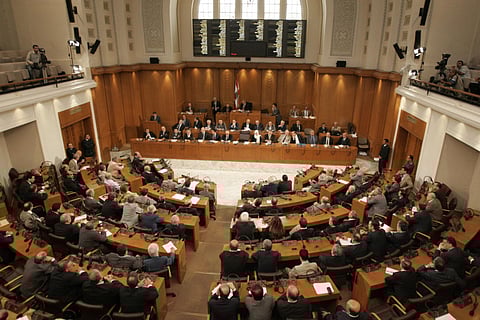
Yesterday, parliament was convened for a 20th attempt to elect a successor to former president Michel Suleiman, whose six-year term ended on May 25, 2014, though lame-duck politicians — who cavalierly extended their own term in office — were in no hurry to fulfill their constitutional duties. Whether a secret deal would be ready by then is anyone’s guess though what was a near certainty is the lack of trust among the Lebanese. No wonder then that the gridlock is the only sure thing left that unites political elites.
Dr Joseph A. Kechichian is the author of Iffat Al Thunayan: An Arabian Queen, London: Sussex Academic Press, 2015.


