Lebanese Miss USA exposes contradictions
Many Arab Americans see Fakih's win as a welcome breakthrough, while some denounce it as an Islamist plot
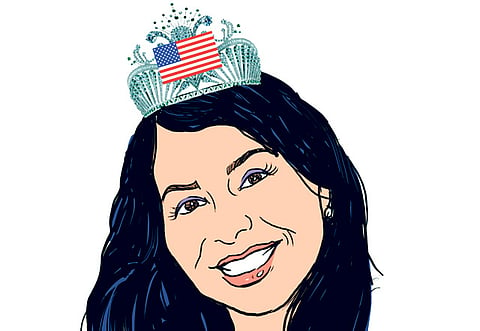
When beauty contests mix with geopolitics, things can get rather ugly. This was demonstrated last weekend by the crowning of Rima Fakih as Miss USA, the first Arab-American and Muslim to win the title.
The 24-year-old who moved to the United States from her native Lebanon in the early 1990s was understandably proud to become the crowned figurehead of American beauty for a year. She, her family and many Arab-Americans also hope her victory will give her embattled and distrusted community a much-needed facelift.
"My father always says, ‘You don't know who you are until you know where you come from'. I believe in that," Fakih says.
Her brother, Rabih, believes his sister challenges prevalent western stereotypes of the Muslim woman: "This will show the good part of Arab-Americans. A lot of people think this area of the world is only about people being covered".
The western image of Muslim women is largely shrouded in the veils — in the form of hijabs, niqabs and burqas — of a grand patriarchal cover-up.
Hardly surprising
Less widely covered or known is the fact that, despite the objections of conservative Muslims, many Arab and Muslim countries run beauty contests of a similar ilk to their western counterparts. In some ways it's hardly surprising that the first Arab-American Miss USA — which I've discovered is actually different from Miss America — should happen to be Lebanese.
Lebanon is a country where glamour and beauty are a major export industry in the form of sexy singers, both female and male. As a sign of this, its own Miss Lebanon title comes with a $500,000 (Dh1.8 million) prize and, in Rima Fakih's words, elicits a kind of "Superbowl" fever among Lebanese.
Other Arab and Muslim beauty contests include Miss Egypt and Miss Indonesia, not to mention the less racy but more inclusive — in terms of dress and dress size — Miss Arab World. Beauty contests were even used as a propaganda tool by Saddam Hussain, with the 2000 crown won by his 15-stone niece.
Pros and cons
I am of two minds about the value of beauty contests. On the one hand, they reflect the misogynistic objectification of the female body — even if we do have a few male equivalents nowadays. On the other, celebrating physical beauty is often just innocent fun in the eyes of its beholders and people should be proud of their bodies. The trouble here is the ever-narrowing definition of what constitutes beauty and how this can trigger low self-esteem, eating disorders and other psychological problems.
And when it comes to Muslim women, beauty contests, despite their tedious superficiality, can be a form of empowerment.
At another level, this challenges the easy and lazy stereotypes that anti-Muslim bigots depend on for their demonisation. And Fakih's victory has left the influential outer fringes of the conservative right in something of a pickle: they don't like it that an Arab and Muslim has won but are having trouble forming a coherent case against her, so instead they have resorted to bizarre conspiracy theories.
Daniel Pipes, a neocon intellectual closely linked to the former Bush administration who compiled a list of five other Muslim winners of beauty contests on both sides of the Atlantic (mostly minor ones, including Miss Nottingham 2005), asked whether this was "an odd form of affirmative action".
Conservative commentator Debbie Schlussel pulled out all the stops, using Fakih's Shiite Lebanese background to brand her a terrorist "Miss Hezbollah" and dismissed the colourful business magnate Donald Trump, who is one of the sponsors of the event, as an Islamic dhimmi.
"Mark my word. Hezbollah is laughing at us, tonight," Schlussel raged. And why? Obviously, because "one of its auxiliary members won the Miss USA title without having to do a thing to denounce them and their bloody murder of hundreds of Americans".
Schlussel does not provide details of Fakih's alleged Hezbollah connection, except to quote unnamed "intelligence sources" who apparently confirm that some of her family members are linked to it. But, given the fact that, in addition to its armed wing, Hezbollah is a large political party, social service provider and the de facto government of the predominantly Shiite south, the vast majority of Lebanese Shiites — and even many Sunnis and Christians — are inextricably tied with the party. In fact, this is even less meaningful than saying an Israeli has links with the Israeli army, as pretty much all Israelis, even pacifist peace activists, have family ties with the country's military.
I very much doubt that, despite the venom of Schlussel and other conservatives, that Fakih feels threatened in the United States. She strikes me as a young woman who loves her adoptive and native homeland and wishes to act as a cultural bridge between the two.
Khaled Diab is a Brussels-based journalist and writer.


