India's new BJP chief: A generational shift, delivered quietly
Why Nitin Nabin’s elevation signals total command of the BJP
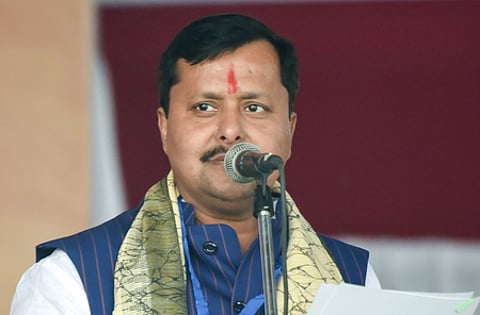
Let me be honest on behalf of my profession: no one in the media — not even the embedded Panna Pramukhs (those servile to the government) — had a clue when Nitin Nabin, 45, was nominated as the new BJP (working) president, replacing long-serving J.P. Nadda.
Nabin, a five-term MLA from Bihar who is an upper-caste Kayasth, is a low-profile Minister of State in Gadkari’s transport ministry. So low-profile, in fact, that a large section of BJP cadre, leaders and the media had to collectively make Google their best friend when his appointment was announced.
As a courtesy, Mohan Bhagwat, Rashtriya Swayamsevak Sangh (RSS) chief, was informed in advance by Amit Shah that Modi had taken the call on Nabin, excluding the old guard. The RSS would have preferred a president who could stand up to the powerful duo of Modi and Shah, but that is not likely in the foreseeable future.
The appointment of Nabin after a protracted delay is a signifier of many things. First, of course, is the Modi–Shah politics of total domination. Many had written off Modi when he failed to secure an absolute majority in his third term, arguing that he would now be dependent on allies and would have to allow the RSS a significant say in running both the government and the BJP.
A normal leader would have tried to placate the RSS by including it in the power-sharing arrangement and letting it have its choice as party president. Modi did not blink. Nadda was allowed to continue as president, no concessions were made to allies, but Modi did publicly acknowledge the RSS with some affection that had been missing in his first two terms. He visited the RSS headquarters in Nagpur and paid near homage to the organisation in his Independence Day speech, calling it the world’s largest NGO.
Generational change
Modi waited until the BJP won the Maharashtra, Haryana, Delhi and Bihar elections in alliance, effectively shutting down the naysayers’ chatter and getting his political mojo back. He made it clear that the choice of BJP president would remain his — hence Nabin. Modi also sought to put the remaining senior leaders of the BJP out to pasture, an unspoken induction into the infamous Marg Darshak Mandal. Nabin, at 45, signals a generational change in the BJP, while Mallikarjun Kharge, president of the Congress, is 80.
The BJP under Modi and Shah has made this transition with clinical ease for one simple reason: they win elections for the BJP and the larger Sangh Parivar, which is currently enjoying the ascendancy of its dreams as it is now the official establishment in India.
Consider Modi and Shah’s choices of new leaders in the states. Modi first appointed Manohar Lal Khattar, an RSS pracharak, in Haryana. Khattar, himself a relative unknown, was later replaced by another relatively unknown figure, Nayab Saini. This pattern continued with Mohan Sharma in Madhya Pradesh, Bhajan Lal Sharma in Rajasthan, Vishnu Deo Sai in Chhattisgarh, Mohan Charan Majhi in Odisha, and Rekha Gupta in Delhi.
Loyalty to the leadership
By passing over established mass leaders such as Shivraj Singh Chauhan in Madhya Pradesh and Vasundhara Raje Scindia in Rajasthan, a clear signal was sent to BJP cadre that a generational shift had occurred. More importantly, these low-profile leaders, plucked from relative obscurity by the powerful duo, owe their complete loyalty to Modi and Shah. While their performance as chief ministers — like most of Modi’s successors in his home state of Gujarat — has been lacklustre, loyalty to the leadership makes up for it.
All these next-generation BJP leaders are accountable primarily to Modi, not to voters. Modi has also, through the appointment of Draupadi Murmu as the first tribal woman President, kept his beloved optics intact, signalling the transformation of the BJP from a largely upper-caste party to one projecting inclusivity through leadership selection and welfare schemes.
Message to Bihar
Nabin’s appointment as president also sends a message to Bihar that the BJP is ready to lead the alliance government and aims to form its own government in the state in the next round. This is the BJP effect on allies — Maharashtra allies Eknath Shinde and Ajit Pawar would do well to proceed with caution.
The BJP under Modi and Shah is perhaps the most formidable election-winning machine India has ever seen, with a war chest meant to intimidate rivals. Nabin will now take charge of this. Two things will be de rigueur for him: maintaining a compulsory non-controversial, low profile as a foil to Modi, and being guided by Shah in running the party.
The single exception to all this is Yogi Adityanath. The multiple-term chief minister of India’s most politically powerful state, Uttar Pradesh, watches the goings-on in Delhi from his perch in Lucknow. Yogi is biding his time.


