India, Pakistan break deadlock
The landmark meeting in Maldives between Singh and Gilani has raised hopes of improvement in relations between the neighbouring nations
We are back full circle to a proposal long familiar to the people in India and Pakistan: keep business separate from Kashmir. There was a time when Pakistan would refuse to have any trade with India until Kashmir was solved. New Delhi would say that it was not opposed to a solution of Kashmir, but the starting point should be business.
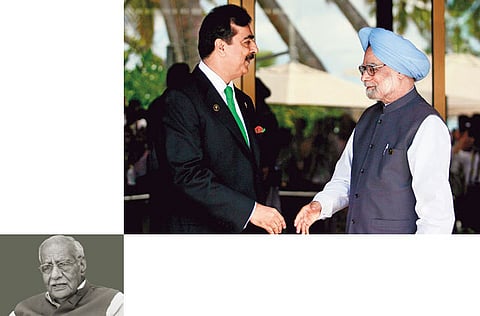
The meeting between Prime Ministers Manmohan Singh and Yousuf Raza Gilani broke the deadlock and Pakistan did not underline Kashmir as the core problem. As Pakistan foreign minister Hina Rabbani Khar said after returning from Maldives that Pakistan would "bend backwards" to be friendly with India. This is a welcome development, not only for the two countries but also for South Asia. Nothing in the region would move because the estrangement between India and Pakistan cast its shadow on any joint step forward. Islamabad should be complimented because it moved away from its old beaten path.
Whatever Pakistan's compulsions — the army is on board — it is a bold step which can lead to the normalisation of relations between India and Pakistan. Singh's decision not to link trade with the sentence to the terrorists, who are being tried in Pakistan for the attack on Mumbai three years ago, is courageous at a time when his own stock is not high.
The Indian media is critical and the hawks are even abusive. But they represent a minority which sees everything in Pakistan in the negative. They do not want Pakistan to fall apart but they continue talking about punishing Islamabad. Their outlook tallies with India's main opposition party, the BJP. And left to both, any breakthrough with Pakistan will be considered anti-national.
Collecting evidence
The Pakistan media may be a shade better. But it too does not rise from the parochial angle it has followed for decades. The murder of former Punjab governor Salman Taseer at the hands of fanatics has silenced even the boldest liberals.
Relations between India and Pakistan have to evolve and be tended to carefully. India's grievance of Pakistan not yet punishing the perpetrators of the Mumbai attacks is genuine. No explanation by Islamabad is convincing.
Yet it has a point when it says that the evidence which India has provided is too weak to get favourable verdict in court. Now that Pakistan's judicial committee is coming to India, it should collect as much evidence as it wants. The case must move forward. And Singh is quite right when he says that another Mumbai may lead to unforeseen consequences. New Delhi will expect that Islamabad does not allow cross-border terrorism. Joint mechanism to eliminate terrorism was supposed to be set up a few months ago. But the proposal remains on paper. The mechanism when established should also visit the sites where terrorists are reportedly trained and armed.
When it comes to trade, New Delhi will have to ensure that there is a level-playing field for Pakistan. The balance of trade will be one indication. If Pakistan's exports are too small compared to Indian exports, doubts may surface about New Delhi's bona fides. True, the list of items would be prepared. But India can ask Pakistan which goods it can conveniently export to India so that there is no room for grievance or discrimination. Maybe, some of the tariff concession New Delhi has offered to Dhaka can be extended to Islamabad.
India's aim should be how to develop Pakistan economically so that it is not dependent on US for assistance. This will ultimately stop foreign interference in the affairs in the region. Pakistan, on its part, should open the country to India's investors. If they can buy large concerns in the UK or the US, they should be able to do so in Pakistan as well. There may be joint ventures between India and Pakistan.
It is understandable that the Pakistan government is under great pressure not to keep Kashmir apart. But there is no doubt that trade between the two countries will generate so much goodwill that a solution of Kashmir may become easy. After all, the governments on both sides did arrive at some understanding on Kashmir.
Once when Nawaz Sharif was the prime minister in Pakistan, the coup by General Pervez Musharraf stalled the solution. The remark by then prime minister, Atal Behari Vajpayee, was: "We were almost there." The second time when Musharraf brokered a solution and was on the verge of inviting Singh for signing the agreement on Kashmir, the lawyers' agitation changed the scenario.
My advice to civil society in Pakistan is that it should speak out. I have not seen a single voice of concern for the judge who sentenced the killer of Taseer. The judge had to disappear after doing his duty because he knew that neither civil society nor the government would come to his rescue.
Kuldip Nayar is a former Indian high Commissioner to the United Kingdom and a former Rajya Sabha member.


