India: Kejriwal’s AAP faces a fading future
Once hailed as a political disruptor, the party now finds itself directionless and divided
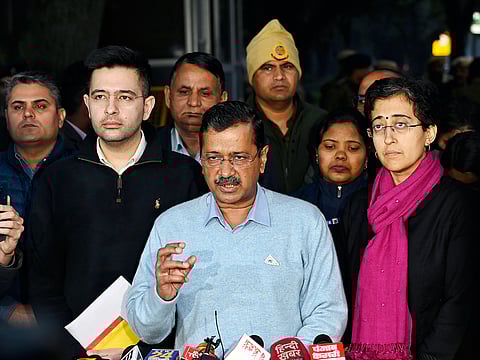
The Aam Aadmi Party (AAP), India’s most successful startup, is on the verge of implosion.
Consider these facts. The AAP has 11 Members of Parliament in the Rajya Sabha (Upper House). Of these, Swati Maliwal once seen as AAP supremo Arvind Kejriwal’s closest political aide, has publicly broken links with the party and called him names after she alleged he got her beaten up at his official residence by his personal assistant Bhibhav Kumar.
Raghav Chaddha, the party’s Punjab-in-charge, is now all set to do a stint in public leadership at the Kennedy School of Government in Harvard University. Chaddha could have learnt real life leadership chops if he had continued to battle for his party as it faces an existential crisis after its crippling loss in Delhi. But Chaddha had earlier stayed away for weeks in London when Kejriwal was arrested and sent to jail.
Chaddha had at that time said he was getting his eye “treated” in London - a luxury very few Aam Aadmi (commoners) have in India.
Harbhajan Singh, the cricketer who Kejriwal sent to the Rajya Sabha, has not even bothered to campaign for the party, let alone do any work for the party inside and outside Parliament.
Ashok Kumar Mittal, another leader sent to Parliament by Kejriwal, has been signalling his anger and rebellion for a while. Almost a year ago it went unnoticed when he withdrew his amendments to the Financial Bill on the floor of the House. The official proceedings of that incident on video is with Gulf News. Mittal went a step further and said he was satisfied with the Modi government’s actions. Surely quite a first for an opposition party.
In his initial years, Kejriwal had nominated two businessmen called “Gupta brothers” (though they are not related) to the Rajya Sabha causing much heartburn among AAP’s activists and workers who naively believed in Kejriwal’s promise that he would reward them.
Narain Dass Gupta and Sushil Kumar Gupta have virtually made no impact in Parliament despite being members since 2018. They have never defended Kejriwal on the floor of the House or attacked and criticised the Modi government. They have, however, been signatories to letters of the opposition asking for impeachment sent to the President. Now the opposition finds that they refuse to sign such letters. During a walkout from the House this session, Gupta kept sitting with the treasury benches signalling publicly his intent of having nothing to do with the opposition.
Writing on the wall
If six out of 11 Rajya Sabha MPs publicly establish that they want nothing to do with AAP and the opposition, then the writing is on the wall as far as where the party is headed.
None of this will come as a surprise to my beloved readers who have been following the implosion of AAP and the morphing of Kejriwal into all that he deprecated for a while now. You knew that AAP was losing Delhi three months before the polls. I kept writing about Kejriwal and his grandiose Sheesh Mahal as he became the leader he was crusading against when he entered politics.
Even now as he does his annual “Vipasana” retreat secluded in a Punjab ashram where he was given a security and VVIP “bandobast” befitting a sitting CM rather than a defeated MLA, Kejriwal has learnt no lessons. AAP currently runs the government in Punjab and Kejriwal is heavily dependent on it for the VVIP luxuries he is dependent on.
Meanwhile, the AAP is abuzz that when Kejriwal returns from his retreat he will ask one of the party Rajya Sabha MPs to resign to make way for him in the Upper House. Apparently the dispute with Maliwal arose because Kejriwal was upset that she had chosen to be away for months in the US with her sister rather than support the party when he was sent to jail. Maliwal flatly refused to quit saying that she deserved to be in the House because she had struggled to set up the party.
Poor judgement and leadership
The implosion of the AAP in the House reveals Kejriwal’s poor judgement and leadership. Rather than rewarding those who had struggled to set up the party with him, he first threw out the original founders - public interest litigator Prashant Bhushan and activist Yogendra Yadav - and then surrounded himself with a coterie of yes men.
One of the few leaders who remain completely loyal to AAP is Sanjay Singh, another MP in the Rajya Sabha. But, says a senior AAP leader, “see how Kejriwal treats him and Manish Sisodia who both went to jail for him. They are simply taken for granted and expected to defend all his hypocrisies”.
Another important takeaway from the near end of AAP is how ideology is the glue that holds parties together in the time of total adversity. The Left in India is a dying force, but you don’t see their members defecting to other parties. AAP prided itself on being “ideology agnostic”, speaking the language of freebies and competing with the BJP when it came to Hindutva as a “saffron lite” version. Now it finds itself outgunned on promised freebies (the expectations always rise) and voters embracing the real thing - Hindutva.
Kejriwal never spoke a word when students in Jawaharlal Nehru university and Jamia were attacked by the central government and the police beat them up. The Citizen Amendment Act (CAA) minority protests in Shaheen Bagh saw him take the line that he would clear the protest site in an hour because it was an inconvenience to commuters. The Muslim voters of Delhi felt orphaned by the AAP.
The BJP has been extremely keen to finish AAP and now Kejriwal’s questionable choices seem to have done the work for them as yet another opposition party bites the dust.

Swati Chaturvedi is an award-winning journalist and author of ‘I Am a Troll: Inside the Secret World of the BJP’s Digital Army’.


