How to build a Democratic majority that lasts
The appeal of persuasion is easy to see, when Trump’s toxic language is so extreme that Hillary may well make inroads with swing voters
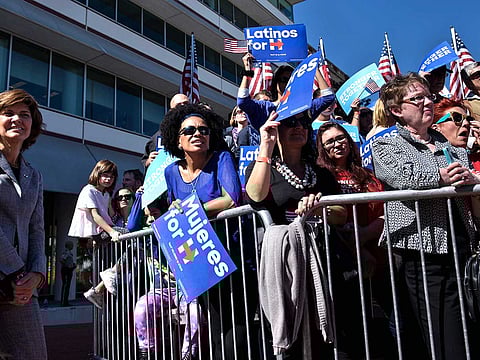
The demographic revolution of the past 50 years has transformed the United States from a predominantly white country into a truly multiracial nation. People of colour have grown to 38 per cent of the population today from 12 per cent in 1966, and that metamorphosis paved the path to electing the first African-American president.
On November 8, Democrats have the chance to secure a decades-long electoral majority for decades, but they are at risk of missing this moment because too many consultants still stick to an outdated and ineffective campaign script that was written for a different, whiter era. Democratic spending is significantly misaligned with the pillars of the party’s electoral advantage and campaigns throw away millions of dollars on ineffective ads, while neglecting efforts to mobilise the rapidly-growing ranks of minorities.
The evidence about the formula for Democratic victory at the national level in America is overwhelming. When large numbers of voters — particularly minorities — turn out, Democrats win. When turnout plummets — as it did in mid-term elections in 2010 and 2014 — Democrats lose.
But the evidence has not translated to the actual practice of those who run and fund Democratic campaigns. The most critical decision campaigns have to make is how to allocate limited time and money between persuasion and mobilisation. Persuasion is aimed at those people who have a history of voting regularly and it generally takes the form of paid advertising, mainly on television. Mobilisation involves the more labour-intensive work of turning out infrequent voters by making phone calls, knocking on doors and driving people to the polls.
Most Democratic campaigns prefer to concentrate on paid ads. In 2012 and 2014, 80 per cent of outside spending on Senate races went to television ads. Since the end of the 2016 primaries, Democratic presidential candidate Hillary Clinton’s campaign and the “super PACs” (Political Action Committees) supporting her have spent $128 million (Dh470.78 million) on ads.
The appeal of prioritising persuasion is easy to see in 2016, when Donald J. Trump’s hate-filled language is so extreme and toxic that Hillary may well be able to make inroads with swing voters (although Trump’s September surge showed the limits of that approach).
But to win the White House and the Senate, a swing-voter-based strategy — which emphasises paid ads attacking Trump, rather than hiring workers to talk to and turn out voters — is the wrong approach. Moderate Republicans may be repulsed by Trump, but that does not mean they will vote against the incumbent Republican senators they backed in 2010.
The gross imbalance between investing in persuasion over mobilisation could potentially be justified if there were evidence showing the efficacy of paid advertising, but there isn’t. Studies looking at decades of election data offer the same conclusion: Paid ads do little to change voter behaviour. A recent study by political scientists Ryan Enos and Anthony Fowler looked at the impact of identical ads when broadcast into neighbouring areas. One area received, according to the authors, “traditional ground campaigning, such as door-to-door canvassing, phone calls and direct mail”, and the other didn’t. The study found that voters in the region that received direct contact had turnout rates 7 percentage points higher than the neighbouring region. (President Barack Obama’s average margin of victory in 2012 in the seven battleground states was 4 per cent).
Another problem: The target audience for ads, swing voters, is dwindling. A 2015 study by a Michigan State University assistant professor, Corwin Smidt, shows that voters are more polarised than at any time in the past 60 years, and just 5 per cent — about six million people in the 2012 electorate — are swing voters. By comparison, the number of eligible minority voters in 2012 who didn’t make it to the polls was more than 25 million.
Twenty years of research and individual campaigns have proved that mobilisation wins elections. For example, Representative Keith Ellison, Democrat of Minnesota, has consistently increased voter turnout in his congressional district over the past decade and he has done it by focusing on personal contact. His campaigns have deployed hundreds of volunteers to go door to door in apartment buildings in his renter-heavy district. He has also organised “Souls to the Polls” programmes in which black parishioners are picked up after church and driven to polling places.
A permanent, year-round system can be established in minority neighbourhoods for a fraction of the funds it takes to carpet-bomb voters with television ads. Lisa Garcia Bedolla, a professor at the University of California, Berkeley, and the author of Latino Politics, has developed a concept called the “civic web” that is a synthesis of the old-fashioned precinct captain model, modern-day social networks and culturally-specific community organising. Paid staff members, neighbourhood team leaders and block captains are part of a seamless network where the employees recruit and supervise volunteers — especially mothers, who are critical to building good voting habits in their families and communities.
The civic web leverages face-to-face social networks and emphasises long-term relationship building. In a battleground state such as Nevada — which Obama won by about 66,000 votes — Garcia Bedolla estimates, the civic web model could, by 2020, mobilise more than 100,000 additional Latino voters at a cost of $3.1 million. The Hillary campaign and its allied super PACs spent $2.5 million on Nevada television ads in June alone.
Making smart investments in mobilisation can tip the election in longtime battleground states like Nevada, Florida and Ohio as well as emerging battlegrounds like North Carolina, Arizona and Georgia.
In 2016, there’s still time to redirect resources to what we know works: Mobilising voters of colour.
— New York Times News Service
Steve Phillips, a senior fellow at the Center for American Progress, is the author of Brown Is the New White: How the Demographic Revolution Has Created a New American Majority and the founder of Democracy in Color.


