Evil in the fourth estate
Murdoch's publication was not engaged in journalism but was involved in what would appear to be criminal activity
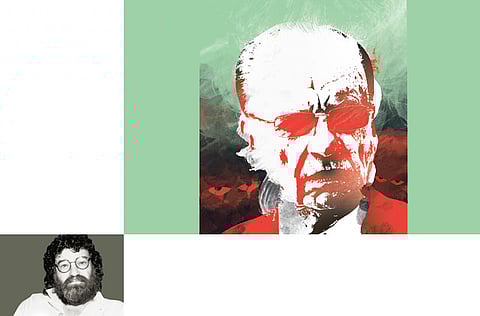
Yes, even the mighty fall, and how! Rupert Murdoch and his humongous media empire have not fallen flat — not yet — but they have fallen from grace, cut down to size for their excesses, arrogance and intrusive forays into the lives of private citizens and public figures.
We are familiar, if from a distance, with those men (more often men than women) whose acquisition of immense power, wealth and prestige in society imbues them with the seductive notion that they cannot be touched by the law, regardless of how they brazenly break it. Their sense of entitlement as, say, presidents, Wall Street magnates, politicians and international bankers, they feel, will shield them against legal retribution. Wrong. For every oppressor, as the Arab proverb has it, a day will come.
Former US president Richard Nixon missed out on going to jail by a hair for his role in the Watergate scandal after Gerald Ford, his successor in the White House, offered him a pardon. Michael Milken, the financier who broke every US securities law imaginable to amass an ill-begotten fortune, accepted a guilty plea in 1990 and served time behind bars. John Edwards, the former North Carolina senator and presidential candidate, was indicted for using campaign contributions to keep his mistress and their baby in hiding during the 2008 run for the White House. And more recently, Dominique Strauss-Kahn, former president of the IMF, whose case is still being adjudicated in court, was accused of attempted rape of a chamber maid in his hotel room in New York.
These men's abuse of power and betrayal of trust knew no bounds, presumably because they were convinced that their privileged status made them untouchable. It's a given, clearly, that a newspaper should pursue the news ‘without fear or favour', fear of government authorities or favour toward interest groups. When the New York Times, as a case in point, stumbled upon American ‘experts' in Guatemala, Florida and Louisiana in 1961 secretly training paramilitary groups for an invasion of Cuba, its editors felt that the right of the public to know trumped ‘national security', and reported the story on April 7, a week before Cuban ‘exiles' landed at the Bay of Pigs.
In a quest to protect the right of the public to know, newspapers can, indeed should, break boundaries. But Rupert Murdoch's ‘newspapers' were not engaged in journalism as professional journalists understood the term. The media mogul's publications were engaged instead in what would appear to be criminal activity: Alleged phone-hacking of innocent citizens, bribery of police officers, editors acting as lapdogs of instead of watchdogs over politicians they favoured, but hiring private detectives to obtain salacious information about politicians they did not like — and the rest of it.
We are told that in the wake of the Watergate scandal, after All the President's Men, by Karl Bernstein and Bob Woodward, was published as a book (that became a best-seller) and later turned into a movie (that made it big at the box-office), the number of students enrolling in journalism schools tripled. They all wanted to become investigative reporters who probed, exposed and made a difference in society. What better, what nobler, calling is there than to ferret out news and information that enriched the political, social and intellectual repertoire of your community? But that's all to do with being a professional newsman or newswoman working for a professional newspaper that pushed the boundaries of the journalistic enterprise in order to inform and edify, not cross the limits of taste — and the law — in order to titillate and scandalise.
American scoops
To be sure, the American media is not without its flaws. Consider the case of reporters fabricating or plagiarising stories: Janet Cooke, say, at the Washington Post who, in 1980, wrote a gripping, Pulitzer Prize-winning story, called Jimmy's World, about an eight-year-old heroin addict living in the city's ghetto — except the story was the product of a fertile imagination. Or that of Jason Blair, a national correspondent for the New York Times who filed plagiarised reports — datelined, say, Houston, Texas — that he had cobbled together on his laptop while sitting in a New York city bar. And Dan Rather, the influential CBS anchorman who went out on a limb to report a story, that turned out to be total bunk, about President George W. Bush's military service record. But of course, the mother of all booboos were the news reports filed by the New York Times star reporter, Judith Miller, on the eve of the Iraq invasion, which appeared on the front page day after day, affirming that Iraq possessed weapons of mass destruction.
But for a newspaper to be brought low by a fabricator or a plagiarist is a far cry from hacking into the phone of a murdered school-girl.
It's not enough that the myth of Rupert Murdoch, who made and broke political careers at whim and at will, and that his media empire, which spanned both sides of the Atlantic, has been deflated. If criminality is involved here, as appears likely, the courts should intervene. Long after Murdoch has been cut down to size, as surely he will be, the wounds he has inflicted will continue to hurt. The evil that men do, as the bard put it, lives after them.
Fawaz Turki is a journalist, lecturer and author based in Washington. He is the author of The Disinherited: Journal of a Palestinian Exile.


