Electorate repudiates government’s policies
It is the first time, since the beginning of the Fifth Republic in 1958, that a president trying to win a second mandate failed to beat his challenger
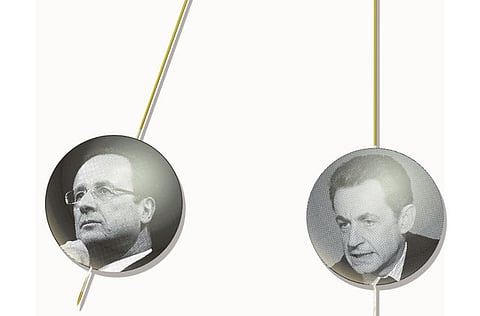
The French people cast their votes on April 22 in the first round of the presidential election. Two candidates will run in the second round: Francois Hollande, leader of the Socialist Party, and the current president Nicolas Sarkozy, supported by his rightwing party, l'Union pour la Majorite Presidentielle (UMP).
What are the lessons of this election so far? First, the turnout was very high, around 80 per cent, contrary to what many commentators and pundits had expected. This is confirmation of the central place of the presidential election (‘the queen of the elections'), which decides France's main orientations over the next five years.
The second lesson is that Hollande, with 28.63 per cent of the votes, came in ahead of Sarkozy with 27.18 per cent. It is the first time, since the beginning of the Fifth Republic in 1958, that a president trying to win a second mandate fails to beat its challenger. This is a clear sign of the French electorate's rejection of Sarkozy, and above all a repudiation of his government's policies — especially economic and social, and the high unemployment they have brought. Indeed, Sarkozy was known as "le president des riches" (president of the wealthy). But there was also a resounding ‘non' to his personal behaviour. For many French people, Sarkozy has discredited the presidential role (there was one particularly symbolic incident in which Sarkozy insulted a demonstrator in front of the television cameras).
The third lesson, of course, is the result of Marine Le Pen, daughter of Jean-Marie Le Pen of the far-right National Front party. Her result, with 18 per cent of the votes, is not that different from the votes her father won before her in the 2002 presidential election (more than 16.8 per cent, another candidate of the far-right won 2.3 per cent), but it is far more then Le Pen Senior's result in 2007 (10.44 per cent). Why this difference? In 2007 Sarkozy ran a dynamic campaign and defended ideas that were important for the far right (security, immigrants), and thus succeeded in gaining a part of their votes. This time, despite a campaign that was very rightwing (especially against immigrants and Islam), he didn't succeed.
But there is another important reason for the National Front's results. Under Le Pen, a mutation has begun — from a fascist, anti-Semitic, anti-state party to a party which wants to be respectable, which rejects anti-Semitism (and replaces it with Islamophobia), which supports the state and its role and is anti-European.
For Sarkozy, the situation is very difficult: Hollande can count on the votes of Jean-Luc Melanchon (from the far-left Front de gauche, with more then 11 per cent of the vote), and on the Green party and other small parties, with around 3.5 per cent. It is the first time since 1981 that this leftwing trend is so strong.
There are two questions. Who will the people who supported Francois Bayrou (a centrist candidate with more than 9 per cent) vote for? And how will Le Pen's supporters vote?
Right-wing propaganda
The first polls show that Bayrou's electorate is divided into three: one third will vote for Hollande, the second for Sarkozy, and the third are undecided or will abstain. Bayrou has not taken sides as yet (in 2007 he refused to side with anyone). The problem is the division among Bayrou's own support base. To gain Bayrou's support, Sarkozy would have to make concessions and make his campaign more ‘centrist' — but then he would risk losing the votes of the Le Pen supporters. And Sarkozy has clearly decided to embrace the National Front's propaganda in his campaign for the second round: attacks on immigrants and Islam, attacks on the ‘elites' and the trade unions, attacks on Europe.
Le Pen has not yet taken a position for the second round, and has said she will not do so before May 1, when traditionally the National Front hold a big demonstration commemorating Joan of Arc. Clearly, she will not call on her supporters to vote for either Sarkozy or Hollande. She is betting on Sarkozy's defeat and wants to be seen as the "official opposition" to the future leftwing president. She is hoping the UMP will implode after the election — Sarkozy said that he will retire from politics if he loses — and will be divided, and weakened by personal ambitions (a fight has already begun between UMP general secretary Jean-Yves Coppe, prime minister Francois Fillon and foreign minister Alain Juppe). She also hopes that UMP members, and even members of parliament, will join her party. For Le Pen, the next general elections (to be held in June) will be decisive: even with 20 per cent of the votes, she is not sure her party will have any of their candidates elected (due to the particularities of France's electoral law).
In any event, the polls show that a majority of Le Pen supporters (around 60 per cent) will vote for Sarkozy. But this is not enough for him to win. And his defeat will mark an important moment: for the first time since 1995, France will have a Socialist president, in a situation of deep economic crisis.
Alain Gresh is deputy director of Le Monde diplomatique, Paris.


