Egypt is in a state of political paralysis
In addition to its economic woes, it is experiencing sectarian violence
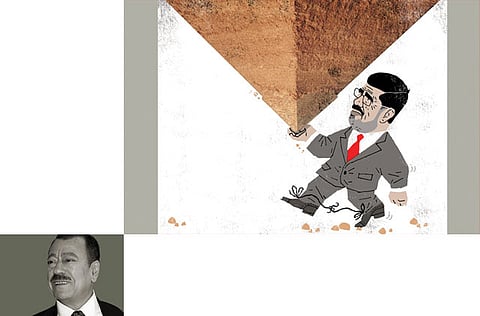
As he enters the 10th month of his presidency, Mohammad Mursi must be reflecting how much easier it is to be in the opposition rather than in the driving seat. Egypt is in a state of political paralysis, with Mursi’s Freedom and Justice Party (FJP) — the Muslim Brotherhood’s political wing — the opposition National Salvation Front (NSF) coalition and remnants of the former regime, consumed by their battle for power.
Parliamentary elections, due to be held this month, were blocked by the Constitutional Court. Now delayed until October, the NSF says it will boycott them anyway unless Mursi first forms a government of national unity. (The trial of Hosni Mubarak ended abruptly yesterday after the judge recused himself).
In November last year, Mursi decreed broad powers for himself in a move variously interpreted as an attempt to circumvent the former-regime dominated courts or simply a brazen coup worthy of his predecessor Hosni Mubarak.
Meanwhile, sectarian violence rages, protests continue and the Egyptian economy sinks deeper into crisis. Mursi’s already difficult task is made a great deal harder by elements of the Egyptian media running a sustained campaign to undermine his leadership and destroy his reputation. Chat shows, in particular, offer a platform for often unsubstantiated criticism of the president and grossly exaggerated caricatures.
Mursi’s response — the arrest of chat show host Bassem Yousuf on charges of insulting Islam and the president — played into the hands of those who claim he is a theocratic dictator.
On Thursday, Mursi announced that he will hold daily Twitter sessions with the general public, underscoring his perception that the mainstream media are deliberately misrepresenting him. Several anti-Mursi media outlets are owned by Mubarak loyalists, who would like to see post-revolutionary Egypt destabilised to such an extent that the military would seize control again.
The absence of a properly constituted government and ongoing instability has brought Egypt to the brink of bankruptcy, deterring foreign investors and tourists alike. The latter have historically contributed 12 per cent of GDP.
Economic woes
The Egyptian pound has lost 17 per cent of its pre-revolution value and the country’s foreign currency reserves are down to $13.5 billion (Dh49.54 billion) — below the crucial level required for three months essential imports (Egypt buys 70 per cent of its food). In seeking financial salvation, Islamist Mursi has been forced down some controversial routes.
First, his government is seeking an International Monetary Fund (IMF) loan of around $5 billion, which would open the doors for additional financial aid from other external sources up to $14.5 billion. However, loans where interest is payable on the principle are at odds with Sharia, which specifically forbids usury.
And that’s not the only problem. In order to secure an IMF loan, Mursi would have to slash the country’s $20 billion a year spending on subsidies, including bread and fuel. With 40 million Egyptians living under the poverty line, there is little room for further austerity.
When Anwar Sadat withdrew state subsidies in order to procure an IMF loan in 1977, it provoked violent riots and nearly brought his government down. Mursi — who I believe has a genuine concern for the poor and needy — already pulled out of one previously agreed IMF loan because the increase in sales tax it required unleashed open rebellion.
Last month, in a morally dubious transaction, Mursi agreed to extradite several Libyans living in Egypt, who are suspected of being affiliated with the former Muammar Gaddafi regime. In exchange, Tripoli transferred $2 billion into Egypt’s government coffers and agreed to send one million barrels of oil a month to Egypt on credit.
The Gulf countries and Saudi Arabia — the Arab countries that could best help Egypt — remain deeply suspicious of the Muslim Brotherhood. Only Qatar has stepped forward, first with $5 billion in deposits and grants and then, this Wednesday, a further $3 billion and a pledge to supply Egypt with natural gas to fill the gap in its energy supplies.
Inexperience
Nevertheless, the country remains in deep financial trouble and many question whether those who are guiding the great Egyptian ship through such turbulent waters have sufficient experience to deal with the situation. In addition to its economic woes, Egypt is experiencing a wave of ugly sectarian violence.
On April 5, four Christians were killed in Khosus; three days later, mourners leaving the Coptic cathedral after attending their funerals were attacked by a Sunni mob throwing stones.
Not that this is a new problem — fighting between Sunni groups and Egypt’s largest minority, the Coptic Christians, was common during the Mubarak era, and there were 17 such incidents in the course of the interim military junta’s rule, resulting in 25 deaths.
Mursi’s liberal critics accuse him of extremism and, while he has condemned the violence, little has been done to prevent further sectarian attacks. There have been five major incidents on his watch, only one has been investigated and there have been no prosecutions.
National Unity is the elusive prize all so-called ‘Arab Spring’ countries yearn for. Without it, Egypt faces three possible future scenarios: An all-out sectarian civil war; a military coup or a popular revolution by the poor.
If Mursi’s presidency is to survive, he needs to become more flexible and include a wide diversity of people in the decision-making process.
He could take a leaf from Tunisian President Rashid Gannouchi’s book here. Following the assassination of secular opposition leader Shukri Belaid in February, Gannouchi dissolved his Islamist-dominated government and appointed independents to all major cabinet posts in a National Unity government. “Stable rule … needs a moderate Islamist-secular coalition,” he concluded.
Mursi could learn from Turkish Prime Minister Recip Erdogan too. He has built Turkey into a regional powerhouse through astute international diplomacy, political cooperation at home and good economic management.
It would be a miracle if Mursi emerges from the current turmoil to lead Egypt into a brighter, more harmonious future. But I have a feeling we are not living in a time of miracles.
Abdel Bari Atwan is editor of the pan-Arab newspaper Al Quds Al Arabi. His latest book is After Bin Laden: Al Qaida, the Next Generation.


