Educators must catch up with reality
Creativity, empathy and other human skills are lost in an education system that purely focuses on good grades and memorisation
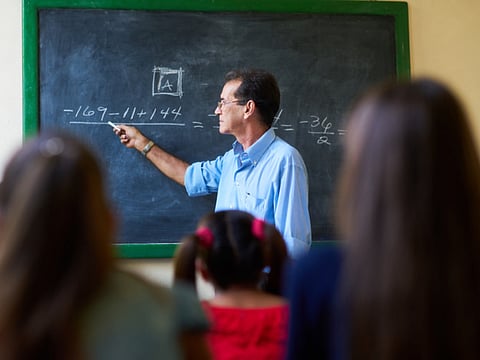
Is our education system really serving its purpose or are the subjects students study often too lengthy and require only memorisation skills?
The purpose of education is to make an individual a good human being and a responsible citizen. This is somehow missing in the education system. The world is experiencing many issues, from unhealthy lifestyles to environmental setbacks and social ills, and the blame often goes to a lack of quality education. We need to have a rousing call for educators, asking them to believe in their students and to create an education system that works for them.
The present system assumes that in order to live, we must have facts and figures stored in our heads. It has bound students to focus only on memorisation just for the sake of being graded well on tests, and it does not expand their understanding or creativity. There used to be a notion that if students can attain good grades, and specialise in a specific field, they would have a good livelihood after graduation. Unfortunately, the rules of the game have changed.
Those who are being thrown into the pressure of performance at an earlier age are often unable to explore and test the waters, and they fail to find suitable jobs. We tend to celebrate schools’ success, instead of people’s success. We equate ‘good schools’ to the graduate scores of students. Year after year, this system of measuring students’ achievement continues, yet proves to be insufficient beyond the doors of a school building. This needs to change.
As technology has advanced, our society has shifted online. In this context of cultural change, the educational system must be redesigned with the times, in order to effectively cater to the needs of society. Global education systems must change their focus by restructuring the school syllabus.
Albert Einstein said: “Everybody is a genius, but if you judge a fish by its ability to climb a tree, it will live its whole life, believing that it is stupid.” The best form of learning occurs when both teacher and student are in pursuit of a deeper understanding. It is a quest that is filled with challenging and impactful experiences. There will be successful members in society if we are able to teach skills such as self-awareness, self-regulation, social skills and positive intelligence. Schools of the future, regardless of their size or technological sophistication, should always assert the best qualities of humanity.
Therefore, the key challenge for educational institutions is to nurture socio-cultural intelligence, to match the pace of the technological revolution and innovative thinking. This would be more valuable than rote learning. We need to fall back on those things that are uniquely human, like teamwork, leadership, empathy, understanding, and creativity. I think that’s what younger generations are hoping for. We must teach them to live, for a better world.
The reader is a former teacher, based in Dubai.


