Don’t worry! Hillary or Trump will fix the Israel-Palestine issue
The US presidential election candidates’ shortsighted policies on this 50-year-old conflict mean a pivotal global problem will only get worse under the next president
In 2017, several months after the United States swears in a new president, the Israeli occupation of Palestinian lands will turn 50 years old. Some birthdays ought not to be celebrated, however. Through its occupation, Israel continues to colonise territory in the West Bank and further entrench its military rule, with no sign of it ending.
American politicians may not want to face this reality, but the situation is dire, leading Jay Michaelson of The Forward to write: “As a temporary policy, the occupation is unjust. As a permanent one, it is apartheid.”
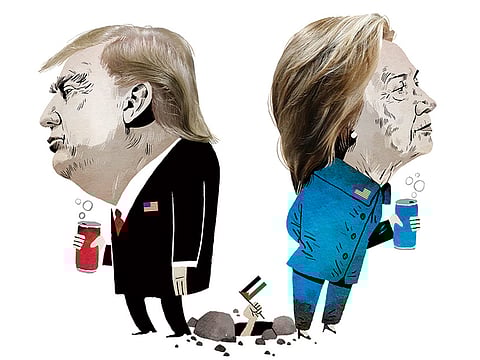
Luckily, both Donald Trump, the Republican presidential candidate, and Hillary Clinton, the Democratic candidate, have good, workable solutions to this most intractable of problems. Just kidding. Although the entire world knows that a durable resolution to the conflict is imperative, not in the interests of justice but also in the pursuit of peace in the region, the American presidential candidates have about as much to offer peace in the Middle East as New Coke and Crystal Pepsi offered to the future of carbonated beverages.
Unsurprisingly, Trump doesn’t seem to know where he stands, but he’ll stand there vehemently. In January 2013, Trump recorded a video endorsing right-wing Benjamin Netanyahu’s run for Israel’s Prime Minister. But by December 2015, Trump told the Associated Press that he would be “neutral” when negotiating a peace agreement between Israel and the Palestinians and he questioned “whether or not Israel’s willing to sacrifice certain things” to come to an agreement. But then, by March 2016, Trump was again changing positions. He said that “it’s probably not possible” to be neutral and by May, he told the Daily Mail that Israel should “keep moving forward” with new colony construction in the West Bank, thereby flouting five decades of stated (though completely ineffectual) US policy. It doesn’t stop there.
Come June, Trump’s co-adviser on Israeli affairs, David Friedman, told Israeli newspaper Haaretz that Trump would probably support annexing parts of the West Bank and that a Palestinian state is not “an American imperative at all”, with Friedman asserting that he’s also unconcerned about a binational state because “nobody really knows how many Palestinians live there”.
In fact, there are 2,898,927 Palestinians living in the West Bank, 1,850,559 in the Gaza Strip, 1,471,201 in Israel, and a total of 12,365,761 worldwide (end of 2015 figures), according to the reputable Palestinian Central Bureau of Statistics. Even the rabidly right-wing Breitbart News — now completely aligned with the Trump campaign — links to a source citing the Palestinian statistics bureau. So when Trump’s adviser says nobody really knows, he must mean Trump doesn’t know. Trump is nobody.
And then there’s Hillary, a politician who seems never to have met a war she won’t vote for. Her bellicose speech in front of the American Israel Public Affairs Committee (Aipac) last March promised not a new solution to the conflict, but rather a shield for Israel from global pressure and nonviolent opposition movements over Israel’s actions and illegal colony activity. The final Democratic party platform isn’t much better on the issue. It repeats language similar to Hillary’s Aipac speech, declaring that Israelis “deserve security” (and Palestinians don’t?), while Palestinians “should be” rather than “must be” free to govern themselves. As a practised diplomat, Hillary surely knows that such word choices matter.
When Democratic party leaders were negotiating the 2016 platform, the Bernie Sanders wing of the party proposed an amendment calling for “an end to occupation and illegal settlements”. This internationally recognised position was considered too “one-sided” for the party establishment and the amendment was defeated by a vote of 73-95, though the final draft twice mentions that Palestinians ought to be able to live in “dignity”.
The Republican Party platform, meanwhile, is zealously anti-Palestinian and basically off in its own world. It states that the party “rejects the false notion that Israel is an occupier”, and describes the completely nonviolent Boycott, Divestment and Sanctions movement as one of several “alternative forms of warfare” being waged upon Israel. So there’s that.
Party platform statements don’t mean much in the end and these reflect more how the Democrats are sticking to a tired status quo framed by the 1993 Oslo Accords and the Republicans are spinning hard to the right. Neither position offers anything that shows that they truly understand the reality of the situation.
According to the New York Times, there are now more than 350,000 colonists living in the West Bank and another 300,000 living in occupied East Jerusalem, greater than double the number since the Oslo Accords were signed and still in violation of the Fourth Geneva Convention, which prohibits an occupying power from transferring its citizens into territory it controls or displacing those who live there. Around 60 per cent of West Bank land, dubbed Area C under Oslo, is under exclusive Israeli control. And the thriving business of colony enterprises further dispossesses Palestinians, as Human Rights Watch recently documented .
Some Palestinians who have lost their own businesses or farms due to Israeli land confiscations, discriminatory regulations or water deprivations are then left with no choice but to work for the very businesses that displaced them in the first place. Palestinian citizens of Israel struggle under a system that accords them fewer rights and opportunities than their Jewish counterparts. And regardless of what one thinks of Hamas, the siege that Israel imposes on Gaza affects all of its inhabitants and is unconscionable. According to the Israeli organisation Gisha, more than 70 per cent of Gaza’s population relies on humanitarian aid, while 47 per cent suffer from food insecurity. In the second quarter of 2016, unemployment was at 41.7 per cent, and at a staggering 57.6 per cent among young people.
Nothing in the current situation excuses the abhorrent and immoral attacks on civilians and any lasting solution must work to guarantee peace and security for everyone. But the precarious situation of today is a consequence and not a contradiction of the 1993 Oslo Accords and it’s high time we recognise that the Oslo Accords are as likely to bring peace to the Middle East as Trump is to unite America.
From its conception, Oslo never required Israel to recognise Palestinian rights to statehood and has instead enabled Israeli encroachment on the West Bank. More than 20 years ago, Edward Said predicted that the accords would establish the Palestinian National Authority not as a sovereign government of the Palestinians but as “Israel’s enforcer” of the occupation. I was a student of Said then and I clearly remember the loneliness from which he objected to the agreement, along with his refusal to attend the White House signing ceremony out of principle.
At the time, he was considered an obstructionist outlier. History has only proven him right. The next president of the United States must recognise the folly of current approaches and seek new solutions. Until now, the international consensus has been focused on a state-oriented resolution as a way to confer rights and stability to Palestinians and Israelis. But what if that equation were flipped, if the focus were instead on enshrining full equality for everyone before even considering the creation of two states?
A new administration ought to concentrate on mechanisms (including withholding aid) geared to guaranteeing the human rights of all the people living between the Mediterranean Sea and the Jordan River, along with ways to preserve the communal rights of each of the communities.
Whether the result of such an approach leads to one state or two states or 21 states on the land is immaterial. (In fact, slim majorities of both Palestinians and Israelis still support a two-state solution.) What matters is that we finally wake up from the 23-year-old slumber induced by Oslo, the numbing half-century of occupation, and the nearly 70 years of Palestinian dispossession, to see that the only durable resolution to this conflict will be one that protects Israelis and Palestinians equally — with liberty and justice for all.
— Guardian News & Media Ltd
Moustafa Bayoumi is an award-winning writer, and associate professor of English at Brooklyn College, City University of New York.


