Dialogue critical to combating terrorism
Keeping communication channels open will let India and Pakistan combine forces
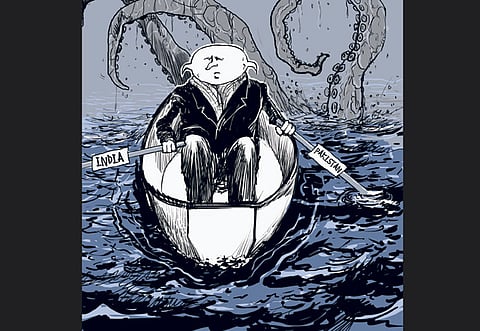
Resuming dialogue is always weighed down by anxiety about outcomes. But India and Pakistan need not worry. Nobody realistically expects too much out of tentative renewals. They hold little promise of anything except the exchange of chai and samosas.
Yet even these renewals are bright arcs in the treacherous sky that hangs over nuclear neighbours. Just the mere return of dialogue signals a recognition from both parties that ritual has its uses. It breaks the ice, presages hope, promises substance, and sets the stage for roadmaps and change.
For those invested in teaching the other state a lesson or negotiating a more nationalist identity by spurning dialogue, there's comfort in the sulphur of emotion. They have yet to understand that national security, or its pursuit, through non-coercive diplomacy is a ruthless business. It bets on the long-term and looks to maximise optimal outcomes.
If a military solution is the best option, then all resources need to be marshalled, such as anger, ballistic missiles, artillery and best planners, to the table. If a military outcome is not in best interests, then chai, samosas and gritted charm it is.
New Delhi will serve the region better if it shelves the threat of cutting off dialogue every time there is a terrorist tragedy. The good news is that templates exist for many of the smaller conflicts in the Indo-Pak terrain.
Pressing issues
It is Kashmir and terrorism that loom as big-ticket items on the roadmap,
On terrorism, Pakistan is facing a blitz. It is a cap-acity deficit, not a commitment lag. Democratic governments may be weak everywhere, perhaps more so in Pakistan, but they hedge their futures against war. They seek opportunities for peace and trade, not because they are nice people, but because they are accountable for losses.
War with India is really not an option when more people die in Pakistan from acts of terror than they do in war-torn Iraq, or for that matter, anywhere in the world.
So New Delhi has to grasp the magnitude of the war roiling Pakistan before it makes dialogue a hostage to the terror that rips through the region. This is not to say that composite dialogue is some metric for success. Far from it.
After the fourth round of composite dialogue sorted out the fine print on many well-worn confidence-building measures, the inertia of leaden intentions dragged movement at its usual pace.
Then Mumbai, or 26/11 happened. Suddenly the state became hostage to terrorists and their goals. This is what has to change if the region has to combat terrorism together, which must not be confused with insurgency at this point. Power must not be handed over to the terrorists by succumbing to reactive behaviour.
The identity of much of the terrorists may not be trans-national at a glance, but the sophisticated military resources and funds that drive them do not originate in Pakistan.
Out of control
In the last two years alone, over 5,000 Pakistanis have lost their lives to terrorism. Try as it may, Islamabad cannot possibly provide a guarantee against bombs in India if it cannot guarantee such a blockade in its military's General Headquarters.
On this count, dialogue should lead to the construction of joint mechanisms for intelligence sharing, best practices and optimal outcomes.
Intelligence is the first line of defence in terrorist terrain, and we need to bolster our states with a formal architecture for interaction between India and Pakistan. Interrupting dialogue will only reify hardened positions.
Second, structured talks on Kashmir will have to re-surface, even if they inch forward. If New Delhi refuses to include Kashmir at a later stage on the formal table, then the dialogue will lose momentum as well as political traction in Pakistan.
Talks on Kashmir will also profit from a back-channel, as well as quiet inclusion of Kashmiri opinion in any dialogue for it to remain credible. Territory must always be about people, not just strategic location.
Giving dialogue a chance is critical for taking Pakistan and India out of a bilateral Cold War time-warp. Giving China a role in a separate trilateral commission for nuclear and other talks can help ease that neuralgia.
India's military focus is still Pakistan. That forces the military here to keep troop strengths balanced when all resources are needed on another, dispersed battlefield.
If one is looking for a game-changer, this will be it. For Pakistan, the potential theatre of conflict will shift where needed, and threat perceptions will slowly start to shift closer to our real ground zero at home.
The Indian leadership should strengthen their prime minister's hand to fashion such a grand strategic bargain for South Asia. Because without one, dialogue will go round and round in vilified circles, becoming a low-intensity space for conflict-prevention.
We need to go beyond crisis-management. We need to shift into conflict resolution and business momentum mode. But for all that to happen, we need to give dialogue a chance.
Sherry Rehman is a member of the National Assembly of Pakistan and former federal minister.


