Colonies are a blockade to peace
No Israeli words can speak as loudly as a large-scale pull-out from illegal West Bank colonies
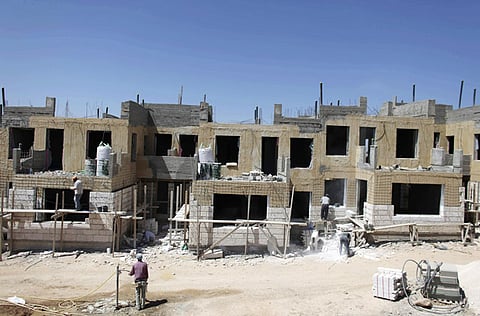
There are plenty of thorns in the side of the peace process, but none as sharp and intractable as Israel's colony programme.
For decades, successive Israeli governments have persisted in their obstinate policies in the West Bank to the detriment of civilians on both sides, despite knowing full well that no lasting peace deal can ever be reached without an end to the colony enterprise.
Although the colonies are deemed illegal under international law, Israeli officials continue to cling to their belief that Israel has every right to settle its citizens in expropriated land over the Green Line. One line of argument employed by colony supporters is that no colony is built on private Palestinian land — though such a claim appears to be based largely on colonist fiction rather than hard facts.
According to a new report by the Israeli human-rights group, B'Tselem, over a fifth of built-up colony areas are constructed on privately owned Palestinian land, giving the lie to the assertions of colonist leaders that their actions are entirely above board.
B'Tselem's figures are based on official government records which reveal a state-wide complicity in the wholesale violations of local and international law — and the deception has been going on for years.
When sanctioning early colony construction in the West Bank, the report says: "the principal means Israel used ... was declaration of ‘state land', a mechanism that resulted in the seizure of more than 900,000 dunams of land [16 per cent of the West Bank], with most of the declarations being made in 1979-1992. The interpretation that the State Attorney's Office gave to the concept ‘state land' in the Ottoman Land Law contradicted explicit statutory provisions and judgments of the Mandatory Supreme Court. Without this distorted interpretation, Israel would not have been able to allocate such extensive areas of land for the [colonies]".
When I interviewed prominent figures in the colonist movement for my book on Israeli colonies, I was met time and again with the declaration that colonies are "more legitimate" than major Israeli coastal cities, in a paradoxical interpretation of Israeli law. "In Haifa and Tel Aviv, they took over Arab property. But the colonist movement wasn't allowed to touch private property," said Daniella Weiss, mayor of the Kedumim colony and a long-time colonist figurehead.
"One of the backbones of the [colonist] movement, according to the guidance of Rabbi Kook, was that we could only build on rocks — not on people's private land — Now as there was a lot of rocky land, the [colonists], including me, settled on the rocks," she explained as she recalled the founding of Kedumim in the mid-1970s.
From rocks to riches, the colony enterprise has covered vast amounts of ground in the succeeding years with people like Daniella at the helm.
However, somewhere along the line the guidance of Rabbi Kook has gone unheeded, because according to official Israeli Civil Administration data obtained by B'Tselem, 21 per cent of built-up land in the colonies is private, mostly Palestinian land, while in Kedumim itself that figure is over twice as high, according to Peace Now figures. If Daniella Weiss was aware of this fact, she chose not to mention it.
Same old story
It is a similar story across the West Bank, with scores of colonies built illegally with government approval, and the crimes compounded by continued state assistance to those residing within the illicit communities. One such colony is Ma'on, in the South Hebron Hills, where buildings have been constructed without permission, with civil administration data revealing that 15 per cent of the colony is built on private, mostly Palestinian, land.
Similarly, the colony's outpost, Havat Ma'on, which is illegal even according to Israeli law, is not only built without permission, but also extends on to private Palestinian land, with all the resulting hardships on the local Palestinians.
According to Israel's Road Map commitments, the outpost is supposed to have been demolished, and yet it continues to be supplied with water, electricity and defence by the Israeli authorities. Moreover, even if the government was inclined to evacuate the outpost as it is committed to do, evacuations in the past have simply resulted in the transfer of the population to other West Bank colonies in the Occupied Territories.
There is little point in expecting the colonists themselves to pack up and leave their cushy, state-subsidised homes as long as there is no official pressure on them to do so. A dogged and dogmatic commitment to illegal settling of the West Bank is the nature of the colonist beast: to expect a volte face to come from within the colonist community is wildly unrealistic.
While it is all well and good for Israelis to demand an end to Palestinian violence and sabre-rattling, there has to be goodwill shown from the Israeli side too — and no amount of words can speak as loudly as the action of a large-scale pull-out from West Bank colonies. Without such a step forward, the region is doomed to forever stagnate in a cycle of stalled road maps and failed efforts, and there will be no peace for both the wicked and good alike, on either side of the divide.
Seth Freedman is a writer living in Occupied Jerusalem.


