British voters have a point to make
The gulf between people and politicians can scarcely be wider than what it is now
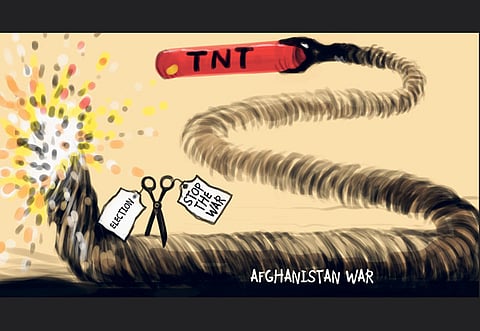
National elections are supposed to be about debating and settling the great issues and controversies facing a country. There are few issues as serious and controversial as the war now being fought by a 10,000-strong British force in Afghanistan. As in the rest of Nato, the war is deeply unpopular in Britain, where the most recent poll showed that 69 per cent regard it as unwinnable and 63 per cent want all British troops withdrawn by the end of the year.
But in the coming general election, this ever more bloody conflict is unlikely to intrude into the heart of the campaign, except in well-rehearsed spats about equipment and funding. The reason is that, unlike in the case of Iraq, all three main parties are signed up to carrying on with a war the public has decisively rejected.
The gulf between people and politicians could scarcely be wider. The British army is taking casualties at a level not seen since Korea and Malaya in the 1950s, with 27 soldiers killed by Taliban guerrillas in the last couple of months and six in the last week. Opposition to the war is strongest in working-class areas where army recruitment is concentrated. Joe Glenton, the first British soldier to be charged with refusing to return to the battlefield and campaigning against a war now costing £4 billion (Dh21.94 billion) a year, was jailed last week.
But the political class seems determined to cling to Nato and its US patron, rather than represent the will of the voters. Even the Liberal Democrats, who benefited five years ago from their opposition to the Iraq catastrophe, appear to have convinced themselves against all the evidence that Afghanistan is a just war for human rights and have signed up to the elite consensus.
The same goes for the bulk of the media, which largely ignores opposition to the war in favour of gung-ho embedded dispatches from the frontline and sanitised commemoration of the young soldiers sent back in a never-ending parade of coffins. The much larger number treated for horrific injuries at Selly Oak hospital in Birmingham are kept well out of sight.
The dangers of ignoring public opinion on Afghanistan do, however, seem to have registered with some politicians, judging by Foreign Secretary David Miliband's repositioning efforts in Boston last Wednesday. Honestly, he warned that the credibility of Nato and "western power" was at stake in Afghanistan. His call for peace talks with the Taliban mainstream and the full involvement of all the regional powers, from Pakistan to China, in a new Afghan settlement represents a significant shift towards the case long made by opponents of the war.
What was missing, of course, was the crucial commitment to bring an end to foreign occupation, without which agreement with all the main forces in the country will be impossible. So far, openings to the Taliban have only been tentative.
Last throw of dice
The idea behind the current surge is to cut the Taliban down to size in preparation for the new settlement all sides understand is inevitable. In reality, it's a last throw of the US dice and so far the signs are it isn't working.
The Taliban have intensified attacks on British troops around the town of Sangin, just as they have returned in force to areas from which US troops were withdrawn to take part in the surge. What reason is there to doubt that the same thing will happen when the US takes the fight to Kandahar in the coming months or that Nato troops are in practice clearing areas of Taliban so that the notoriously corrupt Afghan police can take their slice of the opium trade? Even the US claim to have reduced its "collateral" slaughter of Afghan civilians turns out to be nonsense: the most reliable figures show that more than 80 were killed by Nato forces last month compared with 50 in February last year.
Unfortunately, there is yet no sign that the Obama administration has taken the strategic decision to opt for a negotiated withdrawal from Afghanistan. But there is growing alarm in the US establishment at what Robert Gates, the US Defence Secretary, described earlier this month as a growing European aversion to the use of military force and "the risks that go with it".
No doubt the collapse of the Dutch government over the Afghan war was on his mind.
Miliband seemed to have similar concerns about his own people at the Chilcot inquiry into the Iraq war in London recently, when in the course of a bizarre defence of the 2003 aggression, the foreign minister warned against Britain drawing the "wrong lessons" from Iraq and "turning its back" on the world.
Of course, negotiating an end to a failed occupation doesn't mean turning your back on the world at all — rather the opposite. Some politicians might be groping towards what is the only possible solution in Afghanistan, but if British voters had the chance of a real say on the matter, they would certainly get there a lot quicker.
Seumas Milne is a Guardian columnist and associate editor.


