Britain has vital role in building Iraq peace
London still wields influence in the Middle East and now it can help give Baghdad a stable future
By Tim Collins
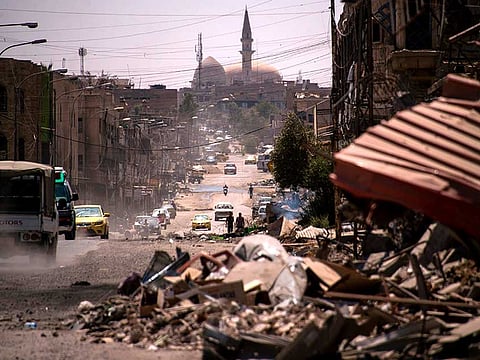
From the ruins of Mosul, from the defeat of Daesh (the self-proclaimed Islamic State of Iraq and the Levant), there is a chance to build a lasting peace not just for Iraq but for the wider Middle East. This is no naive and optimistic boast, but a realistic assessment of the opportunity on offer. And Britain is uniquely placed to help make it happen.
Here’s how we can go about it. We need to realise, above all, that the rise of Al Qaida in Iraq and then Daesh was fuelled by the disfranchisement of Sunnis, who felt that Shiites, under the leadership of Iran, grew too dominant after the demise of Saddam Hussain, so upsetting the regional balance of power.
The vast majority of Sunnis reject Daesh, but they ask themselves this question: why should we send our young men to fight and die stamping out Daesh, only to put ourselves under the boot of Iran and Syrian dictator Bashar Al Assad? They won’t do it. And when, as now, they see images of Shiite militias, draped in religious flags, moving in to the ruins of Mosul to carry out vicious reprisal attacks on Sunnis, their resentment grows.
Such revenge attacks must be stopped now. If not, Iraq should remember that Turkey, a nation of 80 million Sunnis, is on its northern border. Turkey’s increasingly authoritarian leader, Recep Tayyip Erdogan, is itching for an excuse to move across the frontier. “Protecting” Iraq’s Sunnis would be the perfect cover.
There is welcome evidence that the government of current Iraqi Prime Minister Haider Al Abadi understands this. He is Shiite himself, but unlike his predecessor, the disastrous Tehran stooge Nouri Al Maliki, who presided over the wholesale retreat before Daesh in 2014, he knows that only through adequate representation of all sects can stability come.
Britain created modern Iraq, but both Gertrude Bell and T.E. Lawrence knew than unless the Sunni tribes got a homeland there would be trouble — and so it has proved. Since 1920 the problem has been exacerbated, as the Shiite population of Iraq has trebled. Today’s Sunnis feel vulnerable and humiliated — ripe for exploitation by extremists. But there is a route out of this situation.
Britain has a trusted ally in Al Abadi, whose government in Baghdad is no longer a vassal of Iran. Indeed Al Abadi has been brilliant in balancing help from the West while also allowing Russia and Iran to play a hand too. All sides feel represented, none has rendered Al Abadi a puppet.
Britain now needs to help him keep Iraq together by ensuring he offers genuine administrative representation to all its peoples — Kurds in the north, Shiite in the centre and south, and Sunnis to the west. But, as the Sunni tribes bridge western Iraq and eastern Syria, the Sykes-Picot era border between the two nations must be moved. That will take some selling. But there is a deal to be done here.
Russia is a major power behind the rule of Al Assad in Damascus. Yet Russia is focused principally on Tartus, the Syrian port which is a crucial strategic naval asset leased to Moscow. There is an opportunity for the West to acknowledge, rather than challenge, Russia’s interest in Tartus, in exchange for a border shift.
In the West, we have in the past hugely underestimated how important Tartus is to the Russians, and how pragmatic they can be. If we can guarantee that port, we can have them on our side. Britain can also give Al Abadi every diplomatic, commercial and financial support possible.
We can help with long loans for rebuilding. We can help with the infrastructure and know-how behind “safe cities”, doing in Baghdad as we did in Belfast in the Eighties, by bringing goods through ring-road warehouses for separate, safe transport to the centre of cities, so eradicating the truck-bomb threat and allowing normal life to return and flourish.
These are the basic ingredients of a stable future, not just in Iraq but in the region: security, commerce, power sharing. And at a time when many doubt us, this is an opportunity for Britain to show our diplomatic mettle. We still have power and influence like no other country in Europe, bar Russia.
This is not just because of our history and current military power, it is also because of personal connections. Haider Al Abadi spent much of his life living in exile in Britain. He speaks very fondly of his time here. When, as now, everything is in flux, these little things can suddenly become very important.
— The Telegraph Group Limited, London 2017
Tim Collins is a retired British army colonel who served with distinction in Iraq. He is the chairman of specialist security company, New Century Consulting.


