Al Qaida reduced to rubble
American taxpayers were made to fork out trillions to underwrite the government's whole exercise
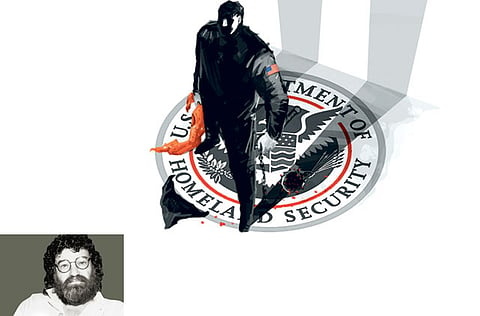
It was an assault like no other, one that came as a bolt from the blue against the US, resulting in the fiery collapse of the Twin Towers in New York, the partial destruction of the Pentagon in Washington, and the death of 4,000 innocent civilians in less than two hours, a convulsive event that, when it took place exactly 10 years ago today, shook the world and forever changed America.
And it took a band of so-called pan-Islamists, led by a tall, bearded and gawky-looking ideologue with delusions about resurrecting the caliphate, a polity dating back to well over a millennium, to pull it off, thus shattering the last authority of reason that Americans had held of their country as an impregnable superpower.
Now in the cold light of hindsight, in the 10 years that separate us from September 11, we may as well ask, now calmly: Who really were these people who dealt that blow to the US on that day? And what was the cost, all around, of the war Washington then launched in retaliation against its enemies, dubbed the ‘war on terror’, a full-fledged war no less rigorous in its sheer intensity than any other?
The claim made by a not insignificant number of commentators at the time that these people who attacked their country were ‘mad terrorists’ who ‘hated’ American democracy and the abundant freedoms Americans enjoyed is too facile to advance today. Clearly, these terrorists, mad or not, were possessed by more complex motivations than that.
Men are driven to become terrorists or, if you wish, rebels, insurrectionists and revolutionaries, for any number of reasons, including the irremediable suffering they have witnessed or they themselves have experienced in their impoverished homelands, where anyone calling for justice is silenced or hounded to destruction, where repression contributes not only to decay in social life but to corrosion in individual consciousness.
Men yearn, especially after recourse to secular remedies has failed them, for that squandered utopia in their past, a mythical time when things were better, almost golden. In this narrative, one’s social wounds will not be mended unless one took up arms to wrest control of one’s destiny. Only the purging fire of total, even nihilistic, revolt against ‘the enemies of God’ and those who underwrite their rule, this narrative further avers, will free men from the shackles of serfdom.
Big powers resented
In this fable, the terrorist sees himself as hero, or hero-villain, an outcast roaming alien lands, all the while hiding an inward fire in his heart and a feverish glitter in his eye. We know him in literature as the Ancient Mariner, the Flying Dutchman, the Wandering Jew and, especially, as Captain Ahab, whose all-consuming preoccupation was to pursue and destroy Moby Dick, the whale that in Herman Melville’s novel embodied the metaphor for the malevolent force in our lives that dwarfs and asserts its will over ordinary men.
In history we know him as the German Thomas Muntzer — the European Osama Bin Laden, if you wish — an early Reformation-era Christian militant who, turning against Martin Luther, became the rebel leader of a scorched earth peasants’ war in the early 1520s. (Muntzer, who was captured and put to death in 1525, remained to Protestant historians a short-lived terrorist, but in later years he was adopted by socialists as a symbol of early class struggle.)
In his introduction to Franz Fanon’s iconic work, Les Damnes de la Terre ( The Wretched of the Earth), the French philosopher Jean-Paul Sartre writes of the redemptive power of violence acquired by a colonised person who, once he exercises it against his coloniser, feels salvation descending on his bruised spirit, a kind of grace lifting him out of the shadow of damnation. Why should the coloniser partake of the excitement of evil without bearing the real cost?
To be sure, throughout history, big powers have always been resented by those living under the shadow of their rule, even though — oxymorons aside — these big powers were benign. Spontaneous revolts against them stretch back from antiquity to modern times, from the Babylonians’ revolt against Assyria in 116 BC to the April Rising in Dublin against Britain in 1916 AD. And, yes, truth be told, there were a lot of people in impoverished countries around the Third World who, though not overly demonstrative in expressing the sentiment, felt jubilation at seeing a swaggering big power like the US meet its comeuppance on September 11.
Today, 10 years after it launched its sneak attack against the US, Al Qaida is a haunted ruin. And America, though shaken, moved effortlessly on — to its second American century.
Yet one wonders. One wonders indeed about that. While it is true that on November 4, 2001, less than two months after the toppling of the Twin Towers, tens of thousands of American sports fans attended the World Series between the Arizona Diamondbacks and the New York Yankees, with then president George W Bush throwing the first pitch — in a seeming snub to anyone who thought America lacked resilience — tens of thousands of other Americans, these soldiers, were shipped to Iraq and Afghanistan to fight endless wars in countries and against communities whose culture, faith and language these young soldiers had little inkling.
Thousands upon thousands of Iraqis and Afghans have been killed, and other people, from other countries, have been rendered, tortured, waterboarded, targeted by drones, and subjected to ‘enhanced interrogation techniques’ in Guantanamo and in secret CIA prisons around the world. And American tax payers were made to fork out trillions of dollars to underwrite the whole exercise.
Hatred continued to imbue the heart against big powers. One wonders if, on that dreadful day — September 11, 2001, those 19 terrorists, moments before they rammed their hijacked planes into the World Trade Center, their hearts full of rage against the US, were echoing the sentiments of Captain Ahab when he finally confronted Moby Dick, harpoon in hand, hollering, “From hell’s heart I stab at thee, for hate’s sake I spit my last breath at thee”. In literature as in history, violence and unreason continue to govern man’s estate.
Fawaz Turki is a journalist, lecturer and author based in Washington. He is the author of The Disinherited: Journal of a Palestinian Exile.


