A peace deal in Colombia is still possible — as my Northern Ireland experience shows
With Nobel Peace Prize-winning President Santos reaching out to the Farc and to Alvaro Uribe, there’s still a good chance to gain popular support
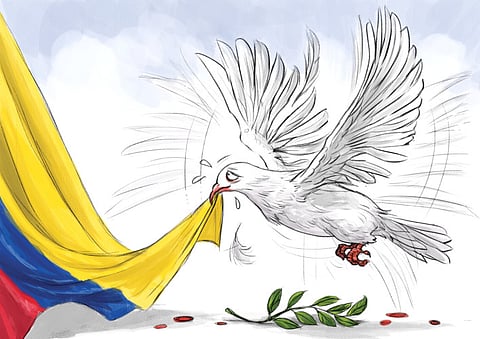
When I heard the result of last Sunday’s peace referendum from Colombia, I felt sick in my stomach. I have been advising President Juan Manuel Santos on the negotiations with Farc (Fuerzas Armadas Revolucionarias de Colombia) for the past five years through my charity, Inter Mediate, and I couldn’t believe that they had actually lost the vote — albeit by fewer than 60,000 of the 13 million votes cast.
The previous Monday, I had been in Cartagena at the signing of the peace agreement. I was sitting next to two women who had lost their sons in the war and were wearing pictures of them on their chests. They were in floods of tears when the signing took place, but then jumped from their seats in joy when the guerrilla leader Timochenko asked the Colombian people for forgiveness for what the Farc had done during the conflict.
It was an emotional occasion after allthe pain the war had caused, with nearly a quarter of a million dead and many millions driven from their homes. It seemed that at last there was hope.
A referendum was not legally necessary for the approval of the agreement, and indeed its result is not legally binding on the government. But I had always been in favour of a plebiscite to demonstrate public support, because only in that way would it be possible to change the constitution rapidly to ensure the agreement was actually implemented.
And I still don’t regret arguing for a referendum — I think the people should have the say in the ratification of a peace agreement such as this. But I was also apprehensive about the referendum campaign, particularly after the Brexit result in the United Kingdom. Opinion polls do not necessarily give you an accurate view of what will happen, especially in the mid-term of an unpopular government.
And in Colombia, the agreement was under attack by a vigorous campaign under the direction of the popular former right-wing president Alvaro Uribe. I was particularly worried about turnout. Why would people sacrifice their time to vote for peace if the polls told them that the agreement would easily be endorsed by 60 per cent to 40 per cent? (Turnout in Colombia was 38 per cent in the event.)
I remembered the referendum on the Good Friday agreement in Northern Ireland in 1998. We had been certain of overwhelming nationalist support for the agreement, but unionist support was less clear. We were initially complacent, but soon realised the scale of the challenge. We had to devote Tony Blair full time to campaigning for a ‘yes’ vote and even draft in John Major — not an obvious ally of the new government — as well as a string of British unionists. In the end, we won with just over 50 per cent of the unionist vote after an exhausting campaign.
But the result in Colombia was not just about turnout. The 52-year war was particularly vicious and the vast majority of the population hated the Farc and had no trust in it doing what it said. A paper agreement does not make people trust their enemy. In fact you have an agreement exactly because the two sides do not trust each other. Trust only comes when the agreement is actually implemented by the other side, rather than remaining just words.
Furthermore, people always want agreements on their terms. Many Colombians wanted to see the Farc leaders serve long jail terms for their crimes and to be banned from political office. Many in Northern Ireland felt the same way about Sinn Fein’s Gerry Adams and Martin McGuinness. But by definition an agreement requires compromises from both sides and is not made on one-sided terms — or if it is, it will not last. Naturally, the Farc leaders were unwilling to sign a deal that meant they would serve 30 years in jail and the agreement instead required innovative provisions on transitional justice, not least to satisfy the requirements of the international criminal court.
Santos truthfully said that there was no Plan B if the agreement was voted down, and there isn’t. All there is another version of Plan A.
A way has to be found to make the agreement acceptable to a wider section of the Colombian public, and that is what the Nobel Peace Prize-winning president has embarked on. If he succeeds, this setback may actually strengthen the agreement. It is always hard to implement a peace settlement that has only partial support in the country, as it was found in Northern Ireland.
Support for the Good Friday agreement declined dramatically among Unionists in the years after 1998 so that by 2003, it was down below 40 per cent, and the moderate David Trimble had been voted out of office. In the end, the agreement got implemented after it was won over by Ian Paisley’s DUP and signed the St Andrews agreement, a modified form of the original agreement, in 2006.
The Farc has said it remains committed to peace and has shown no appetite for going back into the jungle Implementation of the Havana agreement was always going to be difficult in a country as geographically challenged and violent as Colombia, in parts of which the government writ does not run. There is the constant risk of drug gangs filling the vacuum left by the Farc, and of former paramilitaries reverting to killing. Having the political right supporting the agreement will make that implementation inestimably easier.
Luckily, Santos has taken the right steps in the aftermath of the referendum defeat. He has announced that the ceasefire stays in place; he has dispatched his negotiators to meet the Farc again in Havana; and he has reached out to the political opposition, including Uribe.
The Farc too has said it remains committed to peace and has shown no appetite for going back into the jungle. Even Uribe has said that he is in favour of peace and that the Farc should be protected from violence. Wrestling out the necessary amendments to the agreement to widen its support will not be easy. But it does not have to be a drama as long as no one does anything likely to restart the war. That, I hope, is behind Colombians for ever.
— Guardian News & Media Ltd
Jonathan Powell was chief government negotiator on Northern Ireland from 1997 to 2007 and is the director of Inter Mediate, a charity that works on conflicts around the world.


