A call for unifying the ranks
Egypt protests are a slap in the face of Israel and its western allies
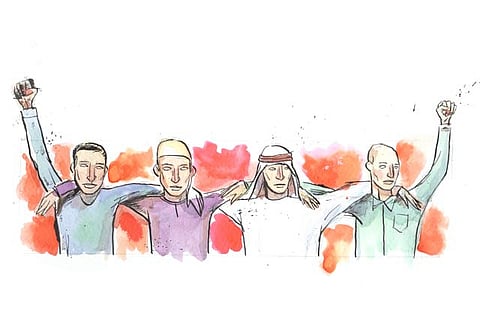
On October 15-16, 1991, president Hafez Al Assad spent more than 15 hours discussing with James Baker, the then US Secretary of State, the terms and phrases which should be used in the Madrid peace process in order to express the Palestinian people's legitimate rights, stressing, in particular, that "[occupied] east Jerusalem is an integral part of the Arab land occupied in 1967".
He also stressed the right of return for millions of Palestinian refugees and their right to create their independent national state. By citing letters written by Jimmy Carter on March 27, 1978 and letters from Ronald Reagan on July 29, 1988, Al Assad tried to prove to Baker that "recognising the legitimate rights of the Palestinian people, including political rights, has always been US policy expressed by US presidents".
Al Assad dwelt on "the common factors which bring the Arabs together" and explained that "just and comprehensive peace and restoring all rights, including occupied Jerusalem and the refugees is the only viable peace".
In a moment of spontaneity, Baker said, "I wonder how important the Arab world would be if all the Arabs reached consensus on this vision. It is a tremendous idea".
It is very rare for a western official to articulate the points of strength which the Arabs enjoy, and which their leaders have failed to use so far citing western agreements and ‘international' treaties. But the objective of all those agreements was keeping the Arabs divided and fragmented. After the West divided our nation into 22 states, it is sowing sedition and separation in every Arab country.
Every day we see a new attempt to divide the Arab world by giving priority to country interests as if they contradict Arab interests. Hostility to pan-Arab parties is promoted while takfiri groups (extremists who brand all those who do not follow their line as apostates) are being encouraged. People's imagination has been fuelled by promises of economic prosperity in the countries which signed peace agreements designed to guarantee Israel's hegemony and arrogance so that it can swallow the whole of Palestine.
In return for this unilateral peace, and for breaking from the ranks of the Arab nation, Israel has become more arrogant and oppressive against the Palestinians — killing them, assassinating their leaders, colonising their land and depriving them of their freedom.
Years of humiliation
For decades of ‘peace', frustration and desperation grew among successive generations of Arabs. They watched Arab blood become so cheap in the eyes of Arab rulers who persisted in making deals with the enemy and appeasing war criminals like George W. Bush who waged war on Islam.
For all these long and tough years, which have seen tragedies and humiliations of the Arab nation, including the destruction of Iraq, the Lebanon conflict, the war on Gaza and the siege imposed on its people by the enemy and the ‘brother', I used to repeat one question to western media: "if we Arabs are not worthy of life, as you portray us, why this continuing preoccupation with us and our region?"
During the past two weeks, Washington has been on high alert as never before. American officials have been holding meetings of the National Security Council chaired by President Barack Obama; the secretary of state has been making statements every two hours; White House and State Department spokesmen have been appearing on TV screens more often than their predecessors during the war on Afghanistan and Iraq; not in support of freedom, democracy and human rights, but in order to lengthen the life of ‘friendly' regimes.
Peace treaties
This unprecedented concern on the part of the US reflects an Israeli concern for its security which is guaranteed by unilateral peace agreements.
The Israeli war on Arabs, by accusing them of ‘terrorism', ‘backwardness' and ‘fanaticism', aims at destroying Arab self-confidence and convincing Arabs, before others, that they are not worthy of life. The idea is to make Arabs feel so frustrated and feeble that their enemies can play havoc with their destiny without meeting with any resistance.
Our enemies have realised that the Arab identity is what unifies and empowers us and that our strength lies in our cooperation. That is why they have been trying to undermine this sacred tie and replace it with religious, ethnic and sectarian infighting until our countries are divided and sedition planted in the ranks of our people. This is the source of Arab weakness, politically, socially and economically.
Could an investor imagine a single unified Arab investment space ruled by one set of laws, regulations and objectives in an Arab market of about 400 million Arabs instead of 22 small investment spaces governed by different laws and procedures? This in itself would turn the Arab world into an emerging economic power in the footsteps of China, India, Brazil and Turkey.
But this is what our enemies in Israel do not want to see. Nor do their allies. Washington and other western capitals who used to shout in support of democracy are today worried about the prospect of an emerging Arab democracy.
However, by confronting the oppressive security systems trained by western powers, the Arab masses have shown that Washington dreads democracy in the Arab world. Its politicians and commentators are wondering whether an Arab democratic regime would maintain the same relationship with Israel.
When some Iranians protested against the regime, Neda Soltani became a universal martyr of freedom; and her photographs were published in all newspapers of the world. Obama himself expressed sadness for her death; but western media failed to mention the name of a single Arab freedom martyr.
This shows that they are not interested in the cause of freedom or the cause of democracy in the Arab world. These are all slogans raised in the face of those who oppose their anti-Arab projects; and that is why Israel killed Palestinian democracy with declared American support; and that is why you hear them wondering why the Arabs have risen now calling for democracy.
What the Arab masses have proven this time is what the Arabs have always shown: that they are a free and proud people who love freedom.
Bouthaina Shaaban is the political and media adviser to the President of Syria


