The soccer slave trade in Africa
The lure of riches ensnares thousands of hopeful footballers from African countries
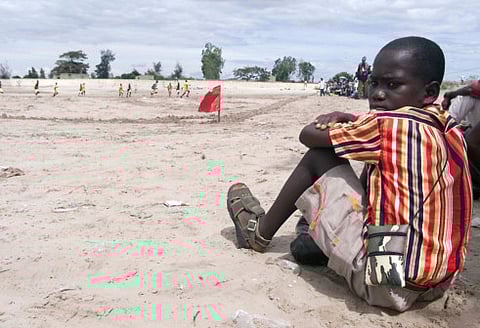
Four years ago Luc Rosso was 16 and living in Cameroon. The promising young footballer attended a local football academy and had dreams of becoming a famous player like Aurélien Chedjou, one of his country’s most celebrated athletes, who recently signed up to play for Galatasaray in Istanbul. So when Luc was approached by a Nigerian scout who promised him a trial in Europe, he thought his dreams were about to come true.
“The agent had seen me play and knew my dream was to be at the very top,’’ says Luc. “He said I could play at a good level.” But there was a cost: The man wanted £6,500 (Dh37,134) to fund Luc’s trip overseas for some football trials at top clubs.
“The agent told my mother that if she could pay the amount I could get a deal. So she borrowed money from various people and gave it to the agent,” says Luc. She hoped that once Luc began playing for a big club, the money he earned would help her take care of her four other children and improve their life.
Everything appeared to be going well and a few days later, Luc was taken to Paris where he was told he would have a trial with a Portuguese club. “The agent took me to the Garde du Norde station and told me that we would get a train from there to the trial venue. He told me to wait on the platform while he got together a few other boys. That was the last I saw of him,’’ says Luc. After waiting on the platform for more than eight hours he realised he had been abandoned.
The teenager, who had never been overseas before, was scared and didn’t know what to do or who to approach for help. “I slept on the streets and in the underground,’’ he says. All he had was his suitcase, which had his football kit and a few provisions like some dried fruits and nuts that his mother had packed. He had given all the money he had to the agent.
Fake agent, fake tryout
Luc was another victim of a con that has fooled thousands of poor young African footballers. The ‘agent’ was obviously bogus. There was no trial. Today Luc doesn’t have enough money to return home and his mother owes thousands of pounds to loan sharks who are constantly at her door. The family has been reduced to growing cocoa plants around their home to make ends meet.
After spending months homeless and on the streets, Luc was spotted by volunteers of a charity called Foot Solidaire, who helped him find free accommodation. They also provided him with some money for food and his basic necessities. But not all such football hopefuls – who come from as far away as Ivory Coast, Ghana and Senegal – are as lucky.
Ask any of the boys kicking worn-out balls in one of Africa’s football academies who they aspire to be and the answers are always the same: Ivorians Didier Drogba, Salomon Kalou, and Yaya Touré and Ghanian Michael Essien. They dream of playing in Europe like their idols. Cashing in on this dream are scouts who frequent ramshackle clubs in Africa hoping to spot a lucrative prodigy.
Paris-based Foot Solidaire helps many people whose dreams turn sour. It acts as a support network for youngsters abandoned in France and directs them to the relevant social services they need to find accommodation and work.
It also lobbies international sports bodies and national governments to raise awareness about the problem. The charity’s founder, former Cameroonian international player Jean-Claude Mbvoumin, says the problem is as global as the game.
“Today the trafficking of young African players is increasing. It is not easy for Foot Solidaire. We are not funded for this scale, we have more and more cases of young people being trafficked,” he says.
A legend gives back
The organisation has, over the years, dealt with a wide variety of cases. “We’re constantly uncovering new problems,” says Jean-Claude. “The main danger is that young players are being treated like objects.”
Governments, football’s governing bodies and international lawyers consider this human trafficking. An estimated 20,000 hopefuls from around the world have fallen prey to it.
The authorities have taken measures to stop this cruel practice. In Ghana, football academies have to be licensed, but many are not. Agents also must be licensed by governing bodies such as the Fédération Internationale de Football Association (Fifa). But many still operate without permission.
At licensed Cheetah FC in Accra, Ghana, where the motto is ‘The impossible is possible’, many of its promising young players have attended trials in countries such as Turkey, Greece and Portugal. But some have been victims of fake agents.
The club’s chief executive officer Abdul-Hayye Yartey says, “It is the dream of every family in Ghana to see their boy play in Europe or outside Africa. They believe that aside from the fame, the boy will be getting some money to take care of the family as well.”
Maurice joined the agent and seven other teenagers. When the day came to fly to Switzerland, the group of youngsters discovered their destination had been changed to Pattaya, Thailand. They had several inconclusive trials with Thai clubs and were eventually abandoned.
The boys stayed in the country together for four months, scraping together money doing casual labour. Some of them managed to go to Spain where they hoped their chances of making it would be bigger, while others found an escape by training with Tunisian clubs. “But I don’t know if they’ve accomplished their dream or not,” he says.
Maurice, who is still in Thailand, was helped by Foot Solidaire to find some casual work and a place to stay. Despite being let down, he still has dreams of becoming a professional footballer.
Shipping youngsters around the world chasing dreams is a practice that Fifa frowns upon. It is taking steps to protect minors, but no matter how many measures are in place, the gap between the riches on offer for successful footballers and the poverty-stricken reality of the young players is so wide, the lure is too much to resist, and too easy to exploit.
Campaigners continue to raise awareness of the issue, but Foot Solidaire’s Jean-Claude is not sure that the message is getting through.
“Football is not well governed... Bad practice is the norm. There is no control. When you call it ‘trafficking’, most African countries are surprised. They think the agents are helping children to have a better life.
“It is not about football, it is a humanitarian issue, it is a criminal act.”
Tell us the story…
Do you know of an individual, a group of people, a company or an organisation that is striving to make this world a better place?
Email us at friday@gulfnews.com or the features editor at araj@gulfnews.com


