The quiet American
Robert Gates, the former CIA chief, is playing a key role in the war on the Taliban
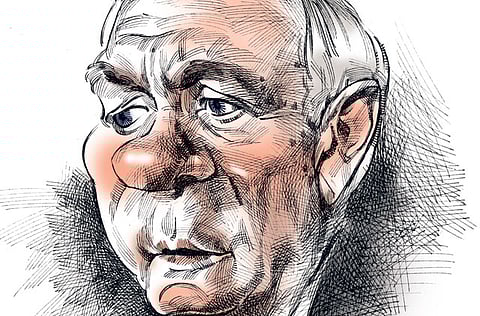
Returning from Islamabad on board his E-4B plane, Robert Gates was finally able to relax. His motto these days, he quipped, was the Danny Glover catchphrase from Lethal Weapon: "I'm getting too old for this." After a gruelling five-day trip to India and Pakistan, the 66-year-old Pentagon chief could be forgiven for having a feeling of "been there, done that". He first travelled to New Delhi as a White House official nearly 32 years ago.
In October 1986, while deputy director of the CIA, he flew secretly to Islamabad and was taken to a Mujahideen training camp close to the Pakistan-Afghanistan border. There, he saw Afghan fighters firing rocket-propelled grenades with lethal accuracy.
The only United States defence secretary to be asked to remain in post by an incoming president, Gates has a unique place in the Obama administration. A Republican, he was brought into the Pentagon by George W. Bush. After advocating, and then overseeing, the Iraq surge that Obama opposed at the time, he has become a trusted, even pivotal, figure in the new administration. An old Cold War hawk, Gates was central to the decision to commit an additional 30,000 troops to Afghanistan.
Gates does not have the international profile of his predecessor, Donald Rumsfeld. At the Taj Mahal recently, a tourist asked about the VIP visitor: "Bob Gates? Is that Bill Gates's brother?"
But despite his low-key demeanour, Gates is an accomplished Washington operator who has fewer enemies than most people who have spent the best part of three decades in government. He is also ruthless. In three years at the Pentagon, he has fired an Army Secretary, an Air Force Secretary, the chief of the US Air Force and the senior American general in Afghanistan. In addition, he forced the cancellation of the F-22 jet, designed to counter the Soviet threat but a pet favourite of powerful figures on Capitol Hill, and pushed for increased production of armoured vehicles to protect troops from improvised explosive devices in Afghanistan.
Perhaps the principal ally Gates has found within the Obama administration is Hillary Clinton, the Secretary of State. The double act — they have even appeared on Sunday talk shows together — is all the more remarkable because under many of the seven presidents Gates has served, the Pentagon chief and Secretary of State have barely been on speaking terms. Gates is better placed than any American official to help salvage the relationship with what is probably the country that can help or hinder what used to be called the "war on terror" — Pakistan. His position in Washington is assured and he also has the credibility of being the only CIA director to have risen to the top from entry level after beginning his career as a trainee spy.
Few have been dealing with the Pakistanis and the Afghans for as long. Among his most prized possessions is a 9mm Makarov semi-automatic pistol given to him by Ahmad Shah Massoud, the Northern Alliance commander assassinated two days before the 9/11 attacks in 2001. Massoud had personally pried it from the fingers of a dead Soviet colonel after a battle in the Panjshir valley.
With the Pakistani population virulently anti-American, Gates was in Islamabad with the difficult brief of encouraging President Asif Ali Zardari's government to act against Al Qaida and the Afghan Taliban in North Waziristan, where Osama Bin Laden is believed to be hiding.
Admitting a "grave mistake" in US policy in abandoning Afghanistan and cutting defence ties with Pakistan in the 1990s, Gates promised that America was in for the long haul this time. He also lavished praise on Islamabad for their operations against the Pakistani Taliban in Swat and South Waziristan over the past year. What America really wants Pakistan to do, however, is to confront the Afghan Taliban as well. With this is mind, Gates repeatedly made the case that "Al Qaida, the Taliban in Afghanistan, Tehrik-e-Taliban in Pakistan, Lashkar-e-Taiba, the Haqqani network — this is a syndicate of terrorists that work together".
At times, he overstated the case, arguing in Delhi that Al Qaida was "orchestrating attacks" using these different groups. In Islamabad, he conceded that "they don't operationally co-ordinate their activities, as best I can tell".
Pakistan grudgingly allows America to conduct drone attacks from Afghanistan inside its borders while publicly condemning them. These fuel anger against the US but Gates and other US officials are left in the invidious position of being unable even to admit that they are taking place, never mind with the assistance of Pakistani forces. Despite being a recipient of massive amounts of American aid — $15 billion since 2001 with another $7.5 billion having just been pledged over the next five years — Pakistan's cooperation with the US has been limited and ambivalent.
Public demands from Gates would be counter-productive and there are signs that his emollient, gently cajoling approach is helping to yield some dividends.
Life is calmer at the Pentagon under Gates. But with America engaged in two wars and led by a novice commander-in-chief whose political fortunes are flagging, he finds himself playing a central role in the very stuff of history.


