Key to the classical, according to Gergely Bogany
Hungarian pianist Gergely Boganyi believes there is rhythm in everything, even in the movement of our bodies
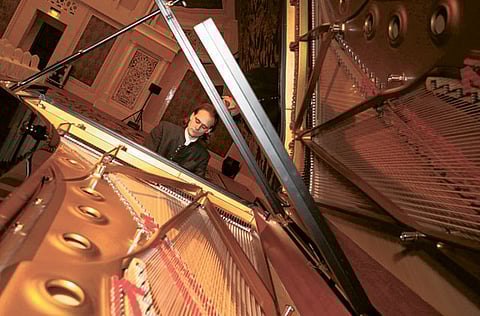
Professional musicians often commit pieces of music to memory. Others commit entire recitals to memory and prepare for performances for six months. Hungarian pianist Gergely Boganyi is different. Not only did he commit the entire works of Chopin to memory but he also then played the more than 200 pieces back to back over a single weekend.
"Classical music cannot be separated from life," he told Weekend Review in Dubai. "Classical music is already inside us, inside everybody; because the rhythm of our heart is music. Our movements are also rhythm — not artificial but very natural rhythm."
During a three-hour recital he allowed the audience to pick a Chopin piece which he would then play; something nobody had ever done before.
Boganyi studied at the Liszt Academy in Budapest, the Sibelius Academy in Helsinki and the University of Indiana in the US. However, he was a very young student, having started to play the piano at the age of 4.
This wasn't a choice by him, though, but by the instrument: "The piano chose me … all I remember is that the piano was satelliting itself … it was a magnet and I another magnet it was waiting to get glued to itself."
Boganyi did find himself glued to his piano last November, performing the entire Chopin oeuvre at the Muveszetek Palotaja in his native Hungary.
"Of the 230 pieces by Chopin, most of them are actually very complex — technically, spiritually, musically and also in their messages, all of them are different. It was a very, very, intense journey," the award-winning musician said.
The recitals ran over a weekend — a Saturday and Sunday — from 10am to 10pm with just short breaks. The cycle was divided into ten full recitals, one after the other.
While he was "entranced" during the marathon Chopin performance, he also had to be "very concretely present, physically".
Boganyi has won a number of awards including the International Franz Liszt competition in 1996 and the Hungarian Gramofon prize in the Best Concert Event and Performing Artist in Hungary category in 2001.
Playing in grand venues doesn't seem to have made much of an impression on him, however.
"I cannot say the Carnegie Hall in New York was the biggest experience in my life, because it was not. It was a very nice hall with very good acoustics and a very good audience, but I have experienced that in 850 other places too," he said.
"Actually, the message of the music is the same everywhere and the people are also kind of the same, because they are human beings. The cultural differences actually don't matter so much; a little, yes, but not so much, because the language of music is above it."
The 37-year-old is only interested in "good" music. This isn't necessarily related to any specific genre but definitely doesn't include pop music.
"The unfortunate fact is that more than 90 per cent of this pop music is inhuman. It's not meant for human beings, because it's an artificial noise, which is actually against human nature — very simple," he said emphatically. "There is nothing in humanity or in our environment that is rhythmically so brutal."
He uses the example of a forest. Trees aren't grown at exact distances from each other and are all different sizes and heights. "What this modern ‘noise' — I'm calling it ‘noise', not music — does is it artificially puts everything into the exact same pattern. Nothing is so even in humanity — nothing."
There is a lot of "good" music from the 1300s, he said, that is entertaining, sparkling and simple in form. The Classical and Romantic periods are his favourites, but he also listens to jazz.
"It's not the form that's important, not the length, not the style, whether it's from 1300, 1500, 1700 or from the 19th century, or Baroque, Romantic, Classical or even Modern. What really matters is whether the music is good," he said. A unique cultural life can be created in the UAE, the pianist said, because the region doesn't have "the ropes of the centuries" behind it.
The pianist occasionally gives master classes and greatly enjoys it, but often doesn't find enough time to teach. Boganyi was in Dubai as a guest of the Dubai Concert Committee, which recently celebrated its 15th anniversary, providing free classical-music concerts in the emirate.
It is a non-profit, voluntary organisation, supported by the patronage of Shaikh Ahmad Bin Saeed Al Maktoum, President of Dubai Civil Aviation and Chairman and CEO of Emirates Group.
Log on to www.dubaiconcertcommittee.com for more information.


