It's a kind of magic
That's what the reel world is to Norman B Schwartz. The instructor of the New York Film Academy, Abu Dhabi.
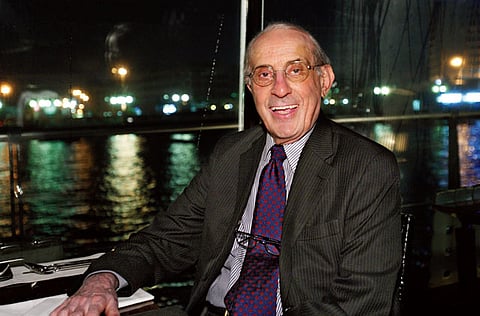
When Norman B. Schwartz graduated in film from New York University in 1954, where he was undergraduate assistant in the Motion Picture Department, he was convinced that he was so brilliant "the world would come knocking on my door".
Ah, the vagaries of youth, you might say, but admits Schwartz, "Modesty had never been my virtue and it took me a while to realise that nobody was really keen to offer me a job."
At this point in his life, however, it was an intelligent piece of advice he received that ultimately got him his first job in the movie industry.
Recollects Schwartz, "A very nice man I met said: ‘Look, every person I meet thinks he is a genius. But what is the one skill that you possess?'
I replied that I was good at splicing films - a technique used [before the computer era] in joining one piece of film, say a long shot to a close-up, which required you to cut the film, scrape it, and use a kind of glue to put it together. Hearing this, he advised: ‘Don't tell people that you are a director; tell them that you love to splice films'."
And so it was that from harbouring notions of being the world's greatest gift to the cinema industry, a young Schwartz began to spend long hours cooped up in a film studio "scraping films, applying glue and sticking it together".
And, in the process, he says, "I also learned to be modest."
From then on for the next 40 years, it was an upward journey in the film circles of both Hollywood and Rome. Schwartz's film career took off as a sound editor and then dialogue coach and director during which time he worked with everyone from Marlon Brando to Arnold Schwarzenegger.
Amongst his most noteworthy projects is his collaboration on the dialogue soundtrack of two Oscar- winning films: The Exorcist and E. T. - The Extra-Terrestrial. He also became the first postproduction (ADR or Automated Dialogue Replacement) director to be admitted to the Academy of Motion Picture Arts and Sciences.
At 60, Schwartz left Hollywood after studying as an auditing director with the well-known acting teacher Sanford Meisner and began directing theatre and teaching actors in Central California. Six years ago he joined the faculty of the New York Film Academy (NYFA) and has taught directing, writing and acting for their schools in New York, Spain, France, Italy and Hungary. Currently, he works as an instructor at NYFA in Abu Dhabi.
The UAE, he says, has become a harbour for people from all over the globe to bring their culture, their life experiences to a port, to a new meeting place, to an open and free market for a new wave of ideas. In this country, he adds, a new cinema will be born.
"We are therefore honoured to bring our wisdom and our knowledge to teach young people at the Academy who have come from near and far to learn how to make films," he says.
"What I like about working in the UAE," says 77-year-old Schwartz, "is that we are in a culture where age is respected. And as wisdom comes with age, I believe that if I have acquired any wisdom by making so many mistakes, then perhaps I can teach young people not to be as dim-witted as I was a long time ago.
"Today, I am at the time in a man's life when he begins to lose family and friends but what keeps me alive is that I have learnt from my mistakes. My hope is that if the youngsters listen to me say it again and again, perhaps they will be more intelligent than I was at their age."
I, ME, MYSELF
I love films which tell human stories. I admire spectacles and special effects but the films that I love are the films that say stories about families, boys and girls, about growing up, trying to make friends. These are the stories that touch me; and these are the kind of films that I would love my students to make.
I consider sound in films as a powerful tool to create a magical world.
I think one of the best movies of all time is E.T. When we made it, everyone thought it was just a children's movie but it succeeded in reaching out to the whole world.
I believe an entertaining experience is when someone comes along and makes us laugh about something we cry about; or makes us cry about something we would laugh about. That to me is art - when I am made to rethink the way I see the world.
I look upon actors as the most important part of telling a story other than the script. Many others, too, contribute to the making of a great movie but it is the actors who make the story come alive.
If I had to choose between the real or reel world, I would choose the reel world though unfortunately we live in the real world! If I could, I would go back and exist in the magic world of the films I love, especially those of Fred Astaire and Ginger Rogers - they would fight over something silly, then he would sing to her and she would sing to him; then they would dance and at the end of it, they would be happy again. I would choose to live in that world but so far I've never found a woman I could do it with! When we fight, we don't get up and dance, and even if we could, we certainly wouldn't dance as beautifully as Astaire and Rogers!
I am inspired by the truth.
I cannot imagine life without friends. One of the great joys of living in the UAE is the opportunity to meet new people. I have friends all over the world and from here, it is easier to travel all around the world to see them.
I think that some of the greatest and most innovative work is not those that we call ‘live action' - it is animation. If I could have worked on a modern-day movie, it would have been Ratatouille. It is an incredible film as it goes beyond what we could have ever imagined in my time.
When a film I have worked on bombs at the box office, my reaction is why and why not? Why have people not loved it? Very often, the answer is because the movie was ahead of its time; that people were not ready for it. For instance, when Enemies: A Love Story, based on a book by Isaac Bashevis Singer was released in 1999, it wasn't a success though I thought it was a wonderful movie. And I would imagine that 25 years from now, people will be echoing the same thoughts.
What I love most about post-production is that you can work on every second and millisecond of the film; that you have the control to change everything and the audience will not even realise it. In film, 24 pictures come by in a second. In post-production, you can work on one little picture for a week, and the final result is the culmination of a very creative process.
What I love most about making movies is working with gifted people - and there are so many. We work as a true family; it is a true collaboration. And nothing is as wonderful as when you come together with your contribution and you realise that all those gifted people have also brought in their best. Suddenly you are awestruck at what it eventually metamorphoses into - and that is cinema at its best.
I am successful because I am alive - longer than most of my friends!
I regret that I did not heed what my father tried to teach me - you will get much better in life if you keep your mouth shut. I believed so fervently in the truth that I thought every man has the right to speak the truth. I realised it only widened my network of enemies. I think my father was right when he said: ‘If you shut up, you will make many more friends and you will get much better in life.' Yes, I regret that.
I wish to have many more years of good life so that I can experience more of life and share the joys of life with young people and my friends.
I, ME, MYSELF
Me and my father
My parents were immigrants to the US. They lived in an ‘alien' world and went by the dictum that as long as you kept to yourself, all would be fine - we could earn a living and there would be food on the table.
My father's philosophy was: Keep quiet. Don't let anyone see who you are. Don't ask anything of anybody. Take care of your family and all else will work out well.
Like most sons would, I too rebelled against this idea and instead of keeping quiet, I spoke up; instead of staying in the house, I went to Hollywood, to Italy, and all over the world.
My father - if he were alive - would have said, why didn't you stay in our house, everything was fine here; what's wrong with our house?
The answer is there was nothing wrong in our house. But isn't it wonderful to find other houses, other cultures and other ways of doing things? Because of my work for the New York Film Academy, I teach in Spain, Italy, Hungary, France and Abu Dhabi. Everywhere I go I learn something different, especially here - how can one live in the UAE and not find something new to discover each day?
Me and my interest in movies
I was an art student, but a terrible art student, because I couldn't draw and my paintings were mediocre. But when I went to the cinema, I thought: My goodness! This is painting, this is art - there are images; this is acting - there is theatre and music. I thought to myself that I could do this and discovered I had a talent for it. So instead of the world producing another terrible painter, I turned out to be a very good director.
Me and my experiences with renowned directors
Some of the directors were extremely talented but terrible human beings; some were very wonderful people but very bad directors; some were very wonderful human beings and very talented directors but unsuccessful. All I can say is, every once in a while you get the opportunity to work with somebody who had everything, like Steven Spielberg - he is a very gifted human being, a very gifted director and a successful filmmaker. But finding such people was very rare.
Me and my thoughts on the modern cinema industry
Today's films generally appeal to adolescents, chiefly in the 18-21 age-group, but are made by older people. As these filmmakers want the youth to come to the theatre, very often the films kowtow to the sensibilities of immature people. And what are their sensibilities? Everyone is cynical; everyone is out to get what they want. What are the messages that come across? Don't trust anybody; everyone is a cheat and a liar.
This is what bothers me about films today - that they are cynical - as young people often are. My belief is that young people are also born full of hope; and that the youth would very much like to change the world. Perhaps they are discouraged because they don't see much change.
I believe, therefore, that directors have a moral obligation - not to cater to cynicism but to teach people to believe in the goodness of man.
Me and the New York Film Academy
The NYFA is a wonderful school because it believes in a hands-on approach. Instead of teaching only the aesthetics, our students go out there in the first week and start making films - usually bad films!
But the best way to learn is to make bad films until you gradually learn to make good films.
I think there is a great deal to learn about the technique of acting for the camera. It is very difficult to teach imagination or creativity. At the NYFA, we try to prepare people for the real world in the business of the technique of the job of acting.
Me and my role models
There are many people that I look up to but whose names will not be recognised because they are not well-known. What I admire in them is that they have lived a decent, honourable life in which, to the best of their abilities, they have not tried to hurt anybody. I've met many of these people around the world. They are not famous but one thing they have in common is that they are happy people, rarely rich. With the money they have earned, they have lived much better lives than those with millions.
Me and my philosophy of life
Do your best to do good to other people.
I, ME, MYSELF
What do young filmmakers in the UAE need to succeed? What are the challenges they face?
Beyond ambition, persistence and talent, it is the ability to make films that will appeal to a general audience that is the key for success. The great ancient oral tradition of Arabic storytelling can be transferred to the visual language of cinema and reach an audience worldwide. Emirati film-makers must strive to tell a story about their experiences, their family, and their world. Good small stories, human stories, will somehow always find an audience.
Look at Slumdog Millionaire. It has cut across nations and nationalities because it tells a universal human story. You don't have to be Indian to understand that story.
The obstacles young filmmakers face in the UAE today is much the same when I was a student: film is enormously expensive to produce and distribute. But the good news is that schools like the New York Film Academy offer training and scholarships. The Abu Dhabi Film Festival, for instance, has started a grant of $500,000 for film-makers from the Arab world. The Abu Dhabi, Gulf and Dubai international film festivals also offer prizes for the best new films in many categories.
Those in post-production are generally not thrust into the limelight as much as the actors and the directors. How do you assess the contribution of post-production to the success of a movie?
I have a very dear friend who once said to me: "We are servants; they are the masters. They are upstairs and we are downstairs. There is nothing wrong in serving people as long as you understand that they are not our friends. Work well and they will pay you well. But the day you begin to think that the master is your buddy, you are in trouble." That's the best advice I was given.
To the layman, the movie industry is all glamour. As a member of the film fraternity, how do you view this industry?
It is very glamorous, yes, but the best movie stars work as hard as any day labourers. To be glamorous and to be exciting is very hard work.
You have worked in both Hollywood and the Italian movie industry. Are there any fundamental differences in the way each works?
America has a very technical, scientific way of making films. People like to understand the science and continue to repeatedly follow the same scientific manner. But Italians have a completely different attitude: why do it the same way always, they ask? It is boring!
So the quality I learnt from the Italians is: Life is an improvisation. Let's do something different and if it goes wrong, let's improvise and fix it.
And I found that when everything was perfect and in its place, people hated it.
But when things went wrong and turned into a disaster, they said: Now, we'll find a way. I learned from the Italians that when you lose the joy of spontaneity, you also lose the element of creativity.
Do movies have a greater role than mere entertainment? What do you foresee as the future of this entertainment industry?
Movies can entertain but they can also educate. I believe we have a moral/spiritual obligation not to feed people the lies they want to believe in but to tell them the truth even if the truth is uncomfortable and they don't want to hear it.
I think spiritual values and family values are worth narrating. I would hope that when you talk of spiritual/family values, people will pay money to see it - but I cannot guarantee that! But I know if you say cynical things, people will pay a fortune to hear it.
I would like to see a new wave of cinema where human values are being repeated time and again so that people begin to believe in it because they are hearing them.
Is there a formula for success in the movie world?
No. Our great director Woody Allen once said: "The secret of success is to show up." If you are around as long as I am, you have a good chance of success! That's the formula I'm living by.
Is there a movie of yesteryear that you wish you had worked on?
I am a great admirer of French director Louis Malle's work. He had the ability to take a simple story about simple people in a village and make you think about the entire world. Indian director Satyajit Ray also had this gift. Malle's movies are so simple they are universal. When I see films like these, I wish I could have worked under these directors.
What are your new projects?
Currently, I do short films for the NYFA and I still write. Whoever comes to me with a project, I will always give my best.


