In China, migration takes a deadly turn
As the government goes on a land acquisition spree without proper compensation, farmers engage in bloody clashes with the police
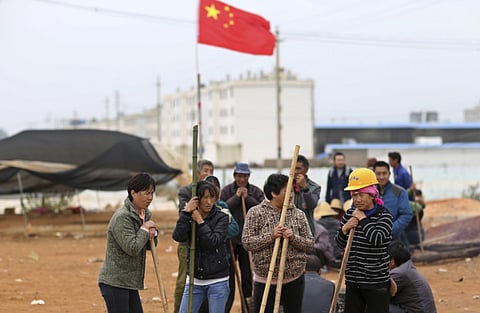
To the people, it looked like an invasion. For three years farmers in Fuyou village had been fighting the government-backed developer who turned their land into a giant construction site. Thugs circled after dark, threatening and sometimes beating the residents. Villagers armed with hoes and scythes had taken shifts guarding the entrance to their narrow streets.
Now, truck after truck packed with men in hard hats labelled “police” and carrying long staves, electric prods and riot shields rolled down the highway. Relatives working in a nearby town say they called ahead to warn that it was on its way. The villagers grabbed steel rods from the construction site, and waited.
The two forces clashed on the wide roads between half-finished buildings under the bright southern sun in China’s Yunnan province — more than 2,000 kilometres from Beijing. The crowd overturned three silver Chevrolets. Small running battles left men bloodied and beaten on the ground.
Villagers captured eight of the “police”, bound them with packing tape and plastic twine, and held them in the village function hall. On closer inspection, the outsiders had the same weathered peasant faces as the villagers. Their dark blue uniforms turned out to be ill-fitting security guard outfits pulled on over normal clothes. One woman called the real police repeatedly.
Late in the afternoon with tensions high, the villagers dragged four of the hostages out to the road, bound them together with a red cloth banner, and splashed them with petrol, demanding that the other side withdraw. Instead, they surged forward.
When the smoke cleared on October 14 last year, the charred and bloody bodies of the hostages lay still bound on the pavement. At least two villagers and two outsiders were found dead in nearby fields.
“We had no choice but to defend ourselves,” says one villager who asks not to be named for fear of retaliation. “If we hadn’t killed them they would have killed more of ours.”
The battle of Fuyou was remarkable for its savagery, but not for the fact that it happened. Land grabs are the top cause of unrest in the Chinese countryside and in the sprawling villages-turned-slums surrounding every city.
China’s rapid urbanisation has been driven primarily by the pull of higher wages in the city, and the opportunity to escape a life of back-breaking farm work. For three decades, cheap labour from the countryside has driven China’s “economic miracle”, as the nation’s premier, Li Keqiang, acknowledged in an address in March.
The rural population has dropped from 80 per cent of the total in 1980 to less than half now. Its contribution to the economy has shrunk even faster, to 9 per cent of gross domestic product from 30 per cent in 1980 — making the cities even more attractive.
But there is an uglier “push” factor too. One-fifth of China’s migrants have had no choice but to hit the road, because their land is gone.
Their numbers are staggering. A 2011 report by the Chinese Academy of Social Sciences found that between 40 million and 50 million Chinese migrants, from a total of 250 million, were landless due to expropriation. Another 3 million people would lose their land every year, CASS estimated.
Officially, Beijing welcomes urbanisation. But growing numbers of people lack the rights and access to services of urban citizens because they are classed as “rural” under China’s restrictive “hukou” registration system, and at the same time lack any farmland to fall back on. That could be a recipe for instability, especially as economic growth slows.
Independent calculations are even higher. The landless population has climbed sharply to 120 million from 40 million just 10 years ago, estimates Hu Xingdou, who researches migrant issues at the Beijing Institute of Technology.
For some Chinese, compensation for lost land is enough to fund a new urban life, or kick-start a small business as the city comes to them. But for millions it is not — setting the stage for desperate battles such as the one that convulsed Fuyou.
Almost half of Chinese villages have lost some or all of their land since the late 1990s, according to a 2011 survey by Landesa, an international land rights NGO. In nearly a quarter of those cases, the villagers were not compensated, the survey found. Research by the Chinese Academy of Sciences indicates that “mass incidents” — the official euphemism for protests or riots — are, not surprisingly, more likely to occur if locals believe they are not being fairly compensated for their land.
That is the case for about a dozen villages and 20,000 people farming the rich flat land of Jincheng township on the shores of Dianchi Lake, south of Kunming, Yunnan’s capital. Thousands of acres have been cleared to make way for the local government’s plan to transform the area into a $3.6 billion (Dh13.2 billion) “ancient city” tourist attraction with lakeside villas, high-rise apartments and, less scenically, an auto parts wholesale market.
Violent land grabs are common throughout China, but the scale of the seizure near Kunming is unusual.
In 2013, Jincheng saw four violent clashes. Almost exactly a year before the fatal 2014 battle of Fuyou, farmers in nearby Guangji village fended off police who had arrived with tear gas to arrest the land movement leaders. They briefly held 15 police and local officials hostage, until authorities agreed to back off. Forty villagers and 27 police were injured.
Across China, the number of violent clashes rose sharply after 2009, as debt-strapped local governments began selling land pledged as collateral to real estate developers. This has put local authorities, and the full weight of the security forces, squarely on the side of the developers.
In 2010, at least 16 land grabs or forced demolitions across China involved the death of at least one person, according to a “blood house map” compiled from state media, compared with only a handful of cases in the rest of the decade. More recently, a villager guarding his fields was burnt alive in Shandong province last year, when demolition crews set fire to his tent.
Farmland in China belongs to the state or the village collective, while the families who have farmed it for centuries legally only hold a 30-year title. Villagers have no say when the government sells the land to a developer, but those who put up a tougher fight can often wrestle a greater share of the revenues. When local governments are in desperate need, however, the face-off can get ugly.
The drive to sell often means that seizures for “development” outpace the natural growth of the city, contributing to the miles of empty ghost towns that surround many Chinese cities.
That appears to be the case along the south-east shores of Dianchi Lake, where prime farmland lies in ruins. Loamy black soil and the deep velvet green of vegetable fields peep out here and there amid a wasteland of rubble and bulldozed soil. Construction sidings trumpet the “China Dream”.
Resistance around Dianchi Lake is so fierce partly because farmers there make an unusually good living growing fresh vegetables that are packaged in local warehouses and shipped across China. Fuyou villagers were offered ¥90,000 ($14,516) per mu (15 mu equal one hectare). That is about four times the national average for compensation but less than other nearby villages received, and much less than the national formula based on a multiple of annual crop income.
“It seems like a lot, but around here it only works out to about two years’ income,” says the Fuyou villager. “Some people have nothing else to live on, they would have to leave to find work. Around here people don’t like to migrate. We like to stick close to home.”
That’s borne out by the statistics. Poor rural counties in China have seen an outflow in their registered population as working age adults leave to find work. But the population of Jincheng township has stayed flat. Young people find service jobs in nearby towns, while their parents continue to farm nearby.
Land grabs disrupt the transition to urban life by pushing people away faster and further than planned. Young adult migrants must support parents who have lost farming income. If village homes are destroyed, compensation funds can disappear into the cost of a new home.
That calculation is already weighing on the village of Anjiang in Jincheng township only a few kilometres from Fuyou. About 50 Anjiang villagers were injured in a pitched battle with demolition crews and police in April 2013.
Two years later, the village is surrounded by rubble although nothing new has been built. With nowhere to farm, many of Anjiang’s 3,000 residents have joined the “floating population” of itinerant agricultural labourers, leaving behind old folks and children.
“Before we were poor but the family was together,” an Anjiang shopkeeper says. “Now people are spread to the four winds.”
After the battle, paramilitary teams locked down Fuyou for two months. Villagers were detained in turns until they named those responsible for the murders. Nine months later, some families have no idea where their men are.
Even today at a checkpoint at the village entrance, guards monitor everyone who comes and goes. Cellphones are tapped.
“We live in such a remote and tiny place, I can’t believe that something like this would happen here,” says a townswoman in Jincheng who witnessed the Fuyou killings. “I used to believe this society was good, but now every time I hear the term ‘the nation’ I feel afraid.”
Ten months on, Fuyou’s rich fields are covered by the gigantic “Pan-Asia Auto Parts Trade and Commerce Hub”, a complex of thousands of warehouses that will open soon. It is part of a Kunming government plan to relocate 14 wholesale markets away from the city proper, despite the merchants’ opposition to moving two hours from any major population centre.
The project is one of the “top 100” for Yunnan province, according to the website of telecoms manufacturer-turned-property developer China Z-Stone, one of the four backers, and “is blessed to have the confidence” of the local county government.
The Fuyou villagers’ protests over compensation delayed the ¥8 billion project for several years, says a Z-Stone sales manager. “But now the problem is solved.”
–Financial Times


