Gorillaz - Are you ready for pop with depth?
The cartoon band's brilliant new album, Plastic Beach, is pop music with no barrier to entry
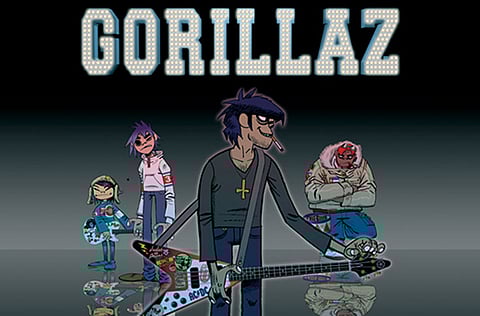
This month, one of the most popular British bands in the world return after a four-year absence. And when I say absence, I really mean it.
Gorillaz may have sold 12 million albums, conquered America, scored number one singles and won BRIT and Grammy awards, but when not on the campaign trail they are as camera-shy as their primate namesakes. Indeed, they've never been seen in the flesh.
Are Gorillaz the ultimate 21st century pop group? It's not just that they are so unapologetically a product of our virtual age, a computer-friendly chimera, a multi-faceted, multi-media, multi-million selling global brand who don't really exist at all. More importantly, they use all the technological tools and marketing chicanery at their disposal to create something utterly of the moment, pop that collapses barriers, blends and bends genres, challenging assumptions and preconceptions in ways that make the cartoon quartet seem bolder and more alive than their flesh-and-blood contemporaries.
Gorillaz' third album, Plastic Beach, is, by almost any standards other than their own, a peculiar beast. The list of collaborators gives some clue as to its musical range. Included are rap stars Snoop Dogg, Mos Def and De La Soul, soul veteran Bobby Womack, iconoclastic punk surrealist Mark E. Smith, rock legend Lou Reed, Chicago soul jazz instrumentalists the Hypnotic Brass Ensemble, the Syrian National Orchestra for Arabic Music and the surviving members of The Clash — Mick Jones and Paul Simonon — reunited in a recording studio for the first time.
The eclectic nature of this line-up is complemented by the way they are tossed together with an almost comical disregard for convention, a lust for musical riches somehow enlivened, rather than constrained, by pop instincts. To listen to Gorillaz is like eavesdropping on the information superhighway, bouncing between global communication satellites, mobile phone calls and internet streams. Each track verges on a cacophonic clash of random conversations and odd juxtapositions, ambient electronic bleeps, horn-fuelled retro soul and hip-hop jams barely strung together with translucent melodies and sci-fi lyrical surrealism. It is channel-hopping, multi-tasking, attention-deficit pop.
Ostensibly, there are four band members: brain-dead vocalist 2D, rock monster bassist Murdoc Niccals, Japanese guitar prodigy Noodle (now replaced, apparently, by an android) and ghostly hip-hop drummer Russell Hobbs. In fact, Gorillaz were dreamt up by Damon Albarn (just as his own first run of Britpop stardom with Blur was coming to an end) and counter-culture comic strip maestro Jamie Hewlett (creator of Tank Girl).
"We were flatmates," according to Hewlett. "One day, we were home watching MTV with our eyes just kind of glazed. If you watch MTV for too long, it's a bit like hell — there's nothing of substance there. So we got this idea for a cartoon band that would be a comment on that."
"We're the generation whose stars come from Pop Idol and celebrity-wrestling shows," adds Albarn. "It's all a bit like a cartoon, really."
It is hard to conceive of something more contrived in pop terms than a cartoon band. Yet Gorillaz are almost the antithesis of manufactured pop, exploiting the freedom granted by artificiality as a springboard for the imagination. When nothing is real, there are no limits.
Although Blur lost the Britpop battle with Oasis, Albarn has proved himself to be the real genius, with an eclectic creativity that has carried him through several projects. Gorillaz are where all his tastes converge, as if the donning of a mask allows him to reveal himself. Albarn has spoken of Gorillaz being a reaction to The X Factor and its attendant culture of "celebrity and voyeurism that's become the most essential thing in people's lives". He said of Plastic Beach: "I'm making this one the most pop record I've ever made, but with all my experience to try and at least present something that has got depth."
Gorillaz' "unreality" pop exposes Simon Cowell's "reality TV" cabaret for the anaemic parody it really is.
Gorillaz could be evidence that a new generation are finally fashioning pop music in their own image — if only it weren't being made by a couple of fortysomething Britpop veterans. But perhaps this is the final proof of Gorillaz modernity. This is pop music with no barrier to entry, the ultimate in self-invention, where all that matters is imagination.


