First drive: Audaciously styled Cadillac CTS-V Coupé
A 6.2-litre V8, 556bhp and dressed to kill. No the Cadillac CTS-V Coupé is not a concept
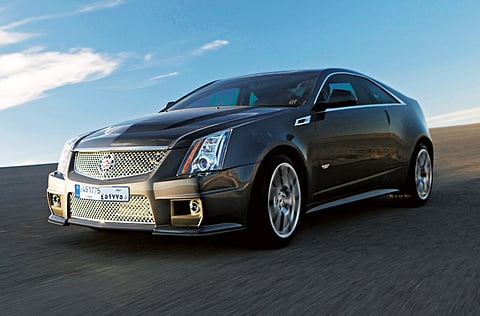
It's a bold manufacturer which announces that the target customers for its new sports coupé are the folks who currently buy from Mercedes, BMW and Audi. But then you need to be bold to offer a brash, angular design when all around you, competitors are heading down the well travelled route of sweeping lines and sensual curves. Let's not forget though that Cadillac is the company which brought us tail fins and space travel-inspired chrome bumpers in the Fifties, so ‘bold' and ‘brash' are probably right there after ‘all-American' and ‘angular' in the General Motors' dictionary of automotive adjectives.
Doubtless there will be buyers of svelte European cars who take one look at the CTS, decide immediately that it's far too ‘new world' and go back to polishing their lederhosen. But Cadillac is hoping that a section of young, affluent buyers will decide the CTS is a refreshing new take on an old concept and that, perhaps for the first time, they will look upon Cadillac as something more than a luxury mobile lounge.
But is it really a sports coupé? If you turn up for the game looking like a Detroit Lions' Defensive End, but play like a synchronised swimmer, frankly, you're going to drown. Fortunately, for prospective owners and lovers of mixed sporting metaphors alike, Cadillac has taken the less than subtle route, and gone the whole nine yards when it comes to equipping the coupés for performance.
The entry level car houses a 3.6-litre V6 engine with variable valve timing, capable of producing 305bhp and 370Nm of torque at 5,200rpm. Driving up very steep roads out of Beirut city and into the mountains, the engine was willing and the six-speed automatic gearbox was smooth to use, with practically indiscernible gear changes, so credit to GM's engineers for the set-up. The auto 'boxes come with Driver Select Control as standard or can be fitted with optional selection buttons on the rear of the steering wheel spokes. Keen drivers might prefer more of a paddle than a button because of the greater degree of access around the wheel, but that's a minor quibble.
Having taken the standard rear-wheel drive car up the mountain and the optional CTS-4 all-wheel drive version on the way back down, I found the latter to be slightly more engaging to drive, with marginally better feedback through the steering. It would be fair to say that the ride is firm in both models — perhaps Cadillac was keen to dispel any thoughts about ‘sofa suspensions' — but the potholed roads of a Beirut mountainside gave the passengers plenty to think about. That's not intended as criticism; I enjoyed the CTS's willingness to tackle the bends securely at high speeds, bearing in mind that at 1,773kg, this is one large chunk of American muscle. Suspension on the CTS is double wishbone at the front, independent multi-link at the rear, with limited slip differential as standard.
On the fast, flat roads of the UAE, most drivers are going to be more than satisfied with the entry level engine and rear-wheel drive layout, but in the Gulf ‘bigger is better', so to avoid disappointing customers who want that little bit more, Cadillac's hero spec model, the CTS-V, offers more than a little more. A whopping 556 horsepower and tarmac stripping 747Nm of torque to be precise, courtesy of its 6.2-litre V8 aluminium power plant. Enough to propel the 1,920kg, rear-wheel drive CTS-V from 0-100kph in 3.9 seconds. It's probably just as well they've fitted six pot Brembo brakes on the front, dynamic rear brake proportioning, and 380 and 373mm diameter vented discs on the front and rear respectively. As if to demonstrate the car's enormous reserves of power, as I leant forward preparing to take in-car shots of a colleague, the GM driver floored the throttle from stand still. Unprepared, I was thrown so hard against the seat back that the camera was knocked out of my hands and on to the rear seats. My advice; you might want to ensure your passengers are seated in an upright position before take offs and landings.
Attempting to recover the camera, I also learnt that access to the rear seats is pretty awkward. The combination of roof line, front seat belt mounting position and a passenger seat which doesn't move forward when tipped, led to some dramatic contortions.
Should you be so inclined, that combination of power and torque is easily converted into powerslides; either deliberate or accidental. With the traction control switched off, exiting a corner with too much right foot, which is almost unavoidable in the CTS-V, leads to the rapid realisation that this is a car designed to sort the men from the boys. Or in this politically correct world, the ladies from the girls. Should you push this car to its limits and if you have the brains and the brawn to do so without the use of traction control, then the Autodrome or Yas Marina circuit, not public streets, are the places to do so.
Leave the electronic aids switched on though and this is a highly rewarding road vehicle, one which almost demands that you push on harder, safe in the knowledge that the suspension and brakes can easily withstand the pressure. On those rough mountain passes, the ride was pretty stiff, in part due to the low profile tyres, but the reward is very satisfying road holding.
There's just a hint of understeer if you try hard to find it, but the car is well balanced in the corners and instills confidence. Once you buy it, I'd recommend you drive straight to Hatta or Jebel Hafeet to realise its true potential.
I ought to tell you about the cockpit in the CTS-V but in all honesty I don't remember how it differed from the standard Coupé. Unprofessional of me? Perhaps, but the truth is I was having so much fun that I failed to notice. Apologies to Cadillac's cockpit design guys, but hey, blame your suspension and engine development team.
The CTS-V utilises Cadillac's Magnetic Ride Control; dampers controlled using magnetorheology. What that means to you and I is that the compression rate of the material within the dampers is adjusted thousands of times a second electronically, allowing fine control and instant adjustment of the suspension as it travels.
There are two selectable settings, Tour and Sports, and naturally you'll be wanting to leave it in Sports and switch the traction control to ‘off' if you're planning on having fun. With an open road and someone else paying for the Michelins, forcing the tyres to momentarily suspend their relationship with the tarmac is possible, but apparently the traction control is never entirely off — GM's litigation conscious lawyers probably wouldn't allow it.
Cadillac has made a lot of progress in terms of the quality of the dashboard and controls, but still has a little more to learn. The majority of the materials were satisfying and well considered but a few odd ones seem to have sneaked in around the edges. Some of the trim and switches on the doors didn't quite match the quality of the rest of the cockpit, and on the centre console, a couple of panels which should have been a snug fit, weren't quite.
I also found that my head was brushing the underside of the sun roof trim much of the time, despite dropping the seat to its lowest position. I tend to prefer a more upright seating position than many drivers but if you're taller than 1.8m, check carefully that the CTS fits you. The seats were on the firm side of comfortable, however, after a couple of hours on twisting, turning roads, I suffered no aches or pains; having badly damaged two vertebrae a couple of years ago, I can spot an uncomfortable seat within ten minutes.
I came away from my day spent with the CTS-V pleasantly surprised. The styling is sure to divide opinion, but at least Cadillac dares to be different. After a long period of financial uncertainty it would have been safer to bring out a dull, generic coupé but instead Cadillac's management chose to stick their necks out. I admire them for that.
There's no mistaking the CTS-V Coupé for any other vehicle on the road and if Cadillac is to attract a new, younger clientele then there's no choice but to create a modern, more distinct brand image. Their latest creation, especially the CTS-V, is perfectly entitled to carry the title of sports coupé. And just because American sports happen to be louder and more colourful than most, it doesn't mean they shouldn't be played.
The Powerhouse
The CTS-V is powered by the most powerful engine in the Cadillac stable, the LSA 6.2-litre supercharged V8. It's essentially the ZR1's LS9 engine with a smaller capacity supercharger and slightly lower compression rate. It uses aluminium alloy cylinder heads and the intercooled Eaton supercharger features a four-lobe rotor design. The power is harnessed through either the Hydra-matic 6L90 dual disc clutch six-speed manual or the six-speed auto with paddle shifters.
The CTS Coupe
1. The CTS Coupé is a creation of Cadillac's own design studio, picking up heavily from the brand's Art and Science philosophy.
2. The final result is almost identical to the 2008 concept, but the main visual differences are the smaller wheels and the much smaller lower air dam.
3. Under the bonnet of the entry-level car is a 3.6-litre V6 engine churning out 304bhp, which is still a respectable figure, just a bit sad when viewed next to the CTS-V's manic 556bhp.
4. A clean design with intricately chiselled details is spoilt only by the rear fender, which although it features a pleasing arch bulge, is so tall it fools the eye into thinking the wheels are 16in.
RIVALS
Audi RS5
Although the Audi's handling is exceptional, it's actually the screaming 450bhp 4.2-litre V8 mated to a seven-speed gearbox that's the star. Sublime build quality means this German is a small step above, but at what price? The RS5 will be available this December, and even if dealers won't give us a price yet, we're expecting a high figure.
Shelby GT500
Even though the recipe is similar — big supercharged 5.4-litre V8 pushing 550bhp — the Shelby uses a heavy-duty six-speed transmission and puts power to a solid axle. Somehow, it manages to be even wilder than the Caddy, but much less sophisticated inside. Dh235,000 gets you a performance bargain.
BMW M6
The V10 engined M6 has long been considered a great GT, but no supercar, despite a mega F1-derived engine and super-fast gearshifts. Anyway, it's now out of production and unavailable at BMW dealerships, but you can pick up a Dh375k 414bhp M3 that will stick to the Caddy through any twisties. Straights are a different story though.
Specs & rating
- Model: CTS-V Coupé
- Engine: 6.2-litre V8
- Transmission: Six-speed auto RWD
- Max power: 556bhp @ 6,100rpm
- Max torque: 747Nm @ 3,800rpm
- Top speed: 320kph
- 0-100kph: 3.9sec
- Price: Dh315,000
- Plus: Spectacular styling, powerful engine, handling


