Safe and secure
Children need special equipment to stay protected in vehicles. Here is the low-down on car seats to keep them from harm
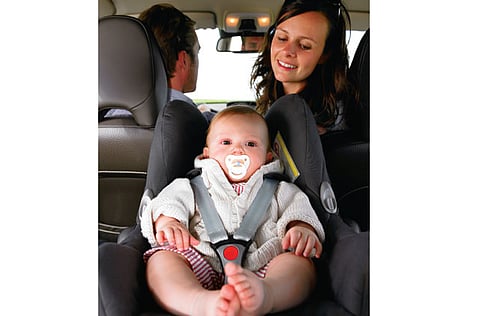
Imagine you're on Shaikh Zayed Road when a hulking SUV swerves in front of your car; you react quickly enough to avoid the errant driver, but collide with an RTA bus. In that moment, one you'll find yourself reimagining over and over again, anything that's not strapped down inside the vehicle will come flying forward after the car has stopped, including its passengers. If you're unlucky, you'll sail through the windshield and hit whatever amalgamation of concrete, asphalt and/or steel that awaits you outside, as your organs smash into each other or into bones. It's not a pretty picture.
Seat belts really work, and in the US, where seat belts have become ubiquitous in recent years, all states except for New Hampshire currently enforce seat belt laws. The efficacy of these laws and other safety campaigns can be seen in the 2010 fatality and injury data, which showed that highway deaths fell to 32,885 for the year, the lowest level since 1949 according to the US National Highway Traffic Safety Administration (NHTSA).
Special requirement
Statistically speaking, seat belt laws work, but the other strategy that has proved effective for the NHTSA is publicity — raising awareness helps save lives. Which is why it's important to note that seat belts and airbags are not as effective when it comes to the youngest segment of our population. Babies require special, but not necessarily expensive equipment to be protected in the car. According to literature based on international best practices, children under 13 should be secured in a car seat specifically designed for their age and weight.
In the UAE, media, government agencies and private businesses are all involved in getting the word out about keeping children safe in cars. Children's accessories store Babyshop, for instance, conducts roadshows at schools across the region that touch on the aspects that govern child safety in vehicles. Rahul Saxena, Head of Marketing, Babyshop, says, "[These roadshows] help deliver the message to children and parents. We have worked with Dubai's Roads and Transport Authority to create a demonstration module that shows the impact of collisions on children in a vehicle, with and without a child car seat."
One size doesn't fit all
Car seats are not a one-size-fits-all affair, and infant car seats are perhaps the easiest to spot as they're smaller than the others — but be sure you verify the specifications. Infant car seats accommodate babies from birthweight to about 13kg, or measuring up to 70- 85cm in length (depending on the specific model).
For greater longevity of use, you may wish to invest in a convertible car seat while your child is still an infant, allowing you to accommodate your baby for longer. But the equipment-testing boffins at Consumer Reports magazine advise against it. They say, "Infant seats, by their design, tend to be more compact and secure infants better when compared to larger convertible models." Convertible, in this case, just means accommodating babies from infancy through toddlerhood, making various adjustments as they grow.
Beginning with your child's trip home from the hospital, he or she should travel in the back seat of the car without exception. Carseat.org estimates that the risk of fatality is 30 per cent lower in the rear seat, and that's reason enough. Also critical is the orientation of the car seat; both NHTSA and the American Academy of Paediatrics recommend rear-facing car seats up until two years of age, or until they exceed the weight and height specifications of the seat. Babies have soft, vulnerable necks, and rear-facing car seats protect them from potentially fatal whiplash.
Dedicated, forward-facing car seats or child seats designed for children weighing about 8kg and above are intended for little ones old enough to support the weight of their own head. Remember though, rear facing is best until around two years of age.
Booster seats are for older children who no longer fit in their forward-facing car seats. A booster seat adjusts to a child's posture and is positioned in place with your car's seat belts — without the booster seat the seat belt can actually cause damage to little bodies, since it's designed for adults.
The child's booster seat can be disposed of when your child reaches around 145cm in height and is between eight and 12 years of age. Even after the belt fits, kids should be in the back seat until they are at least 13 years of age. Jill Ingrassia, Managing Director of American Automobile Association's Government Relations and Traffic Safety Advocacy department, released a statement cautioning parents against the temptation to change seating sooner than recommended: "Moving a child to the next step prematurely is actually a downgrade in safety. Children should remain in their car or booster seat until they outgrow it."
Fix it right
Once you select an age-appropriate car seat, there's still a good bit of learning left to do, according to carseatsite.org, which claims that child safety seat installation error and misuse rates reach close to 95 per cent in many regions. So make sure to read the instructions or seek training from an expert.
Safety is on the mind of car manufacturers as well. Brad Stertz, Corporate Communications Manager, Audi, explains that helping to protect children riding in Audi cars is one of their top priorities. "Something as simple as latch [Isofix] connectors for child safety seats are examined for opportunities to be safer and easier to use," he says. For ease of installation, Isofix base compatible car seats attach directly to Isofix anchor points available in most new cars. Once the Isofix base is installed correctly, you can then detach and reattach the car seat using a convenient quick release system. Most car seats can also attach safely using a standard shoulder harness seat belt, albeit with greater room for installation error if you're not clear on the design.
When in doubt, seek expert advice as many retailers in the UAE are prepared to assist with both product selection and installation. There's no doubt that car seats save precious lives. The only question is whether you're willing to pay attention or not.


