Making your home child safe
As your child becomes more mobile, make sure your home is a safe haven
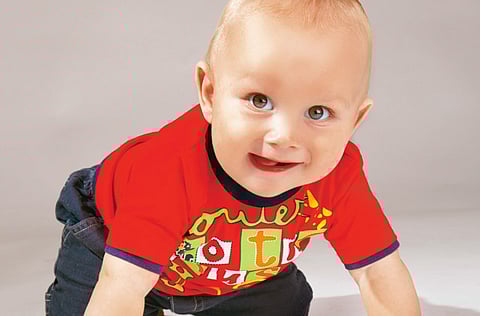
No sooner has your tiny baby outgrown his or her first outfits than you find yourselves with a crawling adventurer, ready to explore every nook and cranny of your home. But is your home a safe haven for your little one, or do dangers exist that could cause injury? And if dangers do exist, should you take all reasonable steps to eliminate any risk or should you teach small children what is safe instead?
Helen Christou, 31-year-old mother to toddler George, recommends parents buy a comprehensive childproofing kit and ensure everything is fitted and ready long before children become mobile.
"Look at everything in your home from a baby or child's perspective," Christou says. "Corners of coffee tables are often sharp and are usually at head height for babies just learning to pull themselves up, so you will need to attach protective covers; panes of glass in furniture can be smashed, so stick shatter-proof sheets to them; small fingers can easily fit into DVD players and even plug sockets, so fit guards and socket covers."
According to Safe Kids Middle East — part of a global network of organisations whose mission is to prevent accidental childhood injury — falls are the leading cause of hospitalisation and emergency department visits of all childhood injuries. "The most obvious risk at home is falling down stairs, so we made sure we had secure stair gates fitted at both the top and bottom," says Christou.
The danger zones
Mother of 11-month-old Olivia, Wendy Francis-Best, 34, says homes are often full of less obvious dangers from everyday objects and as such, vigilance is required.
"Anything leaning against a wall, such as an ironing board, can be pulled down so should be safely stored," she says. "And anything with small parts, such as dry cat or dog food, cat litter or coins, can be a choking hazard; check your floor several times a day to make sure nothing has been dropped."
Bathrooms and kitchens can pose a particular risk, according to Francis-Best. "Babies and children can fall head-first into the toilet, and bidet taps with hot water can be turned on," she says.
"Knobs on the oven are often within reach so turn the oven off at the main switch, and make sure toilet lids are latched closed.Crockery and cutlery should not be stored in reachable cupboards or drawers, nor should cleaning products such as bleach."
Francis-Best suggests keeping doors closed to prevent small fingers becoming trapped in hinges or between door and frame, while Christou fitted door-stoppers. "We found foam door-stoppers that attach to the top of the door and stop the door from being closed, but can't easily be seen," she says.
Safety lessons
Some parents, however, prefer to avoid placing restrictions within the home and instead focus on teaching their children safe habits.
"I think teaching children what is dangerous and off-limits is far better, and letting themlearn what things are and what they do rather than not letting them touch or do or try anything," says Karolina Nelson, mother of Louisa, five, and two-year-old Zach.
Francis-Best agrees. "We are constantly teaching Olivia what not to touch — it's never too early to start that, or teach your child what they can or cannot do," she says.
Nelson says completely restricting access to dangers may even backfire. "What is totally off-limits and banned often becomes more intriguing for children but if they know what [something] is, then I think they will grow up with more respect for certain things," she says. "Let them touch a cup of hot tea, for example, but never leave it so they can reach it or spill it over themselves."
Distracting technique
Nelson chose not to make any modifications to the family home when her children became mobile. "We tried to teach them what wasa no-no by just saying no and trying to reach them before they got to [the danger]," she says.
"We had to say no a million times anddistract them all the time but I found it better that way than covering everything up, [such as] all the sockets, because then when you do remove all the childproofing, all of a suddenit becomes very exciting again. This way, I found we managed to take the excitementaway from dangerous things and eventually >they just lost interest." Of course, Nelson says children should never be unsupervised in anarea containing dangers. "As much as children should try [things], obviously you have to look out for their safety first and foremostand never leave them unattended in areaswhere they aren't safe," she says.
Francis-Best agrees. "The safest environment for a child is a supervised environment," she says.
Swimming pool safety
Living in such a warm climate with many outdoor facilities means parents often have extra considerations such as pool safety. Safe Kids Middle East recommends installing four-sided isolation fencing at least five feet high around your pool, equipped with self-closing and self-latching gates, and ensuring the house is not used as one of the sides. Rescue equipment, a telephone and emergency numbers should also be kept next to the pool. Safe Kids Middle East says pool alarms and covers can be used to provide an extra layer of protection, but insists these should be used in conjunction with secure fencing and not relied upon to keep children safe.


