Controlled chaos
Known for exuding high energy in their crazy shows, Arcade Fire connect with their audience through direct, emotional passion
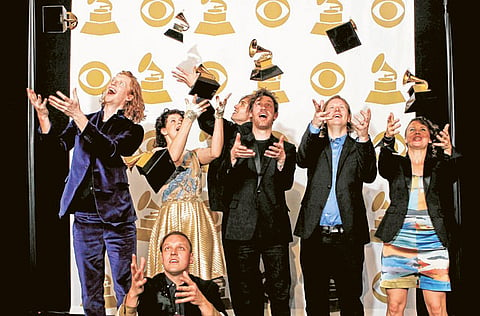
If you've never heard of Arcade Fire, you might be wondering what's so special about them.
That was the question being asked across the US following this year's Grammy Awards, when Arcade Fire, a band with no hit singles to its name, beat favourites Lady Gaga and Eminem to pick up the album of the year award for The Suburbs.
"Who is Arcade Fire?" became a top 10 Google search, while Twitter went wild: "NEVA HURD OF THOSE CHEATAS," wrote one US tweeter catching the general tone of outraged bafflement, "WHO R DAY? SUM SORTA VIDYA GAME?"
In the UK, Arcade Fire had already made more of an impression, having topped most album of the year polls; two days after the Grammys they would burnish their reputation by collecting two Brit Awards. Their last British gig was in Hyde Park in June, where they played to an adoring crowd of 60,000.
For the still uninitiated there are seven members of Arcade Fire (although the line-up is often supplemented for live performances) they formed in Montreal in 2001 and they are signed to independent US label Merge. They have released three extraordinary albums: Funeral (2005), an inspirational meditation on family deaths; Neon Bible (2007), their apocalyptic take on faith and consumerism; and last year's elegiac epic The Suburbs. They perform without archness or irony, untainted by notions of hipster cool and possess a kind of joyous bohemian grandeur. Precariously balanced between chaos and control, between internal meditation and urgently external communication, in their moment, Arcade Fire sound like the most vital group alive, the last great hope that rock 'n' roll is still valid.
‘Most conservative'
"A lot of people get really stuck in this idea that everything's been done, and there's nowhere left to go," says frontman Win Butler. "Rock 'n' roll is almost the most conservative form of performance art: you play your guitar, these are the moves, this is what the songs are about, and this is the energy.
"I always felt like there's so many sounds to make and things to talk about in songs. There's more to life than ‘I love you baby, la, la, la'.
"I approach it more like filmmaking: you would never say every film has been made. You just tell another story. I thought I would try and talk directly about common experiences that aren't that cool to talk about, which is the starting place for a lot of the art we do."
"I was blown away the first time I saw them," recalls bassist (and multi-instrumentalist) Tim Kingsbury. "It was Win and Regine [Chassagne, now Butler's wife] and a couple of other people, playing in a loft party in Montreal, and it was really a shambolic mess with equipment that didn't work very well, but there was something magical there."
Kingsbury, Richard Parry (guitar, cello and keyboards) and Jeremy Gara (drums) were all in another Canadian band and gradually the groups merged, with Win's brother Will and violinist Sarah Neufeld completing the line-up.
"The chaos is a lot more controlled now, for sure. When we first started touring it was a nightmare, we'd play a show and all of a sudden Win's guitar would cut out, and at the end we'd find a severed cable because Will had smashed a cymbal through it. But we were putting out so much energy it kind of made a good show, even if the music started to sound a bit crazy.
"The good thing about this band is there's always enough people to carry the show."
Butler says he never planned for Arcade Fire to be a large band. He moved to Montreal aged 20, to attend McGill University. "I was really just super open, and wanted to meet people and play as much as possible.
"Regine was so crazy talented, she could play anything, and Will was able to play different instruments, and it all fell into place. It's actually a pain in the a** to switch instruments on every song, but it just seems right.
"I was really sick of bands just ignoring the audience as a posture in rock music. And I think we fed off each other in terms of trying to engage the audience, not in a hammy way, but actually trying to be aware of the space that you are playing in, and trying to connect in some way through the music.
"When we all got together, we kind of brought out that aspect in our personalities."
Butler cuts an odd but imposing figure, his natural authority somehow enhanced by the bashful, goofy grin that lights up his face. Yet he is reticent in interviews, with a certain hesitance, as if wary of imposing himself, meeting many questions with a blank stare, or an uncertain "Umm". He is, perhaps diplomatically, unwilling to identify himself as leader of Arcade Fire. "We're not musicians for hire. We are a band."
‘Has personality'
Other members are less equivocal about Butler's role. "It's not a collective, where everyone's equal and no one's in charge," says Gara. "Win writes tons of material and he's a decision maker. He prefers to talk about having a directorial role, but he is a leader, as a personality."
Butler has a touch of the charismatic preacher about him, an air of other worldly spirituality. Born Edward Farnham Butler III, his father was a geologist, his mother a classical musician, and he was raised in her Mormon faith. He attended the prestigious Philip Exeter Academy in New Hampshire, doing creative writing and religious studies.
"I'm not practising, but everyone has a world view, and it comes from somewhere, and I think there's a pretty big vacuum without it. There's always some idea that people live by."
He speaks with appreciation of his "privileged" background. "We were very lucky, we had a lot of advantages and chances to do things that most people can't do.
"Our family is super-musical, there's nothing less shocking than being a musician. It would have been shocking if we'd become accountants."
In The Suburbs, Butler's lyrics evoke a bittersweet nostalgia for teenage innocence, a time of both artistic awakening and tribal division, when friendships are made and broken over the cut of your trousers. "I guess I threw my lot in with the artists, to see what would happen. That's still my tribe.
"Even as well as we do with the band, there are a lot more efficient ways to make money in the world. We went to a fancy boarding school and 60 per cent of the students ended up in investment banking.
"For myself, it is about trying to make something. The interesting thing about this job is you kind of have to stay a kid in a lot of ways, you have some weird impulse and follow where it leads. In a normal job you probably spend a lot of time trying to brush those thoughts away and get on with it."
There is an intense idealism at the core of Arcade Fire, although Butler seems uncomfortable acknowledging it. They perform with a direct, emotional passion, intent on making a connection, and ready to try and take the rock audience to a higher spiritual place. "We don't think about our audience when we're making music, it's a selfish impulse," insists Butler.
"But when we're putting it out in the world, I want it to be of service."
"We want to experience the same thing as the audience," says Gara. "This euphoric spirituality, if you will, its why we work together as people and friends, you're chasing this weird, unexplained musical experience, trying to get soul from it, magic. We all seek it in different ways."
Kingsbury adds, "When the band's playing and it's a good show, I get the feeling that this is where I'm supposed to be right now, this is exactly what I'm supposed to be doing, It's a really good feeling."


