Bentley Continental GT is a mean machine
The Bentley Continental GT has always been an impressive car, but can it be improved upon?
I learnt to sail on a remarkable stretch of water called the Pentland Firth, across the northern top of Scotland where the Atlantic and the North Sea meet, in a series of small open dinghies. These diminutive craft bobbed and skipped across the tumultuous bay, chopped around sailing marks and scampered for the line. The key to success was maintaining momentum, a task made all the more difficult by their relative lack of weight. One good wave could stop them almost completely dead in the water.
Only later did I discover the delights of long-keel craft, sailing an eight-metre cruiser-racer in the waters of the Clyde, before moving on to even bigger yachts such as Drum. These beautiful boats were utterly unperturbed by the small chop that so much upset our little dinghies, their sheer weight carrying them around a mark and settling into a steady and rapid reach with barely a ripple of movement.
It was a sensation that was powerfully recalled when I found myself behind the wheel of the new 2011 model of the Bentley Continental GT. Nor does the analogy end there - it is worth knowing that speed through the water is a function of waterline length, which means that the longer the yacht, the faster it goes. Being passed on the water by a 27m classic Fife under full canvas is a shocking experience for something that looks so sedate at rest.
We first experienced the Bentley Continental GT in 2003. Then, it was a completely new design, a two-door coupé based on the platform underpinning Volkswagen's Phaeton, and incorporating the twin-turbocharged compact W12. It was a bold move, and ultimately a very successful one - the car has consistently and substantially outsold its VW counterpart, and remains Bentley's biggest-selling model to date.
Eight years later, the Continental GT has built a loyal fan base, and spawned a number of variants - sports versions, convertibles and four-door Flying Spur derivatives. Now, the time has come to update this successful car, though at first glance the revisions appear so slight.
What's the difference?
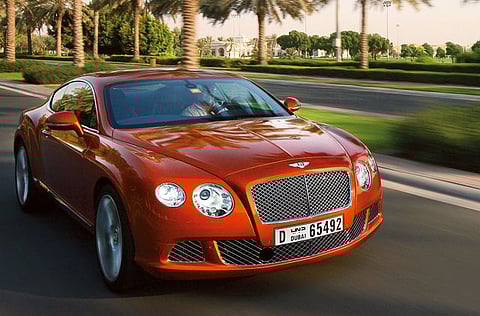
A sharp-eyed fan will see the difference between the old and new headlights, with integrated LED running lamps now encircling each lens. New "superformed" alloy wings (a sophisticated form of metal pressing developed for the new Mulsanne) allow sharper lines and curves unachievable by conventional means. The waistline is higher, the haunches more prominent and muscular. In fact, it is only when you park the two cars side-by-side that you realise how extensive the revisions are. It is indeed a very successful refresh of an already great design.
Inside, the revisions are equally extensive. There's a new High Resolution 20cm touch screen display through which you can adjust almost all of the car's dynamics, and which provides the interface for navigation and entertainment systems too. Our particular car was finished in a bold "Flame Orange" metallic paint, hand-applied and mirror-smooth throughout, and this was complemented by Imperial Blue leather with contrasting stitching and embroidering in orange thread.
The seats were optional "Muliner" design with diamond-pattern stitching, and very comfortable and supportive they were too. Both cooling and massage options were incorporated in our test car.
Where there was wood, there was beautiful book-matched veneer, which blended in perfectly with our bold orange exterior. There are few finer places to sit than inside a modern Bentley.
Under that long bonnet is the familiar twin-turbocharged 6.0-litre W12, now producing 567bhp and 700Nm of torque (up 15bhp and 50Nm over the previous version). Power flows through a ZF-sourced six-speed automatic, here tuned to deliver quicker shift responses and double-downshift capability for enthusiastic driving. All-wheel drive continues, but the torque split has been changed to the 40:60 front-rear set-up first encountered in the Supersport, for better feel and more rear-wheel drive characteristics.
It's leaner and meaner
The new Continental has also shed a bit of weight - 200kg to be precise - though it still tips the scales at a not insignificant 2,320kg. Nevertheless, the power and torque available are sufficient to propel the car to 100km/h in 4.6 seconds and on to a top speed of 318km/h.
However, it is the imperturbable manner in which this is accomplished that most impresses - no matter how brutal you are with the throttle, all you hear is a muted roar from the engine and the world around you goes silently into reverse. Wind noise is almost completely absent, and the air suspension eliminates transmission of any intrusion from wheels or road. You can raise the air suspension for better clearance over speed bumps, and it lowers automatically at high speed for improved performance. It is always supremely quiet and composed, unperturbed by minor imperfections and riding imperiously over large ones.
Most of the time at the wheel of the Continental you are aware of how little of the outside world intrudes. There's very little noise, the ride is superlative and steering is precise and accurate. You surf around on a wave of torque, cosseted and comforted as the world drifts by. But never forget that Bentley's original purpose was to build "excellent, fast cars" and look for the "sport" setting - simply press the flying "B" on top of the gearshift and the Continental is a car transformed. It feels as though it has shed a third of its weight, shifting from eager to enthusiastic at the press of a button.
Now there is absolutely no question about the second half of Bentley's ambition, and the Continental attempts to rewrite tectonic movement as it lunges for the horizon. Few cars enjoy such duality of nature, and the darker side of the Continental is a delight to explore. It is never going to be a lightweight sportscar, but the Continental's raison d'être is different. This is primarily a gran turismo, a car for travelling vast distance in absolute comfort, to cross continents and cultures while cosseting its occupants through every swift kilometre. While quiet and composed in the throng of a city, the Continental GT yearns to be given its head on a long and open road. What a car this would be to drive across a continent.
The introduction of the original Continental marked a change of direction for Bentley, a move away from the purely hand-built tradition into a new era where the best of modern automation could be combined with the bespoke to create a new breed of supercar. And so it is in the Continental GT, a fusion of the finest engineering, technology and construction with traditional craftsmanship and manufacturing skills. No two cars are ever identical, yet in the new Continental GT, they all aspire to the same pinnacle of achievement, to set the benchmark for what a supercar can be.
Inside info
Built in: Crewe, England
Engine: 6.0-litre W12 twin turbo
Output: 567bhp/700Nm
Transmission:six-speed automatic, permanent 4WD
Performance: 0-100km/h in 4.6secs, 318km/h max speed
Jonathan Castle is a Dubai-based freelancer


