Auto matters: Oiling the wheels
As the summer heats up it puts additional pressure on your engine's moving parts
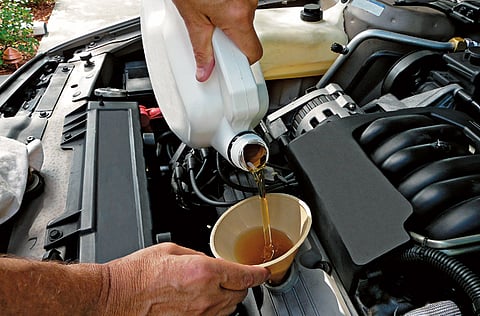
Let’s face it, for most drivers, oil is oil, something that gets changed occasionally when their car goes in for a service and for the rest of the time gets completely ignored. It’s not as if it’s going to make any significant difference to the performance of your car, is it?
Well, actually, it is. You might have spent many thousands of dirhams tuning your car’s engine, but a fill with cheap lubricant is all it takes to kill it.
Why bear all the expense of having an engine stripped, polished, balanced, blueprinted, ported and tweaked, if you’re not going to invest in a decent oil to help it achieve maximum potential? An engine is only as good as the oil you put in it, and the more performance you demand, the better oil you’re going to need. Here’s why.
Internal combustion engines of all shapes and sizes contain a large number of metal components that move against each other. Bearings turn, pistons rise and fall in the cylinders, camshafts bear on followers and chains slide over tensioners. All these components need to be lubricated because a lack of lubrication leads to rapid and catastrophic failure.
The secret is to keep the metal surfaces apart, separated by a molecule-thin layer of oil. When the surfaces glide over each other, everything works perfectly.
So how to choose the right oil? Basically, there are three main categories and depending on the performance of your engine, one is right for you. The first is mineral oil — basically a refined version of what comes out of the ground and was the industry standard for a great many years. Next is part synthetic, which combines regular mineral oil with a proportion of synthetic oil. And then there’s fully synthetic, which is an oil manufactured to very precise tolerances, and that offers much better standards of lubrication, viscosity, temperature control and longevity.
Fadi Dawalibi, PCO market space manager for Castrol suppliers BP Middle East, explained the differences. “For Castrol, you can recognise the differences by the following grades. Castrol GTX 20W-50 is a full mineral engine oil that fights sludge better than industry standards. Castrol Magnatec 10W-40 is a part synthetic engine oil with unique molecules that clings to metal parts to ensure best in class start-up protection. Finally there’s Castrol Edge, a 5W-40 fully synthetic engine oil for advanced performance engines.”
What do the numbers mean? Basically, they indicate that it is a multi-grade oil, designed to offer the benefits of both low and high viscosity oils. The first number, 5W, 10W or 20W (the ‘W’ stands for ‘winter’) shows the viscosity of the oil at low temperatures. Not so critical here, but where temperatures plummet you need an oil that will stay thin at low temperatures to aid starting and allow your engine to turn easily.
The second number is how the oil will perform when it reaches 100-degree Celsius and so provide better protection at high temperatures.
Ain Rashid, customer relationship manager for AXCL Gulf FZE agrees. “For normal passenger cars including saloons, we recommend mineral-based engine oil with an API grade ranging from SF to SM. For 4x4s we recommend mineral-based SL grade oil with SAE 20W-50 considering the climatic condition here in the UAE. We also recommend fully synthetic motor oils for high-performance sportscars and SUVs.”
The SL and SM designation refer to standards set down by the API (American Petroleum Institute) and will appear on most oils, along with similar gradings from the ACEA (Association des Constructeurs Européens d’Automobiles). The SM specification was laid down in 2004 and means improved oxidation resistance, deposit protection and wear protection and better low temperature performance over the life of the oil compared to earlier categories.
No matter which oil you choose, it is worth investing in the best you can afford. Being aware of the condition of your engine’s oil, and changing it regularly, is probably the single most important thing you can do to preserve your car’s performance and extend its lifespan. If you haven’t looked at your dipstick in the last six months, do it now!


