Tristar: “Safety is not what we do, it is who we are”
Global safety day engagement ranges from hazard perception to mental resilience
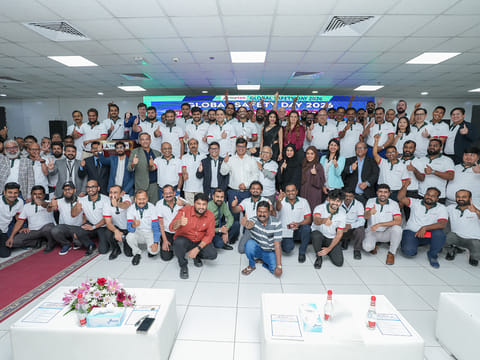
When dialogue is placed at the centre of an employee programme, instead of just display or declaration, the message gets indelibly reinforced. On 28 April, the Tristar Group ran a hybrid safety programme, with staff in attendance at its Jebel Ali headquarters, and livestreamed to colleagues located at offices around the world. The unifying message for the Group’s roads, fuels, maritime and warehousing verticals was presented under the banner, ‘Safety is not what we do, it is who we are’.
Global Safety Day aligns with the International Labour Organisation’s World Day for Safety and Health at Work, which this year, spotlighted psychosocial safety – recognising the impact of workload, stress, fatigue and workplace culture on employee wellbeing. Tristar’s emphasis on preventing harm reflected a wider shift from rules and compliance to awareness, judgement and shared responsibility at work.
The programme opened with a short film produced and directed by Tristar employees, featuring members of staff and their families, and connecting various worksite protocols with the people who wait at home for them.
In his welcome address, Shivananda Baikady, General Manager of Road Transport and Warehousing, introduced the concept of barrier thinking: anticipating points of failure and reinforcing the controls of equipment, processes and behaviours can prevent minor errors from escalating. Safety teams drawn from across departments exchanged practical guidance on how best to identify hazards, when to step back from a task, why raising concerns is critical, and the importance of routine behaviours that limit risk.
Guest speakers addressed broader safety concerns. Thomas Edelmann, Managing Director of Road Safety UAE, highlighted the risks of distracted driving and urged motorists to treat attention as an active safety discipline. Amena Japanwala, Senior Leadership Coach and facilitator at Agility Kuwait, addressed workplace mental health by offering practical ways to manage pressure and build more resilient teams.
A highlight of the programme was the recognition of safety excellence across the organisation, honouring employees who act decisively to prevent harm. Awards were presented for the most effective safety intervention, early identification of hazards, and for outstanding performance across safety, security, environment and quality. The Emergency Response Teams of Tristar Uganda and Tristar Oman received special recognition for actions that exceeded operational and workplace expectations.
Closing the session, Sridhar Srinivasalu, Tristar’s Group HSEQ Manager, returned to a central idea: safety is shaped by small, consistent choices – maintaining attention, reporting near-misses, and intervening early. He emphasised how active engagement helps uphold Tristar’s exemplary safety records across operations. The scale and dispersion of the Group’s operations were reflected in the audience interactions, with more than 775 employees participating in person and via live broadcast.
As part of the Global Safety Day activities, delivery drivers in the UAE also participated in specialised training sessions conducted at the Road Transport and Warehousing head office in Dubai’s Jebel Ali. Classroom instruction and practical training focused on hazard perception, and practical manoeuvres such as coupling, decoupling and controlled reversing, skills that strengthen critical competencies for safe road transport operations.
This initiative is part of Tristar’s continuous efforts to reinforce safety and responsibility across its global operations. The Group nurtures a proactive and preventative culture that prioritises the health and wellbeing of employees, contractors, customers, and the communities in which it operates.


