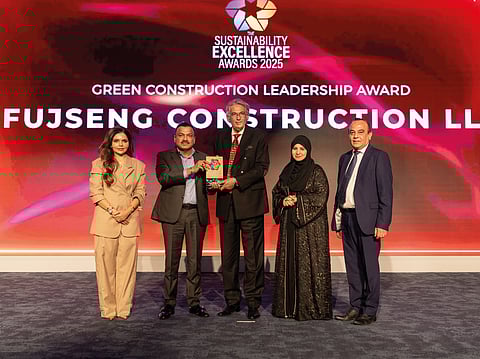
The Sustainability Excellence Awards 2025: FujSeng Construction LLC wins Green Cosntruction Leadership Award
Driving the narrative for sustainable, low-carbon construction practices
What has inspired our organisation to focus on sustainability?
FujSeng’s focus on sustainability is inspired by the visionary leadership of the UAE, whose strong commitment to environmental stewardship and long-term national resilience sets a clear direction for businesses. The leadership’s proactive initiatives and enthusiasm to protect the planet for future generations motivate us to align our operations with the UAE Net Zero 2050 goals. As a construction company employing approximately 2,500 professionals across civil and MEP works, aluminium façade, steel, and facilities management, we recognise our responsibility and capacity to reduce carbon emissions. By adopting efficient construction practices, optimising resource use, and integrating sustainable technologies, we can create measurable impact. We are proud to contribute toward achieving the UAE’s 2050 objectives and to play a meaningful role in building a sustainable future for generations to come.
Which achievement in your sustainability journey are you most proud of?
The sustainability achievement we are most proud of is the successful optimisation of HVAC performance in one of our key projects. Despite high energy consumption, the installed systems failed to maintain required comfort conditions and resulted in excessive relative humidity, causing mold formation and damage to valuable assets such as paintings and leather furniture.
Our team conducted a detailed technical assessment, identified the root causes related to system design and control strategies, and implemented targeted corrective measures. As a result, indoor comfort and humidity levels were fully restored in line with international standards. More importantly, the optimised solution reduced overall power consumption by approximately 40 per cent. This achievement reflects our commitment to data-driven analysis, operational efficiency, asset protection, and delivering sustainable, high-performance built environments.
What was the biggest challenge you faced and how did you overcome it?
The biggest challenge we faced was managing multiple constraints simultaneously, including intense pressure from client representatives, timely availability of critical materials, uninterrupted site access, and approval of our commercial proposal.
We overcame these challenges through a systematic, structured approach based on robust project management and engineering controls. This included conducting detailed technical assessments, developing a phased execution plan, and performing risk and constraint analysis to prioritise critical activities. We implemented proactive stakeholder coordination, value engineering to optimise cost and scope, and a clearly defined method statement aligned with site conditions. Additionally, procurement scheduling, alternative material evaluations, and controlled access planning ensured continuity of work. This integrated approach enabled effective decision-making, minimised disruptions, and ensured successful project delivery within agreed timelines and performance requirements.
How do you measure the impact of your sustainability initiatives?
We measure the impact of our sustainability initiatives through a structured, data-driven performance framework. Key performance indicators are defined for energy efficiency, carbon reduction, water use, waste diversion, and indoor environmental quality. Baseline data is established and compared with post-implementation performance using energy meters, BMS data, and utility records. In civil construction, we track material optimisation, use of low-carbon concrete, and reduction of construction waste. For aluminium and façade works, we measure thermal performance, recycled content, and façade airtightness to reduce cooling loads. Performance audits, benchmarking, and lifecycle cost analysis validate results, ensure continuous improvement, and confirm alignment with the UAE Net Zero 2050 sustainability objectives.
What advice would you give to others striving for sustainability excellence?
Organisations striving for sustainability excellence should begin with a clear strategy aligned with national and international sustainability goals. Establish measurable targets supported by data-driven KPIs and integrate sustainability into design, procurement, and execution phases. Early-stage technical analysis, value engineering, and lifecycle assessments are essential to optimise energy, materials, and operational performance.
Engage stakeholders across all levels, from leadership to site teams, through training and accountability frameworks. Adopt innovative technologies, efficient construction methods, and sustainable materials to reduce environmental impact without compromising quality. Continuous monitoring, audits, and performance benchmarking should be used to drive improvement. Most importantly, view sustainability as a long-term business enabler that enhances resilience, efficiency, and value for future generations.


