His point of view
Indian actor and director continues to make his kind of cinema while having theatre-goers in fits of laughter
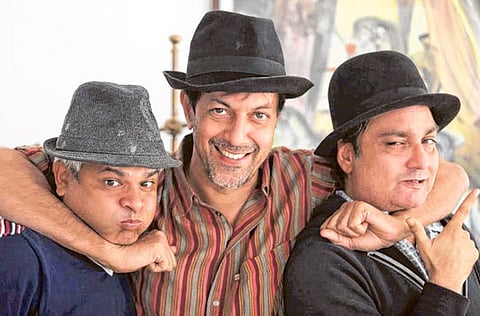
Film actor and director Rajat Kapoor was 6 years old when he first saw a clown. “It was probably at the Ramleela in Delhi or at Gemini or Apollo circus,” he says. “I remember getting friendly with the clown — he even invited me to his tent-cum-dressing room backstage. I felt special and privileged because suddenly I was a friend of the ‘star’,” he says. The encounter had a profound effect on Kapoor with serious repercussions, one of which has resulted in “a lifelong obsession with clowns”. “For us, the children, it was always the clown who was the star at the Ramleela, not Ram, Sita or Ravan. And needless to say the clown was always part of Ravan’s troupe, the bad guys so to speak,” he adds. And this is a sensibility that he has managed to retain in both the films he makes and his work in the theatre, replete with clowns and characters with shades of grey.
But why it has to be clowns remains a big question. It is something that he admits happened instinctively, even as he tries to explain. “Because a clown is able to cut away from all social moorings and conventions and get straight to the emotional core and articulate an emotion in its purest form. I also feel the clown, for me, has become a metaphor for all performers, so maybe using a clown gives me a chance to look at everything from a performer’s point of view. I say ‘maybe’ because I’m not sure even as I try to articulate and find reasons for what I do instinctively, and you know well that reasons are more often than not justifications and fall short of the truth.” The self-deprecating humour of the red-nosed clown who would rather have audiences laugh at him than fail at making them laugh altogether continues to be evident in most of Kapoor’s works, be it films such as “Raghu Romeo”, which went on to win a National Award and travel to a slew of film festivals across the world, or “Mithya”, which incidentally had the makings of Shakespeare’s “Hamlet” transposed to a gangster setting in Mumbai.
The affable actor who is best known for his roles in Farhan Akhtar’s “Dil Chahta Hai”, Mira Nair’s “Monsoon Wedding” and Sagar Bellary’s “Bheja Fry” is also one of the few film directors who have managed to continue working successfully in theatre in spite of his hectic film schedules. His first experiment with clowns was the hugely successful play “C for Clown”, starring Atul Kumar, Ranvir Shorey, Vinay Pathak, Joy Fernandes and Sheeba Chadha, made 15 years ago. The play was created as a tribute to silent and black-and-white cinema, of which Kapoor is a big fan, and to the genius of Chaplin.
“C for Clown” combined slapstick featuring interesting body work and physical movement on stage with a narrative that did not rely on words. And the best part — the actors spoke in gibberish, a made-up language with some English words thrown in. “C for Clown” went on to do more than a hundred shows and became one of the most acclaimed plays in Kapoor’s oeuvre. His next take on clowns resulted in another play, “Hamlet — The Clown Prince”, which was created as a sequel to “C for Clown”, and his most recent theatre production is a Shakespeare-clown adaptation called “Nothing like Lear”.
Kapoor continues to be among the handful of film directors in India who have managed to stay away from the glossy, star-centred commercial Bollywood circuit by continuing to make small independent films that have fortunately found a niche audience in the in last two decades. His tryst with cinema started in the early Nineties as a graduate of the acclaimed Film and Television Institute of India (FTII). His first film was a short, on Hindustani classical music, called “Tarana”, which won the National Award for the best short film and for best cinematography. His first feature-length film “Private Detective”, made in 1995, is, however, yet to see the light of day.
“I finished the film in 1997. Naseer (Naseeruddin Shah) played the private detective. It was also the first film for many other actors such as Aly Khan, Irrfan Khan, Kenneth Desai and Kashmira Shah. Unfortunately the film was never released. I had to wait until 2004 for my first release, ‘Raghu Romeo’,” he says. “Private Detective”, along with other films directed by Kapoor, was screened in Amsterdam two years ago as part of a Rajat Kapoor retrospective.
His latest release, “Fatso”, a charming tale of a man trapped in a fat person’s body, came and went without a trace. His next film “Ankhon Dekhi”(seeing is believing) — said to be a tale of a man who refuses to compromise on his honesty, so much so that he believes only what he sees — is set to release early next year. Of the films he has made so far, “Mithya” was what he calls “a bonafide commercial success” while “Mixed Doubles” also made some money. Given today’s multiplex culture that takes all kinds of cinema to an audience, the big question is how difficult it is for a filmmaker on the fringes of Bollywood to continue making his own kind of cinema. “Very difficult,” he says, instantly. “However, there was a brief time between 2005 and 2008 when our kind of films found both producers and audiences. That period went away as surreptitiously as it appeared, and the big Bollywood blockbuster has made a comeback since then.”
The tribulations of being an independent filmmaker starts with the agony of looking for funding or finding a producer and ends with the helplessness of not managing a theatrical release for the finished film, all of which Kapoor has suffered over the years. “But I’m always an optimist. The cycle will turn again, not that anything is going to change much — the big blockbuster with a good-looking hero and lovely dancing heroine will always rule in India. But I’m fine with that as long as we can continue to make some films on the side, some of them will be released in cinemas and others will be watched online — just as long as we continue to make them, because the joy is in making them and the good thing about cinema is that it lasts. And somebody is going to watch our film someday, even if nobody is watching them today.”
Kapoor admits readily that most of his films have been possible because he works on a low budget, which enable his producers to recover their investments quickly. “This is the Woody Allen model. His films, it seems, are made for so little money, that they are not dependent on theatrical revenue at all because the films recover through ancillary sources — satellite, DVD and VOD rights. Which is why Woody saheb has made some 40 films in 40-odd years, and this understanding has allowed me to make the films I want to, without anyone telling me to change this or that. And I find myself in a very fortunate space, where I have complete freedom to make my films the way I want to make them.”
While films are a different kettle of fish with erratic schedules and unpredictable release dates, his work in the theatre has been prolific, with “Hamlet — The Clown Prince” performing more than 160 shows across the world, something that has kept Kapoor on his toes, in fact more than his work in cinema. “Thank God for theatre because it has kept me going,” he says. “Making a film takes a long time whereas making a play, not so long. There were long periods where I could not make a film, and I would have been suicidal — not really, but you know what I mean — if it wasn’t for theatre. The joy that theatre offers is of a very different flavour from film, and I’m addicted to both.” Even as “Hamlet” travels the world, his latest theatre production, a one-clown show with Vinay Pathak, has received rave reviews and in a sense completed his clown trilogy on stage.
Did he ever imagine that this work in theatre would be this popular? “Not in our wildest dreams,” he says. “A few months ago, Vinay[Pathak] and I were abroad with ‘Nothing Like Lear’ and both us were talking about how we are actually living our dreams. This was a fantasy — travelling with plays and reaching a new audience, performing and moving to another city. It’s sheer joy, and I’m very grateful for all of it — everyday.”
With “Ankhon Dekhi” set for release soon and “Hamlet — The Clown Prince” and “Nothing Like Lear” well established in the theatre-touring circuit Kapoor promises that his next play, in 2014, will also be a clown take on another of Shakespeare’s texts. “But this time with ten clowns, because I promised my daughter that it would have many clowns — she was so scared doing ‘Lear’ with just one clown would be so boring that I had to promise her the next one would have ten clowns!”
Nirmala Ravindran is a writer based in Bengaluru, India.
BOX: Clowning around
“Hamlet — The Clown Prince” takes William Shakespeare’s greatest tragedy and turns it upside down.
The irreverent laugh riot is a brilliant take on the classic, staged with a bunch of clowns. A clown company recovering from the recent recession (and hence with the cost-cutting measures) decides to stage Shakespeare’s masterpiece, only to make a mess of things, as the actors forget their lines and fight with each other even as they perform.
The internal dynamics of the group of clowns further the action and add to the confusion as the cast constantly make fun of Shakespearean language and manners. One of the best things about the spoofish nature of the play is the interaction with the audience, for you are never allowed to forget that these are a bunch of clowns staging a play rather than a group of serious actors mouthing Shakespeare’s lines. Gertrude steps out of her character to flirt with an audience member, Hamlet’s father’s ghost constantly breaks into a dance, and Polonius(because he talks too much) is gagged with adhesive tape. And the best yet: Hamlet is slapped on the face by his real-life girlfriend who is playing his mother!
All the tomfoolery does not, however, take away from the essence of “Hamlet” and the opening scene of the play, a veiled tribute of sorts to the magic of theatre, is an ode as much to Shakespeare’s genius as it is to Kapoor.
Starring well-known theatre and film actors Atul Kumar, Kalki Koechlin, Namit Das, Neel Bhoopalam, Sujay Saple, Puja Sarup and Rachel D’Souza, “Hamlet — The Clown Prince” has completed 200 shows. It has been staged in Singapore, Indonesia, Bangladesh, China, the Netherlands, Israel and the United Kingdom, besides performances across India. The group’s first Middle East performance will be in Dubai this month.
Hamlet — The Clown Prince will be staged on November 9 and 10, 7.30pm, at CenterPoint Theatre, Dubai.


