
6 smart exercises for summer
Beat the heat with six exercises that build strength and fitness without overheating
When temperatures climb, many people put their fitness goals on hold. Running feels harder, outdoor workouts become exhausting and even a short gym session can leave you drenched in sweat. The good news is you don’t have to train harder to stay fit during summer. In fact, this is a good time to focus on exercises that build strength, improve mobility and keep your heart healthy without placing unnecessary stress on your body. These six exercises deliver maximum benefits while helping you stay comfortable, making them ideal for the hottest months of the year.
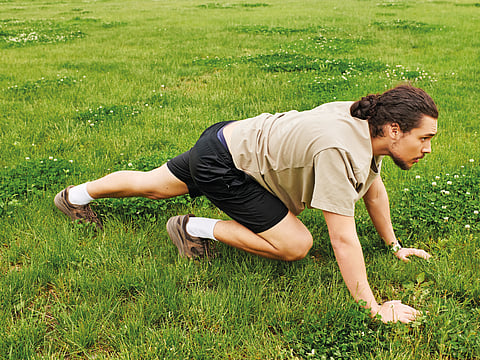
1. Bear Crawl
Don’t let its playful name fool you. The bear crawl is a surprisingly demanding full-body exercise that works the shoulders, chest, core and legs simultaneously.
Because the movement is slow and controlled, it develops stability, coordination and muscular endurance without requiring heavy weights or complicated equipment.
How to do it
Crawl forwards for 20 to 30 seconds while keeping your knees just above the floor. Rest and repeat three or four times.
2. Walking Lunges
A complete lower-body workout, walking lunges target the glutes, quadriceps, hamstrings and calves while challenging balance and coordination. Unlike jumping exercises, lunges increase strength without rapidly raising body temperature. They’re also easy to modify by using only body weight or holding light dumbbells.
How to do it
Take 10 to 12 lunges on each leg. Complete three sets.
3. Farmer’s Carry
One of the simplest exercises is also one of the most effective. Pick up a pair of dumbbells or kettlebells, stand tall and walk at a steady pace.
The movement strengthens your shoulders, arms, core, back and legs while improving grip strength and posture. Because it doesn’t involve explosive movements, it elevates your heart rate gradually, making it easier to perform in warm weather.
How to do it
Carry a pair of weights for 30 to 60 seconds, rest, then repeat three to four times.
4. Incline Walking
If running feels too demanding in the heat, increase the incline instead of the speed.
Walking uphill burns more calories than walking on a flat surface while placing less stress on the joints than jogging. It also keeps your heart rate in a steady training zone without leaving you exhausted.
It’s ideal for beginners and experienced exercisers alike.
How to do it
Walk for 20 to 30 minutes on a treadmill set between a 5 and 10 per cent incline.
5. Kettlebell Deadlift
The kettlebell deadlift strengthens the muscles that support everyday movement, including the glutes, hamstrings, lower back and core.
Unlike kettlebell swings, which are highly explosive, the deadlift allows you to build strength at a controlled pace without dramatically increasing your heart rate.
How to do it
Perform 10 to 12 repetitions for three sets, focusing on slow, controlled movement.
6. Resistance Band Pull Aparts
Many people spend more time indoors during summer, often working at a desk or sitting in air-conditioned spaces. Resistance band pull aparts help counter poor posture by strengthening the upper back and rear shoulders. They require very little effort, create minimal body heat and are ideal as part of a warm-up or recovery workout.
How to do it
Hold the band at shoulder height and pull it apart until your arms form a straight line. Slowly return to the starting position. Perform 15 to 20 repetitions for three sets.
Summer workout tips
A few simple adjustments can make exercising safer and more comfortable during the hotter months.
· A few simple adjustments can make exercising safer and more comfortable during the hotter months.
· Exercise early in the morning or after sunset whenever possible.
· Drink water before, during and after your workout instead of waiting until you feel thirsty.
· Wear lightweight, breathable clothing that helps sweat evaporate.
· Reduce workout intensity if temperatures or humidity are particularly high.
· Stop exercising immediately if you feel dizzy, nauseous or unusually fatigued.


